
Edge Gateway Vendor Evaluation Guide: OS, Security, Interfaces and Lifecycle
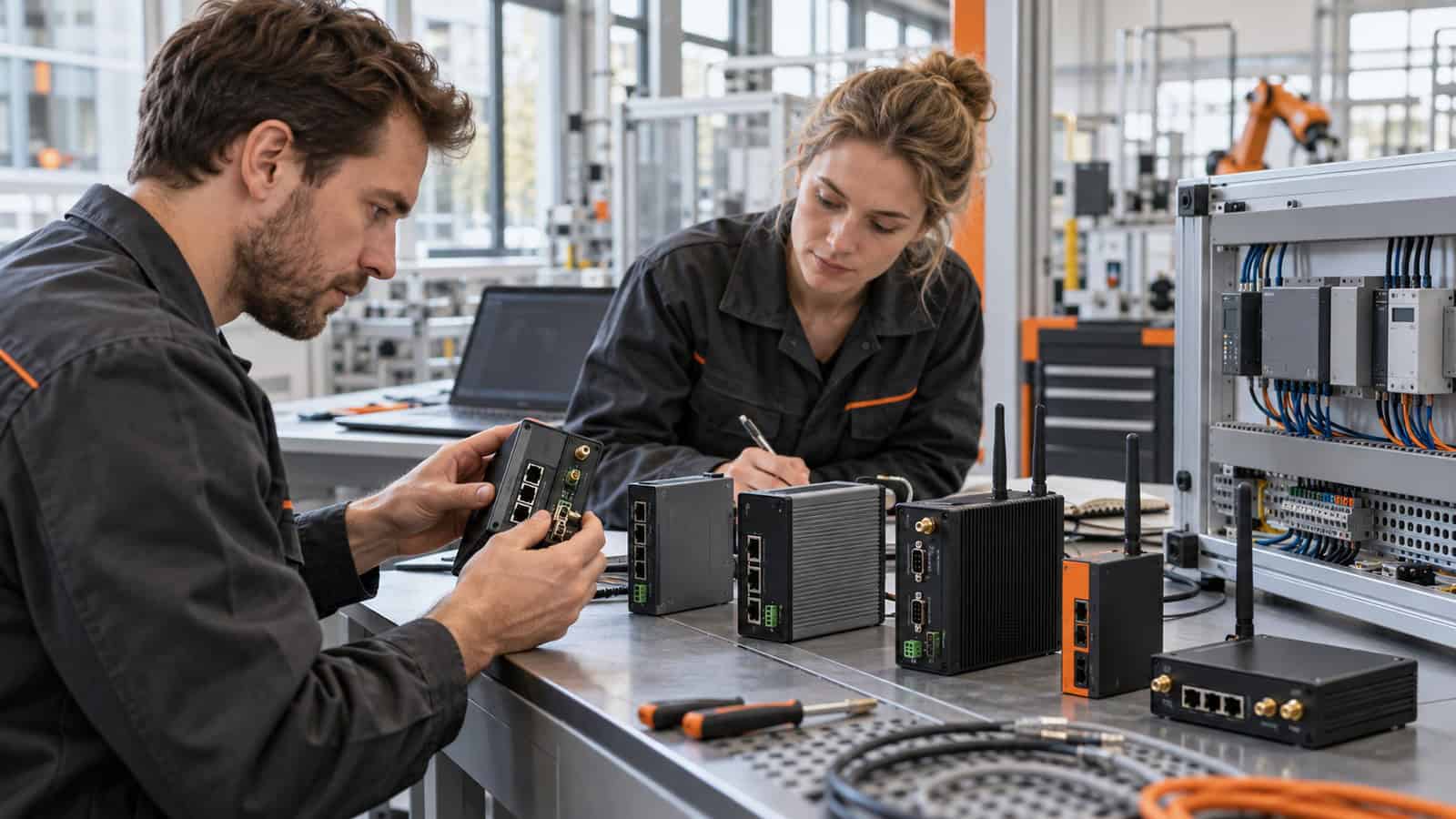
The Robustel EG5200 Edge Computing Gateway provides a useful high-integration reference for vendor evaluation: Debian-based RobustOS Pro, Docker, local compute, five Gigabit Ethernet ports, serial and digital interfaces, cellular variants and RCMS management. A vendor still earns approval by running the buyer’s workload under production conditions and explaining how the device will be secured, updated and replaced.
A Vendor Shortlist Needs Exit Criteria
At programme level, I would score the work that continues after commissioning as heavily as the initial interface match. Container updates, security ownership, replacement hardware, configuration recovery and evidence during an outage determine whether a platform scales cleanly. Procurement should ask to see those routines, not accept them as future implementation details.
Use gates that can reject a candidate early. A powerful processor does not compensate for a missing field interface, an unsupported runtime or an unmanageable lifecycle.
- The exact application and runtime install on the intended OS and architecture.
- Required southbound and northbound interfaces are supported in the required direction.
- Sustained CPU, memory, storage and thermal behaviour pass the production workload.
- Security ownership covers identity, secrets, remote access, updates and audit.
- Fleet operations can provision, observe, roll back, replace and retire a unit.
- The vendor states product lifecycle and support responsibilities in usable terms.
The Robustel Public Safety CCTV Application Example using the EG5100 illustrates why connectivity, local edge activity and remote access must be evaluated as separate paths. It is architecture evidence on another model, not a performance result for EG5200.
The Operating System Becomes an Ongoing Obligation
Ask whether the platform uses standard package and container tooling, which languages and libraries are available, how kernel or application dependencies are maintained, and what happens when a package reaches end of life. Confirm whether the application requires privileged containers, host networking or device access; these choices change the security review.
| OS question | Evidence to request | Operational consequence |
|---|---|---|
| Can the current workload be reproduced? | Versioned build and deployment manifest | Replacement units can be rebuilt |
| How are updates staged and rolled back? | Tested procedure and retained image | Failed releases have a recovery path |
| How are secrets handled? | Identity and credential workflow | Cloned devices do not share unmanaged secrets |
| What remains during WAN loss? | Local service and buffer test | Cloud outage does not create an unknown state |
Interface Count Means Little Without Ownership
Count ports only after naming roles. Direct device attachment may suit a compact cell, while a larger estate needs a managed switch that owns VLANs, redundancy and port diagnostics. Serial port availability does not prove support for every field protocol, and Ethernet does not prove a particular industrial application.
The Robustel Secure Remote Access to Industrial Robots Application Example shows remote service as an identity, network and application chain. Use it to ask where maintenance access terminates and who approves it; the example does not prove native robot-controller integration.
Where the Robustel EG5200 Edge Computing Gateway Fits a High-Integration Estate
Robustel EG5200 edge computing gateway provides a quad-core Cortex-A53 CPU, 4 GB LPDDR4 RAM, 32 GB eMMC, Docker on RobustOS Pro, five Gigabit Ethernet ports, two configurable RS-232/422/485 ports, digital inputs, relay outputs, USB, HDMI and 4G or 5G variants. Optional Wi-Fi 6 and Bluetooth are model-dependent, while RCMS supports central management.
That combination fits sites where local compute and several network or peripheral connections belong in one edge node. It may be disproportionate for a single serial conversion or a small routing-only task. Conversely, deterministic control, functional safety, switch-fabric functions or an unverified application runtime should remain with the appropriate dedicated platform.
For production deployments on Robustel EG5200, E2C Factory can add a matched operational layer for supported machine-data collection, local processing, continuity, visualisation, alarms, workflows and northbound integration. EG5200 supplies the compute and interface boundary, while E2C Factory can reduce the number of separately assembled data-operation components. The combined value depends on the exact supported integrations and project configuration.
| Workload shape | Robustel model direction | Evaluation focus |
|---|---|---|
| Compact LTE edge and basic application hosting | EG5100 or EG5101 | Runtime, interfaces and resource margin |
| Multiple RS-485 networks and eSIM operations | EG3120e | Serial topology, exact application and cellular model |
| Two-port edge AI or 5G workload | EG5120 | Sustained compute, memory and interface budget |
| Five-port, peripheral-rich edge node | EG5200 | Consolidation boundary and shared failure domain |
The Robustel EG5000 Series quick-pitch video helps a procurement team understand family roles before it requests exact-model proof.
Rehearse the Lifecycle Before Award
Commission a small fleet, deploy the application, rotate a credential, stage an update, force a rollback, replace one unit and restore it from controlled records. Observe the site during WAN loss and after backlog replay. The acceptance document should identify who owns the OS, container, application, field data and upstream service.
Vendor evaluation is complete when the operating team can repeat those actions without relying on the original project engineer.
よくある質問
Q1. What should I look for in an edge gateway?
Start with the workload, required interfaces, operating system and lifecycle process. Then validate compute, memory, storage, security, environmental fit and recovery under sustained production conditions.
Q2. What is the difference between an edge gateway and an IoT gateway?
The terms overlap. “Edge gateway” usually emphasises local application processing as well as connectivity, while “IoT gateway” may describe a simpler protocol or network bridge. The actual software and hardware role matters more than the label.
Q3. Does an edge gateway replace a PLC?
Normally no. An edge gateway can collect, process and forward operational data, but deterministic control and safety functions should remain on platforms designed and validated for those duties.
Q4. Can edge gateways run Docker containers?
Some can, when the operating system and resources support Docker. The container image, CPU architecture, device access, privileges, storage and update process still require validation on the exact model.
Q5. When is the Robustel EG5200 Edge Computing Gateway a strong vendor fit?
It fits projects needing substantial local interfaces, Docker-based applications and cellular connectivity in one industrial edge node. Prove the exact workload and decide whether consolidating those roles creates an acceptable shared failure domain.
結論
For interface-rich edge workloads that need an open Linux environment and managed cellular operation, the Robustel EG5200 Edge Computing Gateway is a credible high-integration shortlist candidate. The choice is strongest when the operating team has also accepted the application, update and replacement responsibilities that come with the platform.
Specifications establish eligibility; a lifecycle rehearsal establishes fit. I would make build, security, observation, recovery and replacement evidence part of the award record.
Explore More Articles About Robustel Edge Computing Gateways
著者について
Robert Liao | Technical Support Engineer
Robert is an IoT Technical Support Engineer at Robustel, specializing in industrial networking and edge connectivity. A certified Networking Engineer, Robert focuses on the deployment and troubleshooting of large-scale IIoT infrastructures. His work centers on architecting reliable, scalable system performance for complex industrial applications, bridging the gap between field hardware and cloud-side data management.