
Choosing a Modbus Gateway: RTU-to-TCP Conversion vs Full Edge Processing
The Robustel EG5100 edge computing gateway fits Modbus integration projects that have grown beyond simple connectivity and need local applications, buffering or additional data handling. A straightforward Modbus RTU-to-TCP converter may still be the better choice when the requirement is only to make existing registers reachable over Ethernet. Full edge processing becomes valuable only when the gateway is expected to understand and act on the data.
Imagine thirty Modbus RTU energy meters connected to an RS485 bus. The original project requirement is simple: an Ethernet-based SCADA system needs to access those registers over Modbus TCP.
Later, the requirements expand. Engineering wants engineering-unit scaling, standardized tag names, local buffering, alarm rules and a second data path into an analytics platform. At that point the project is no longer selecting only a protocol converter.
Decide Whether You Are Transporting Registers or Interpreting Data
A Modbus gateway can perform several very different roles. At the simplest level, it bridges communication between Modbus RTU and Modbus TCP so an Ethernet client can communicate with serial devices.
A more data-aware gateway may actively poll registers, normalize values, add timestamps or buffer records. A full edge-computing gateway may then run custom applications, combine Modbus data with other sources and publish the result through other northbound interfaces.
These responsibilities should not be collapsed into one product category.
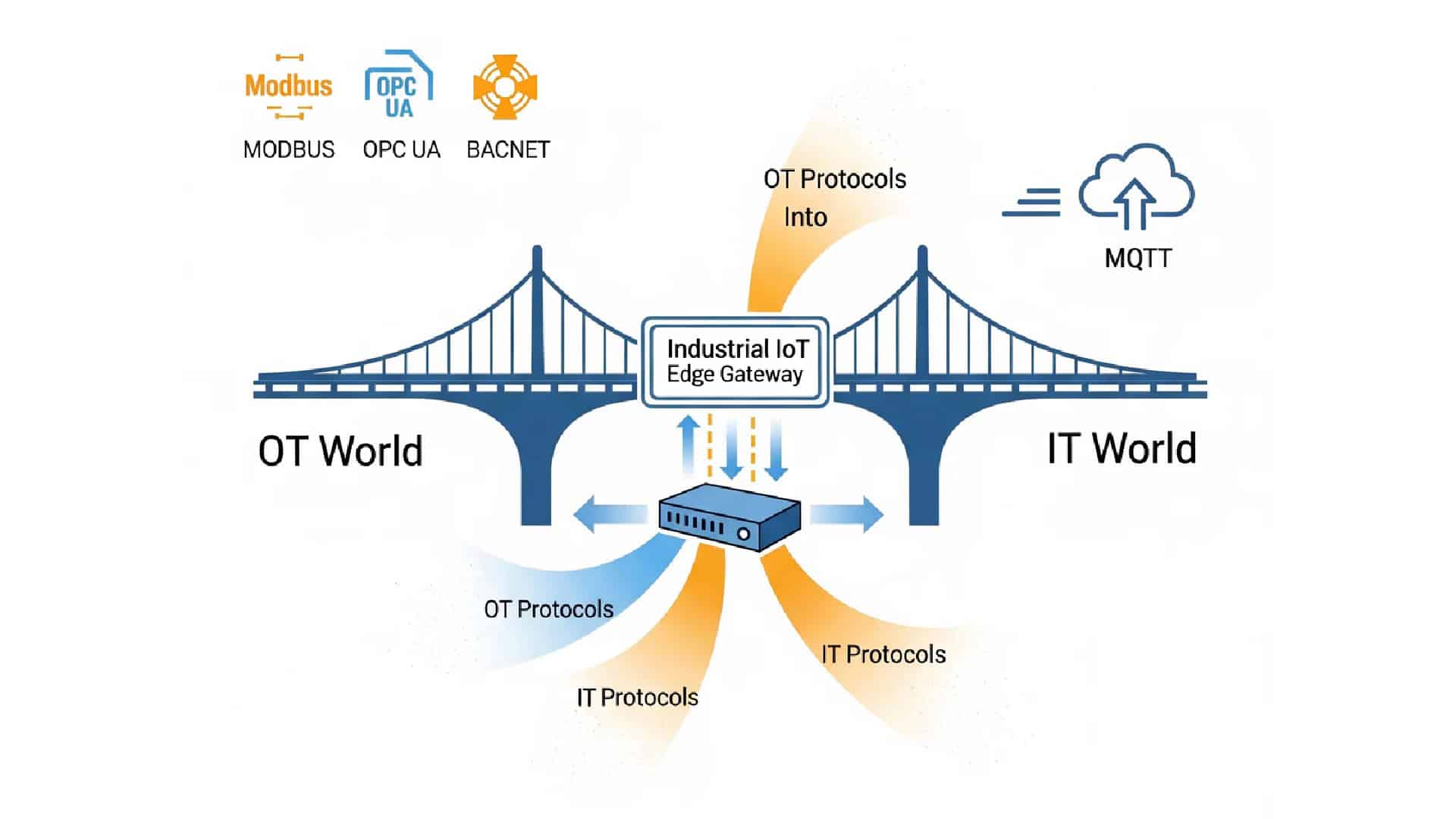
The Robustel Edge Computing Gateway portfolio becomes relevant when the integration has crossed into local software and processing. If the project only needs transparent or straightforward protocol conversion, a simpler gateway can remain easier to configure and maintain. The first selection question is therefore what the gateway must know about the data.
When Modbus RTU-to-TCP Conversion Is Enough
A converter is often sufficient when the upstream application already owns the register interpretation. For example, the SCADA system may already know that holding register 40021 represents line voltage, apply the correct scale factor and maintain the alarm logic centrally. The gateway only needs to provide reliable communication between the Ethernet client and serial network.
In this case, additional local applications may add little value. The project should instead concentrate on serial fundamentals: RS485 wiring, baud rate, parity, device addressing, polling behavior and whether the existing bus architecture supports the intended master/client arrangement.
A Robustel solution should not be made more complex simply because local processing is available. If conversion solves the complete requirement, operational simplicity is a valid design objective.
Polling, Scaling and Buffering Create a Different Gateway Workload
The architecture changes when the gateway starts owning part of the data model. Suppose several meter manufacturers use different register layouts and scaling. The upstream platform would prefer one consistent format regardless of which meter is installed at the site.
Local software can poll the source registers, apply validated scaling, create standardized names and publish a cleaner dataset.
Buffering adds another responsibility. If the upstream connection disappears temporarily, the project may want selected records retained locally and forwarded after connectivity returns. Neither function is simply RTU-to-TCP transport.
Robustel’s Connected CNC Machines Application Example demonstrates the broader machine-integration principle. An EG-series edge gateway can sit alongside existing industrial equipment and create a managed data path by using supported industrial interfaces and protocols exposed by the machine, PLC or control layer. The gateway does not replace the existing control architecture, and the example should not be interpreted as native support for proprietary CNC controller protocols. Its relevance here is the separation between machine-side data acquisition and the new upstream application.
Once the gateway begins interpreting, normalising or retaining data, application ownership and version control become part of the design.
Custom Applications Add Value—and Maintenance Responsibility
The next step is a local edge application. The gateway might combine Modbus values with digital I/O, another serial device or an Ethernet source. It may apply site-specific rules or publish data to a northbound interface that the original Modbus equipment does not support.
The RobustOS Pro edge computing operating system provides a Debian environment for containers and native Linux applications on supported Robustel edge gateways. That software flexibility makes more complex protocol and data workflows possible, but it also gives the project responsibility for testing, deployment, dependencies and updates.
This is the point at which the Modbus decision becomes an edge-computing decision. Robustel’s Where Is Edge Computing Actually Used in Industrial IoT video provides useful context for this transition because local computing becomes justified when the site must do more than move packets between protocols. The added capability should be accepted only when it removes a real integration problem.
How the Robustel EG5100 Edge Computing Gateway Fits Both Sides of the Modbus Boundary
The Robustel EG5100 edge computing gateway fits projects where serial integration and moderate local processing need to coexist.
Its configurable RS-232/RS-485 interfaces and Ethernet connectivity allow it to sit between legacy serial equipment and newer IP systems, while RobustOS Pro provides the environment for additional data handling when the project requires it.
A focused installation may use the EG5100 as part of a relatively simple serial-to-IP integration. Another installation can use the same hardware class to host validated applications for polling, normalization, buffering or northbound publishing.
The value of this flexibility is that the hardware does not force the project into full edge processing from day one. The limitation is equally important: more software means more lifecycle responsibility. A custom connector has to be maintained, monitored and recovered differently from a fixed protocol-conversion function.
The best-fit architecture therefore selects the lowest responsibility level that still solves the integration problem.
Validate the Serial Bus and Failure Behavior Before Rollout
Modbus projects often fail because software design begins before the serial network has been characterized.
Commissioning should verify addressing, timing, cable topology and device behavior under representative load. If the new gateway polls a bus already used by another controller, the design must confirm that the additional communication is permitted and does not interfere with the existing system.
The test should also cover data behavior. If a meter disappears, does the application report unavailable data or continue showing the previous value? If the WAN fails, what is retained locally? If a register definition changes, can the team identify which configuration produced the upstream value?
A useful responsibility ladder is:
| Requirement | Basic converter | Data-aware gateway | Full edge processing |
|---|---|---|---|
| RTU/TCP communication | Core role | Core role | Core role |
| Register polling | Basic/implementation dependent | はい | はい |
| Scaling and normalization | Usually upstream | Local | Local |
| Buffering | Limited/implementation dependent | 可能性 | Application-defined |
| Local rules | No or limited | Limited | はい |
| Custom applications | いいえ | Depends on platform | Core capability |
| Maintenance complexity | 最低 | 中程度 | 最高 |
The right Modbus gateway is therefore determined by responsibility, not by the number of protocols listed on its product page.
よくある質問
Q1. When is a simple Modbus RTU-to-TCP gateway enough?
It is often enough when the upstream SCADA or application already understands the register map and only needs Ethernet access to the serial devices. In that architecture, adding local application logic may increase complexity without solving another requirement.
Q2. When does the Robustel EG5100 edge computing gateway become relevant?
The Robustel EG5100 edge computing gateway becomes more relevant when the project needs serial connectivity together with buffering, local preprocessing, custom applications or additional northbound integration. The required workload should still be validated before choosing an edge-computing architecture.
Q3. Does a Modbus gateway automatically understand register meaning?
No. Modbus defines how data is addressed and exchanged, but the application still needs documentation showing what each register represents, how it is scaled and how the value should be interpreted.
Q4. Is edge processing always better than simple protocol conversion?
No. Edge processing creates value only when the project needs functions such as local data transformation, buffering, rules or application hosting. A simple converter can be easier to commission and maintain when those functions are unnecessary.
Q5. What should be tested on an RS485 Modbus network before rollout?
Verify wiring, termination, baud rate, parity, addressing, polling timing and the effect of the new gateway on existing communication. The project should also test device loss, stale data and gateway restart behavior.
結論
Choosing a Modbus gateway begins with deciding how much responsibility belongs at the gateway. The Robustel EG5100 edge computing gateway can support projects that extend beyond basic serial connectivity into local data handling and application execution, but not every Modbus installation needs that additional layer.
Use RTU-to-TCP conversion when the task is primarily transport. Add data-aware processing when the site needs normalization or buffering. Move to full edge applications only when local software solves a defined integration requirement.
The simplest architecture that meets the workload is usually the easiest one to operate reliably.
Related Reading on Edge Computing in Industrial IoT:

著者について
Robert Liao | Technical Support Engineer
Robert is an IoT Technical Support Engineer at Robustel, specializing in industrial networking and edge connectivity. A certified Networking Engineer, Robert focuses on the deployment and troubleshooting of large-scale IIoT infrastructures. His work centers on architecting reliable, scalable system performance for complex industrial applications, bridging the gap between field hardware and cloud-side data management.