
Cellular Lift Gateway for Multi-Site Portfolios: Provisioning, Monitoring and TCO
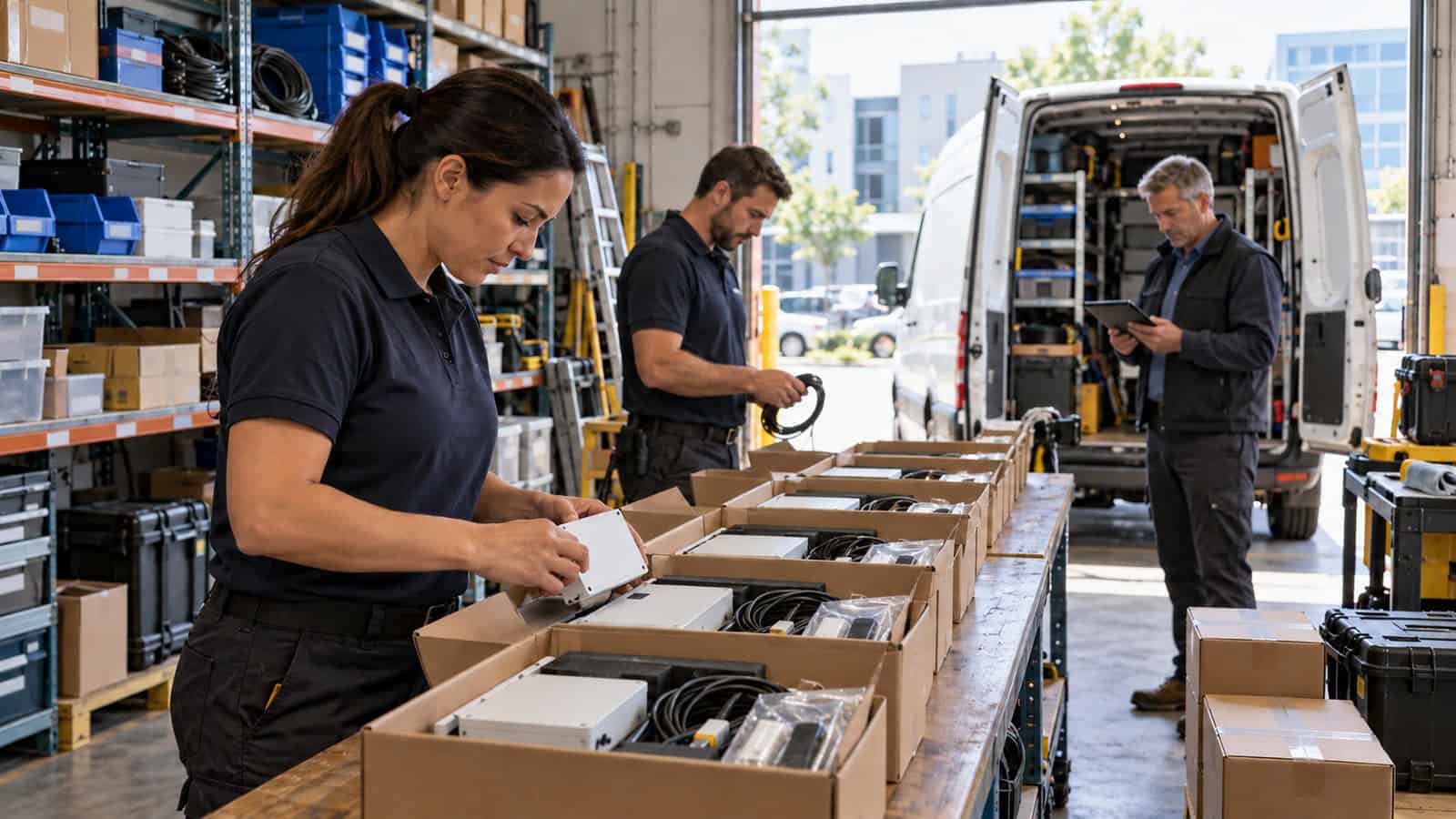
The Robustel EV8100 Elevator Voice Gateway gives lift service companies and property portfolios a common VoLTE/VoIP, FXS and RCMS-capable platform, but fleet value comes from standard provisioning, exception monitoring and evidence ownership rather than from installing the same box at every address. TCO should include SIMs, batteries, supervised testing, monitoring-centre work and site access alongside hardware.
Segment the Estate Before Standardising It
Group lifts by handset/autodialler, monitoring centre, mobile coverage, building access, power arrangement and applicable service obligations. A national template can hold common gateway and security settings while site profiles preserve voice destination, caller identity, APN, antenna record and battery information.
Start the rollout with representative difficulty: an older analogue phone, a basement with marginal RF, a site with restricted access and a multi-car building. A pilot containing only the easiest machine room produces optimistic labour and failure rates.
Make every exception measurable during the pilot. Record extra antenna work, monitoring-centre coordination, repeat access, handset changes and post-install call failures against the site profile. Those records show whether the portfolio needs another standard build or a separate service tier; averaging the difficult sites into one installation figure hides the cost and support risk.
Build TCO Around Activities
Use the intended contract period and state every assumption. Include procurement, staging, installation, antenna work, SIM and voice service, monitoring-centre onboarding, battery supply and replacement, periodic supervised calls, remote management, firmware changes, call-outs, spares and decommissioning.
| Activity | Unit to measure | Typical hidden dependency |
|---|---|---|
| Provisioning | minutes per gateway/site | Monitoring-centre record ready |
| Commissioning | hours and repeat visits | RF and legacy phone behaviour |
| Monthly service | SIM, monitoring, platform | Data/voice tariff and ownership |
| Incident | remote minutes/site visit | Safe access and specialist availability |
| Battery care | test/replacement event | Temperature and approved cell |
Do not invent an ROI percentage. Compare the managed design with the actual current process and update the model from pilot records.
For the pilot, make engineers log touch time separately from waiting time. A two-hour visit may contain ten minutes of configuration and ninety minutes waiting for access, a lift technician or monitoring-centre confirmation. Remote management can address only some of those minutes, so this split prevents the business case from claiming savings against work the gateway cannot remove.
Provision Identity, Not Just Configuration
Link serial number, SIM identifiers, building, lift/car, monitoring destination and responsible service organisation. Protect credentials and restrict reassignment. A replacement unit must assume the correct site identity without leaving the failed gateway active in management or voice records.
Robustel’s Tsaro case study provides real Robustel EV8100 deployment evidence for standardised provisioning, remote oversight and recurring operational records. It is a useful fleet reference for Australian operators, with the compliance workflow and commercial assumptions rebuilt around the local portfolio rather than copied from the North American deployment.
Monitor Exceptions, Then Close Them With a Call Test
Use Robustel RCMS platform for supported gateway and network visibility, configuration and update workflows. Define alarms that lead to action: registration loss, repeated reconnect, battery exception, unusual data use or configuration drift. Give each alert a severity, response owner and closure evidence.
Remote status can reduce blind visits, but it cannot hear the audio or confirm the monitoring centre’s identity screen. A remotely cleared fault should still trigger the supervised verification required by the maintenance procedure.
How the Robustel EV8100 Elevator Voice Gateway Supports Portfolio Operations
The Robustel EV8100 elevator voice gateway combines one FXS port, dual SIM, VoIP/VoLTE support, industrial interfaces, local battery provision and RCMS compatibility in one platform. That allows integrators to define a repeatable physical and management boundary while keeping handset compatibility, carrier service and monitoring-centre acceptance as explicit site records.
Robustel’s smart-elevator application example illustrates how emergency voice and selected lift data can be managed as distinct services through one gateway architecture. Portfolio teams can use that separation when designing service ownership, then qualify each controller interface and analytics workload before adding it to the standard build.
The Robustel EV8100 Quick Pitch video can support training for provisioning and field teams, followed by the project’s own work instructions.
Govern Changes Across Service Boundaries
Firmware, SIM provider, SIP service, monitoring-centre routing, handset programming and battery specification can each affect the result. Use a canary site and require a completed voice test before expanding material changes. Keep the change record with affected sites and exceptions.
The portfolio owner should receive a concise monthly view: installed base, sites without recent evidence, unresolved alarms, battery exceptions, configuration drift, data/voice spend and repeat visits. That turns the gateway estate into a managed service rather than a hardware inventory.
よくある質問
Q1. What is a cellular lift gateway?
It connects a lift emergency phone or communication system to a mobile voice or IP service and may add remote device visibility. Compatibility and call acceptance depend on the complete installed path.
Q2. How much does a cellular elevator phone cost?
Costs include more than the gateway: installation, antenna work, SIM/voice service, monitoring, batteries, testing, support and future changes. Compare lifecycle cost using the same site assumptions.
Q3. Can lift gateways be monitored remotely?
Many can expose device and network status, but remote monitoring does not replace every supervised audio and identity check. Define what each alarm proves and how it is closed.
Q4. Does dual SIM eliminate lift phone outages?
No. It may add network diversity, while the gateway, antennas, power, handset and monitoring centre remain shared dependencies. Test the complete failure path.
Q5. Why standardise on the Robustel EV8100 Elevator Voice Gateway?
It provides a common FXS, VoLTE/VoIP, dual-SIM and RCMS-capable platform that can support repeatable provisioning and fleet operations. Each legacy phone and site still requires qualified acceptance.
結論
The Robustel EV8100 Elevator Voice Gateway can reduce portfolio variation by providing one managed communications boundary, but the strongest TCO case is built from repeatable work and visible exceptions rather than assumed savings. Standardisation should make identity, testing and recovery easier—not hide local differences.
Use pilot labour, mobile usage, battery work and incident records to update the commercial model before scaling. That gives procurement a service cost it can defend and operations a fleet it can actually support.
Explore More Articles About Robustel Lift Connectivity


著者について
Robustel Editorial Team
The Robustel Editorial Team publishes practical articles on industrial connectivity, edge computing, LoRaWAN and device management, focusing on deployment considerations, technical limitations and long-term operation.