
5G Router with Ethernet Ports: How Many Ports Does an Industrial Site Need?
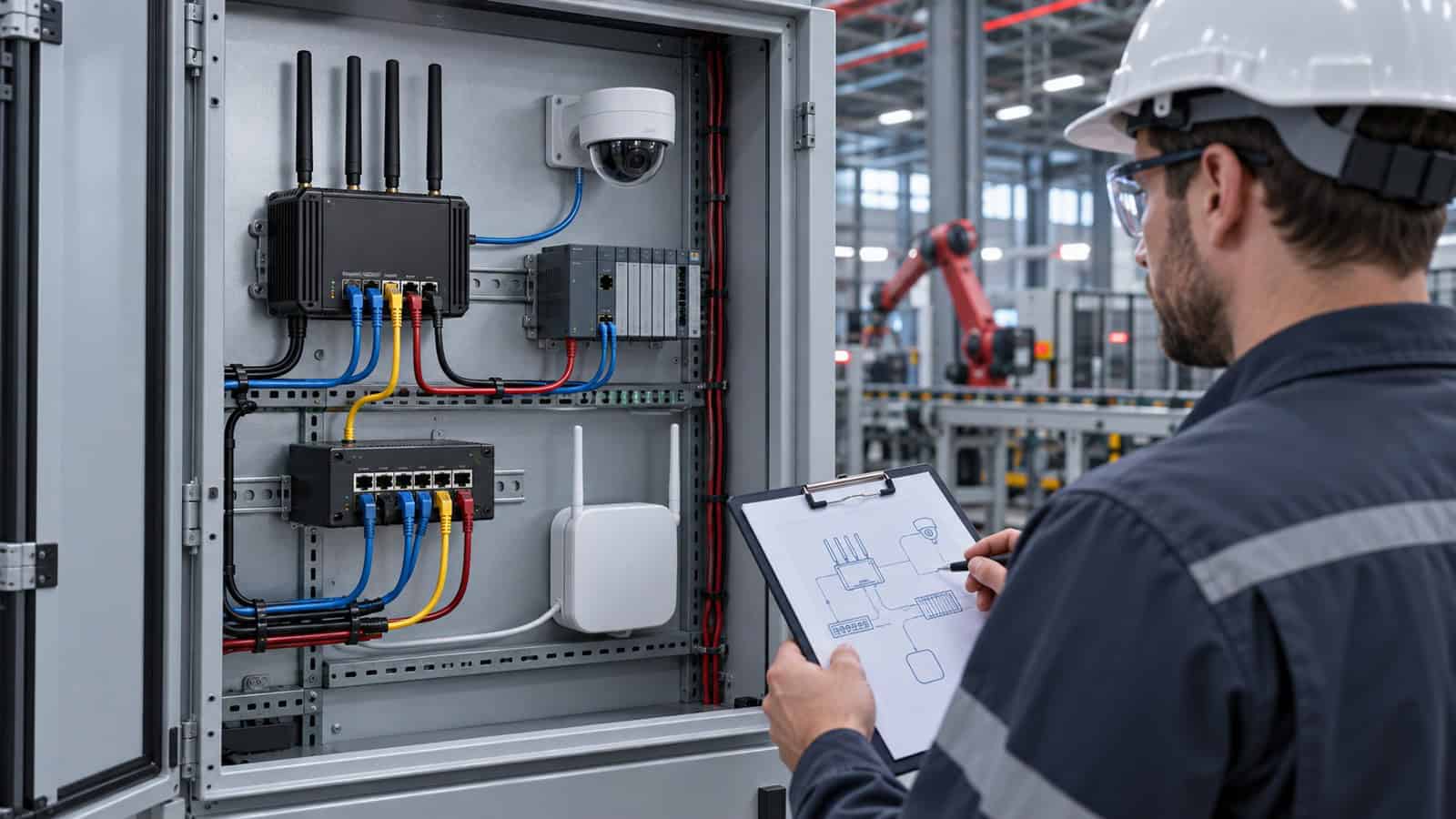
The Robustel R2120-5G Industrial 5G Router provides five Gigabit Ethernet ports, four of which can supply 802.3af/at PoE. That is valuable when a compact site has several powered endpoints—but five ports are not automatically better than one.
Count the equipment that must connect, then decide which network functions the router should own. An external managed switch may still be the right answer when the site needs more endpoints, fibre uplinks, formal segmentation, ring redundancy or a switching feature not documented for the router.
Build a Port Budget from Connections, Not Device Count
Start with physical roles. Include the upstream WAN handoff if Ethernet is used, every local controller or computer, an access point, camera, service laptop connection, and the uplink to any downstream switch. Allow for redundant links only where the surrounding equipment and design actually support them.
| Required connection | Quantity | Speed or power requirement | Trust zone | Direct router port? |
|---|---|---|---|---|
| Existing firewall/WAN appliance | 1 | 1 or 2.5GbE as designed | WAN handoff | Often |
| PLC or machine controller | 1–2 | Usually modest traffic | OT | If isolation is adequate |
| IP camera | 1–4 | Traffic plus PoE budget | Video | If PoE and segmentation fit |
| Local access point | 1 | Gigabit and possible PoE | WLAN | Design dependent |
| Service connection | 1 | Temporary | 保守 | Reserve or switch port |
| External switch uplink | 1 | Aggregate traffic | Multiple | はい |
The last column is deliberately conditional. A spare socket is not the same as an approved network boundary. If a camera network, controls network and maintenance network require separate policy, confirm how VLANs, firewall rules and administration are owned before treating the router’s ports as a small switch.
Port Speed Has to Match the Traffic Path
A cellular link and an Ethernet interface have different roles. A 2.5GbE port does not promise a 2.5 Gbit/s 5G service, just as several Gigabit ports do not imply that all attached devices can send at line rate through the mobile network. The local interfaces may also carry traffic that never leaves the site.
The Robustel R5010 Industrial 5G Router provides one 2.5GbE interface and USB modem mode. It suits an architecture where an existing firewall or switch owns the LAN and the cellular device primarily provides the WAN.
Robustel’s High-Speed Branch Office Routing over 5G with the R5020 Application Example illustrates the broader case in which the cellular router also owns several local connections. That architecture changes the port calculation: local device traffic, management access and the WAN handoff need named interfaces and trust zones before aggregate throughput is considered. Use the example to decide whether routing belongs in the cellular device or an existing firewall. It describes an intended design, not guaranteed throughput for a carrier or branch.
If a port aggregates several cameras or machines through a switch, size it for realistic concurrent traffic, protocol overhead and local processing. Peak link labels are a useful ceiling, not a production benchmark.
Decide Whether PoE Belongs in the Router
Integrated PoE can remove injectors and a separate PoE switch from a small cabinet. It can also concentrate the power design in one place. Check the power budget of every endpoint, startup draw, cable length, supply capacity and thermal conditions. “Four PoE ports” describes connectivity; it does not establish that every combination of four powered devices is supported at full load.
This distinction matters at unattended sites. Robustel’s Smart Parking Application Example places cameras, meters, sensors and backhaul in the same distributed roadside architecture, so it is a useful prompt for building the endpoint inventory before selecting PoE. For each device, record startup draw, steady load, cable route and the consequence of losing power; then decide whether the router, an injector or a managed PoE switch should own recovery. A reachable router can aid diagnosis, but the example does not establish a particular port count or power budget.
How the Robustel R2120-5G Industrial 5G Router Fits Compact Powered Ethernet Sites
Robustel R2120-5G industrial 5G router brings five Gigabit Ethernet ports, four PoE-PSE ports, dual SIM, Wi-Fi, RS-485 and DI/DO into an IP30 industrial router. In a small cabinet, that can let one managed device provide 5G backhaul, local Ethernet attachment and power for compatible endpoints.
The architectural gain is fewer boxes and fewer inter-device cables. It is most convincing where the connected devices fit the available port and PoE budget, the router’s network controls meet the segmentation requirement, and all equipment can be installed in a protected enclosure. Robustel RCMS can then add fleet visibility and management for the router estate.
Do not select it simply to avoid buying a switch. A larger or more complex LAN may benefit from a dedicated managed switch whose lifecycle, redundancy and switching features can be engineered independently. The R2120-5G is a compact converged option; it is not a universal replacement for industrial switching.
Match the Other Robustel Models to the Port Role
- Robustel R5010 Industrial 5G Router: one 2.5GbE port for a focused cellular handoff to existing network equipment.
- Robustel R5020-Lite Industrial 5G Router: two Gigabit Ethernet ports for a compact site with a simpler LAN.
- Robustel R5020 Industrial 5G Router: four Gigabit Ethernet ports plus RS-232, RS-485 and DI/DO for a broader site role.
- Robustel R5020e 5G eSIM Router: four Gigabit Ethernet ports where eSIM provisioning also matters.
- Robustel R5030 Industrial 5G Router: five Gigabit Ethernet ports and Wi-Fi 6 where the router also owns a larger local access role.
The R5020 5G IoT Router Quick Start Guide video is helpful when preparing a bench configuration. Port sizing still has to be completed before configuration, because a successful link test says nothing about the final segmentation or aggregate load.
よくある質問
Q1. Do 5G routers have Ethernet ports?
Many do, but the number and speed vary. Check whether each port is LAN-only, WAN/LAN configurable, PoE-capable, and suitable for the network role you intend to give it.
Q2. Can I connect an Ethernet switch to a 5G router?
Yes. This is often the cleaner design when the site needs more endpoints, managed segmentation, fibre, redundancy or a switching function beyond the router’s documented capabilities.
Q3. Is 2.5GbE faster than Gigabit Ethernet?
The interface has a higher nominal link rate, but end-to-end performance is limited by every part of the path, including cellular service, router processing, the peer device and traffic conditions.
Q4. How many Ethernet ports does an industrial router need?
Enough for the defined direct connections and uplinks, with a deliberate service strategy. A port budget should also include trust zones, PoE demand and expected growth; raw device count alone is not enough.
Q5. When should I choose the Robustel R2120-5G Industrial 5G Router?
Choose it for a protected industrial site where 5G backhaul, up to five direct Gigabit Ethernet connections and power for compatible PoE endpoints genuinely belong in one compact router. Use an external switch when the LAN needs broader switching or resilience features.
結論
The Robustel R2120-5G Industrial 5G Router is a credible compact-site choice when several direct Ethernet connections and powered endpoints genuinely belong at the router. Five sockets do not remove the need for a switch; they simply make a converged design possible within the verified port, PoE and segmentation limits.
Finish the selection on paper before ordering hardware. Name every connection and trust zone, total the normal and startup power, and measure simultaneous traffic through the intended topology. If those checks expose broader switching or resilience requirements, keep the router focused on connectivity and give the LAN to a dedicated managed switch.
Explore More Articles About Robustel Industrial 5G Routers:
著者について
Robert Liao | Technical Support Engineer
Robert is an IoT Technical Support Engineer at Robustel, specializing in industrial networking and edge connectivity. A certified Networking Engineer, Robert focuses on the deployment and troubleshooting of large-scale IIoT infrastructures. His work centers on architecting reliable, scalable system performance for complex industrial applications, bridging the gap between field hardware and cloud-side data management.