

5G Router vs LTE Router: Which Is the Best Fit for Industrial IoT?

The Robustel R5020-Lite Industrial 5G Router provides full-5G connectivity and Gigabit Ethernet for projects whose traffic or WAN role justifies that capability, while the Robustel R1520 Industrial 4G/LTE Router remains a practical fit for many industrial telemetry and remote-connectivity applications. The right decision is not whether 5G is newer, but whether LTE has become a real constraint.
The arrival of 5G RedCap also means that the decision is no longer always binary. Some projects can remain on LTE, some can use a reduced-capability 5G architecture, and others genuinely require the broadband headroom of full 5G.
LTE Still Solves Many Industrial IoT Problems
A remote PLC, meter or environmental monitor may send only modest amounts of traffic. Where LTE coverage is mature, the application is stable and the existing router provides the required interfaces, replacing the cellular layer simply because 5G is available can introduce cost without removing an operational problem.
A replacement also affects more than the modem. Antennas may need to be reconsidered, configuration baselines changed, regional SKUs requalified and installation procedures updated. If the existing LTE system is not limiting the workload, keeping it in service can be the lower-risk engineering decision.
This is particularly relevant for large fleets, where even a small amount of unnecessary work per site becomes significant at scale.
Use Workload Thresholds Rather Than Technology Labels
The case for full 5G becomes stronger as the cellular connection carries more data or takes ownership of more business traffic.
Robustel’s Digital Signage R5020-Lite Application Example illustrates a workload where the cellular path may need to deliver large media files, urgent content updates and operational reporting to a distributed estate of screens. That is fundamentally different from a remote meter transmitting compact readings at regular intervals.
Branch WAN is another step change. If cellular moves from emergency backup to the connection carrying normal cloud applications, software distribution and user traffic, available network headroom becomes more important.
LTE, RedCap and Full-5G Workload Direction
| Application condition | Technology worth evaluating | Robustel example | Why |
|---|---|---|---|
| Stable low-volume industrial telemetry | LTE | ロバステル | Avoid replacing an architecture that already meets the requirement |
| Compact M2M or utility connectivity with serial equipment | 5G RedCap | Robustel R3000-Lite 5G RedCap Router | RedCap with one Ethernet port and separate RS-232/RS-485 |
| Distributed IoT needing more Ethernet, Wi-Fi and GNSS | 5G RedCap | Robustel R2110 5G RedCap Router | Richer local architecture without automatically moving to full 5G |
| Digital media, high-volume edge traffic or business WAN | Full 5G | ロバステル | Greater cellular and Ethernet headroom |
| High-density local Wi-Fi plus 5G backhaul | Full 5G | ロバステル | Wi-Fi 6 and five Gigabit Ethernet ports address a different site role |
This table should not be read as a fixed performance ladder. LTE, RedCap and full 5G have overlapping use cases, and network availability still varies by operator and region.
Coverage Can Reverse an Apparently Obvious Upgrade Decision
A full-5G router installed where usable 5G coverage is poor may provide less operational benefit than a well-engineered LTE installation.
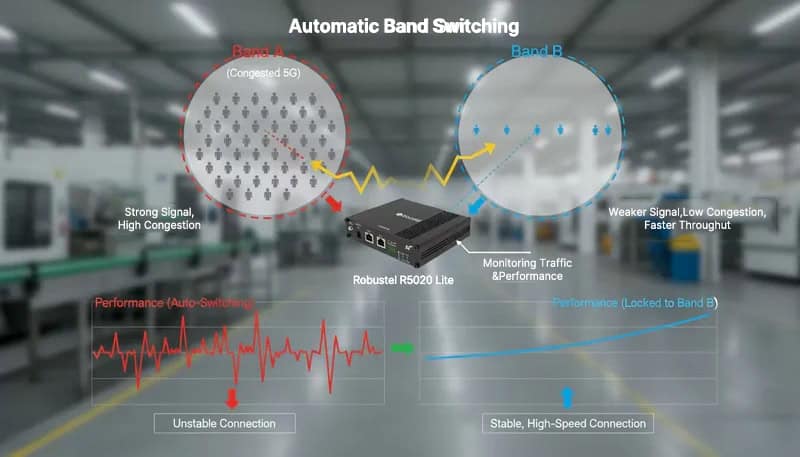
The R5020-Lite supports previous-generation cellular connectivity as part of its platform, but fallback capability does not make 5G performance universal. The project still needs to verify the final antenna position and confirm that the application remains usable when the preferred cellular generation is not available.
Mobile deployments make this especially visible. Robustel’s Managed Vehicle Wi-Fi Application Example presents R1520 for LTE requirements and R5020-Lite for 5G requirements within the same broader service architecture.
The engineering value of that comparison is that mobile connectivity should be tiered by real workload. A service provider may have customers whose usage is comfortably served by LTE and others whose traffic justifies 5G. Technology generation can therefore follow service demand rather than becoming a fleet-wide rule.
How the Robustel R5020-Lite Industrial 5G Router Helps When LTE Becomes a Workload Constraint
The Robustel R5020-Lite Industrial 5G Router provides two Gigabit Ethernet ports, full-5G cellular connectivity, Wi-Fi 5 and one configurable RS-232 or RS-485 interface. It is relevant where a site needs greater cellular and local Ethernet performance without the broader interface set of the R5020.
That makes the strongest upgrade candidates relatively easy to identify. A deployment that now carries larger files, digital media, more intensive upstream traffic or normal business WAN services has a clearer reason to evaluate the R5020-Lite than a site whose traffic profile has not materially changed.
Robustel’s “5G Router, 5G RedCap, or 4G: How to Choose for Industrial IoT?” video explains how full 5G, 5G RedCap and 4G fit different industrial connectivity requirements. The important purchasing question remains whether the application actually needs the additional capability of 5G, or whether the existing LTE architecture still meets its bandwidth, latency and operational requirements.
Compare the Whole Router, Not Only LTE vs 5G
Moving to a newer cellular generation can also change the local interface architecture.
Robustel R1520 vs R5020-Lite
| Capability | Robustel R1520 LTE Router | Robustel R5020-Lite Industrial 5G Router | Selection implication |
|---|---|---|---|
| セルラー | 4G/LTE | Full 5G with previous-generation support | Choose according to real workload and network availability |
| イーサネット | 5 × Fast Ethernet | 2 × Gigabit Ethernet | Newer cellular generation does not mean more physical ports |
| Serial | Separate RS-232 + RS-485 | One configurable RS-232 or RS-485 | R1520 can fit sites that need both serial standards simultaneously |
| I/O | DI/DO and analog input | Different, more compact interface profile | Review the physical architecture before replacement |
| GNSS | Available on relevant variants | Available on relevant variants | Verify exact SKU |
| Fleet management | RobustOS + RCMS | RobustOS + RCMS | Management continuity can reduce migration complexity |
The table highlights an important migration risk. A site can need more cellular bandwidth while still depending on legacy interfaces provided by the existing LTE router. Replacing the device without mapping those local connections first can create a technically faster WAN and a functionally incomplete installation.
When LTE Becomes a Constraint, Full 5G Is Not the Only Next Step
5G RedCap creates another option for projects whose requirements are changing but do not resemble high-bandwidth branch or media workloads.
The Robustel R3000-Lite 5G RedCap router, for example, combines RedCap and LTE connectivity with one Fast Ethernet port and separate RS-232 and RS-485 interfaces. The R2110 5G RedCap provides a much richer local architecture with four Gigabit Ethernet ports, Wi-Fi, GNSS and separate serial interfaces.
These products demonstrate why the migration question should ask what has changed. A requirement for a 5G-native technology path or a newer cellular lifecycle does not automatically imply that the project needs the complete capability of a full-5G broadband router.
Use Fleet Evidence Before Approving a Migration
The Robustel RCMS platform can provide operational evidence such as connection state, signal and data usage across deployed Robustel routers.
That information is useful when deciding which sites should move first. A group of routers with modest, stable traffic and satisfactory LTE performance presents a different business case from branches whose traffic has expanded significantly since commissioning.
A staged upgrade normally produces a better result than assuming that every device in a fleet should migrate at the same time.
よくある質問
Q1. Is 5G always better than LTE for industrial IoT?
No. Full 5G provides greater network capability, but that capability creates value only when the workload uses it. LTE remains suitable for many telemetry, monitoring and remote-access applications.
Q2. When should I upgrade an industrial LTE router to 5G?
Consider an upgrade when LTE creates a measurable capacity, responsiveness or lifecycle constraint. Video, large file transfers, business WAN traffic and higher-volume edge applications create stronger cases than periodic low-rate telemetry.
Q3. Can a 5G router work where only LTE is available?
Current Robustel full-5G routers support previous-generation cellular connectivity, but the exact regional model and carrier compatibility must still be checked. Applications should also be tested at fallback performance rather than assuming that LTE will support a workload sized around full 5G.
Q4. Is 5G RedCap an alternative to both LTE and full 5G?
It can be another technology option for some industrial applications. RedCap is designed around a different capability profile from full 5G, while LTE may remain the most practical choice for established workloads that already operate reliably.
Q5. Is the Robustel R5020-Lite always a better choice than the R1520?
No. The Robustel R5020-Lite Industrial 5G Router provides full 5G and Gigabit Ethernet, while the R1520 provides five Fast Ethernet ports, separate RS-232 and RS-485 and additional I/O. The best fit depends on both cellular workload and local equipment.
結論
The Robustel R5020-Lite Industrial 5G Router is a strong migration option where LTE capacity or the changing WAN role has become a verified constraint, while the R1520 remains a valid industrial LTE router where its performance and interface architecture continue to meet the project requirement.
The migration decision is now better viewed as LTE, RedCap and full 5G technology selection rather than a compulsory LTE-to-5G replacement cycle. Measure what the application actually needs, verify the available networks and move each site class only when the new cellular tier removes a real operational limitation.
Explore more articles about Robustel’s 5G routers in industrial IoT:



著者について
Robert Liao | Technical Support Engineer
Robert is an IoT Technical Support Engineer at Robustel, specializing in industrial networking and edge connectivity. A certified Networking Engineer, Robert focuses on the deployment and troubleshooting of large-scale IIoT infrastructures. His work centers on architecting reliable, scalable system performance for complex industrial applications, bridging the gap between field hardware and cloud-side data management.