
5G Router for EV Charging Stations: 2026 Vendor Evaluation Guide
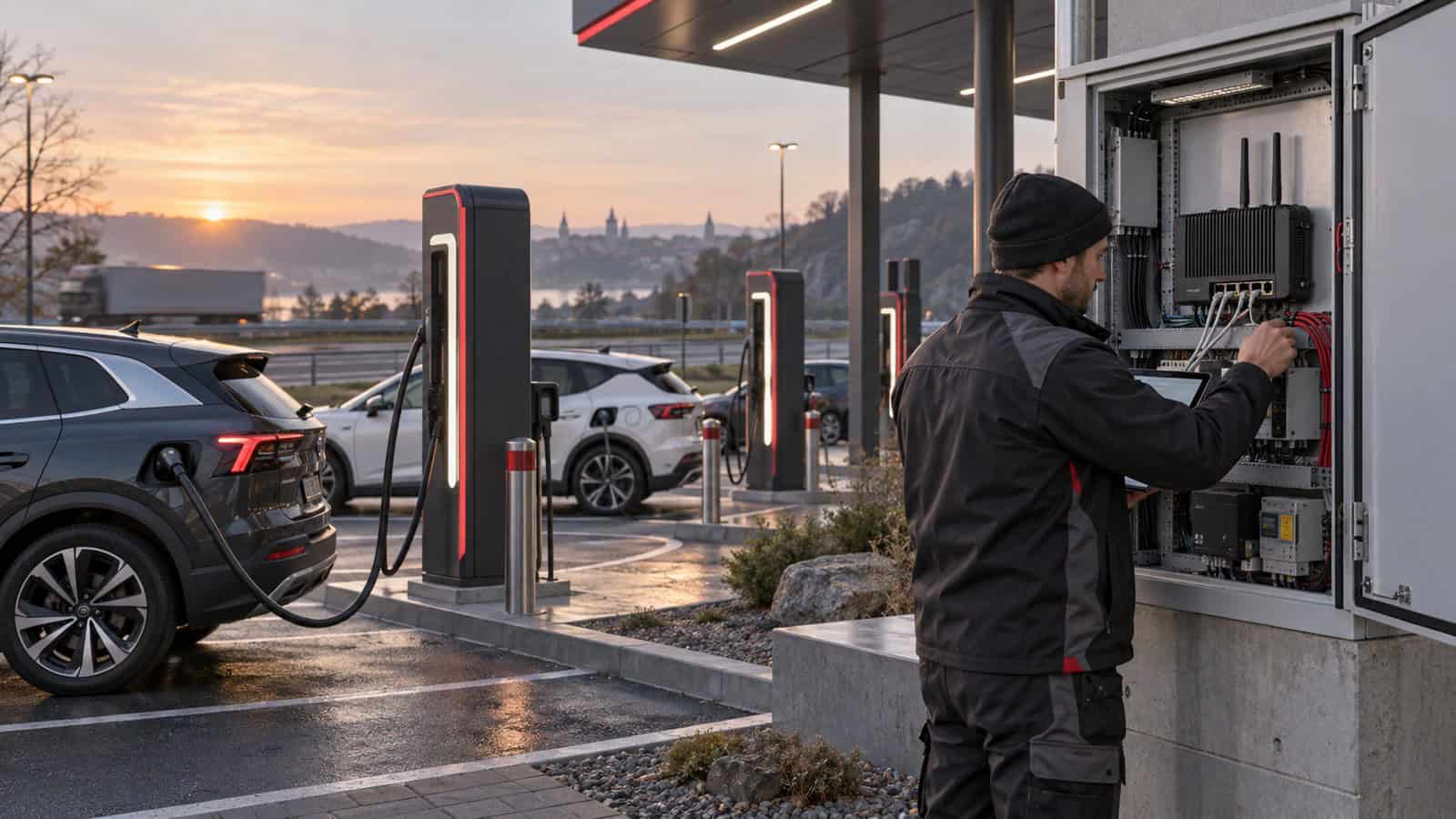
The Robustel R5020 Industrial 5G Router provides four Gigabit Ethernet ports, dual physical SIMs, Wi-Fi, RS-232, RS-485 and DI/DO. Those capabilities can suit an EV charging site, but a vendor evaluation should begin with the charging service rather than the router specification.
A charge point may need to authorize sessions, report state, support payment or roaming services, deliver operational alarms and give technicians controlled remote access. Some local functions can continue during a WAN interruption; others depend on the upstream platform. The router’s job must therefore be written as a set of service and recovery requirements.
Define What Must Continue During a WAN Loss
Ask the charging-platform team to separate local charging behaviour from cloud-dependent functions. Can an already authorized session continue? How are new users handled? What data is buffered, and how is it reconciled? Which alarms must still reach an operator through an alternate path?
The router cannot answer these application questions by itself. It can provide primary or backup cellular connectivity, but service continuity also depends on charger firmware, backend design, addressing, VPNs and carrier policy. A useful acceptance test removes the WAN during an active session, during authorization and during a software update, then records the outcome at the charger and platform.
Treat the Cabinet as Part of the Product
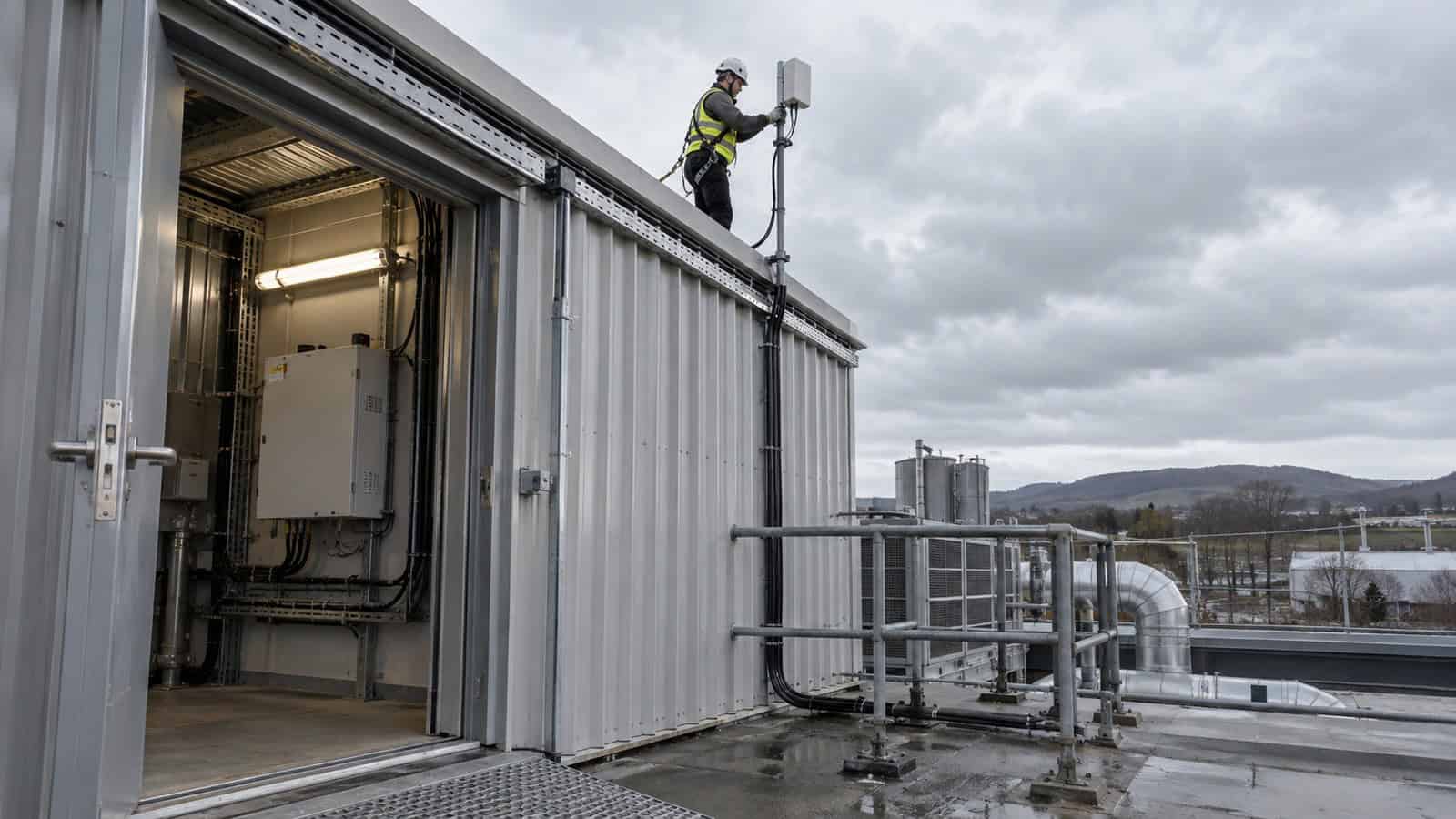
The Robustel R5020 industrial 5G router is IP30 and needs a protected installation. Roadside charging equipment may face temperature swings, moisture, dust, vibration, electrical noise and constrained antenna locations. The integrator must provide the appropriate enclosure, power protection, grounding and antenna system.
Robustel’s Smart Parking Application Example is an adjacent roadside architecture rather than an EV charging deployment. It is useful because the cabinet must support several device classes, backhaul and remote operations at an unattended location—the same conditions that make ownership unclear at a charging site. Turn that resemblance into a cabinet checklist covering power, antenna, local ports, service access and the equipment that must remain reachable during a fault. Charger behaviour and payment continuity still require their own evidence; the example is not a design that can be copied unchanged.
Security Evaluation Needs an Ownership Map
List every management path: local charger interface, router administration, vendor cloud, maintenance VPN and any site LAN. Assign an owner, authentication method, logging requirement and update process. Then decide which connections are initiated from the site and which inbound access methods are genuinely necessary.
A second SIM is useful only when the failure conditions are understood. Two subscriptions on the same network, or two paths sharing the same damaged antenna or power supply, may not provide the independence buyers expect. Verify operator diversity, antenna design, switching logic and management reachability during failover.
The Robustel R5020 overview video gives evaluators a concise view of the hardware interfaces before a bench test. It is not a substitute for the charger-vendor security model or a site-specific network design.
How the Robustel R5020 Industrial 5G Router Supports Managed EV Charging Connectivity
The Robustel R5020 industrial 5G router fits a charging-site architecture that needs several local Ethernet connections, industrial serial interfaces or I/O alongside cellular backhaul. Four Gigabit Ethernet ports can connect a charger controller and other site equipment where the segmentation design permits. RS-232 and RS-485 provide options for documented serial integrations, while DI/DO may support simple site signals.
Dual physical SIMs allow two subscriptions to be prepared within the router. Robustel RCMS adds fleet-level device visibility and management, which becomes increasingly valuable when charge points are distributed across many unattended sites. Together, the hardware and platform can make faults easier to triage: an operator can distinguish a router or cellular issue from a charger that remains locally reachable.
Ethernet or serial ports cannot establish charger-protocol compatibility by themselves. Coverage, failover time and payment continuity remain outcomes of the carrier, charger, backend and recovery design. Choose Robustel R5020 when its interface set matches the site and the operational team will use the management capabilities; a one-port R5010 may be cleaner where an established charger controller or firewall owns every local function.
Turn the R5020 Specification into Named Responsibilities
- The network integrator assigns each Ethernet port and documents segmentation; spare ports remain disabled until a purpose is approved.
- The charger supplier confirms the actual Ethernet or serial protocol and defines what the charger does when its upstream session disappears.
- The cellular owner provides the two subscriptions, APN details and escalation path, then proves that the intended operator diversity exists at the site.
- The operations team defines which RCMS alarms trigger action and which charger faults still require the charging-platform tools.
- The cabinet designer remains responsible for ingress protection, antenna placement, grounding and the complete thermal result.
This division is more useful than asking whether the router is “EV ready”. It identifies who must close each dependency before a rollout can be repeated across unattended sites.
Score Vendors Against an Acceptance Plan
| Evaluation area | Evidence to request | Site acceptance test |
|---|---|---|
| Cellular fit | Supported bands, SIM design, antenna options | Survey both intended subscriptions at final position |
| Recovery | Switching and health-check controls | Remove primary path and verify charger/platform recovery |
| Local network | Port roles, VLAN/firewall capability | Test approved zones and deny unintended paths |
| Environmental fit | Temperature and ingress requirements | Test complete protected cabinet under credible load |
| Operations | Fleet visibility, configuration and update workflow | Diagnose a staged fault without local access |
| Lifecycle | Firmware policy and support process | Record rollback, replacement and credential rotation steps |
Apply the score to the complete service, not a polished demonstration. Robustel’s Fixed-Line Backup over 5G with the R5010 Application Example keeps an existing network appliance in charge while cellular supplies another WAN, making it a useful reference for separating router recovery from charger and backend recovery. In a charging pilot, repeat that boundary test during authorization, an active session and a management task, and record which system restores each function. The example clarifies the handoff model; it is not evidence from an EV charging estate.
よくある質問
Q1. Why do EV chargers need internet connectivity?
Connected chargers may use it for authorization, payment or roaming services, status reporting, alarms, software management and remote support. The exact dependency depends on the charger and backend architecture.
Q2. Can EV chargers work without Wi-Fi?
Yes. Many sites use Ethernet or cellular connectivity, and some local charging functions may continue temporarily without any WAN. Confirm the behaviour with the charger supplier rather than assuming every feature remains available.
Q3. What data connection do EV chargers use?
Common options include Ethernet, cellular and site Wi-Fi. The best choice depends on site infrastructure, coverage, security ownership, availability targets and who will operate the connection.
Q4. How do charging stations stay online during a network failure?
They may use an alternate WAN or SIM path and may retain defined local functions while upstream service is unavailable. Continuity has to be tested at application level because restoring IP connectivity does not restore every session automatically.
Q5. When is the Robustel R5020 Industrial 5G Router suitable for EV charging stations?
It is a good candidate when a protected charging cabinet needs dual-SIM cellular backhaul, several Gigabit Ethernet connections and documented serial or I/O interfaces, with the router managed as part of a larger fleet. Final suitability depends on the charger protocol, carrier service and tested recovery design.
結論
The Robustel R5020 Industrial 5G Router can anchor connectivity at a protected charging cabinet when its Ethernet, serial, I/O and dual-SIM roles match the charger design. It does not make the charging service continuously available on its own; authorization, payment, VPN and backend recovery remain shared system responsibilities.
A useful vendor decision comes from the fault log, not the feature table. Interrupt each path during real charger states, identify which team restores each function, and keep the model only if the complete service returns within the agreed operating limit. That evidence can be repeated across the estate and defended during procurement.
Explore More Articles About Robustel 5G Routers
著者について
Robert Liao | Technical Support Engineer
Robert is an IoT Technical Support Engineer at Robustel, specializing in industrial networking and edge connectivity. A certified Networking Engineer, Robert focuses on the deployment and troubleshooting of large-scale IIoT infrastructures. His work centers on architecting reliable, scalable system performance for complex industrial applications, bridging the gap between field hardware and cloud-side data management.