
VoLTE Lift Phone Gateway: Australian Network and Deployment Checklist
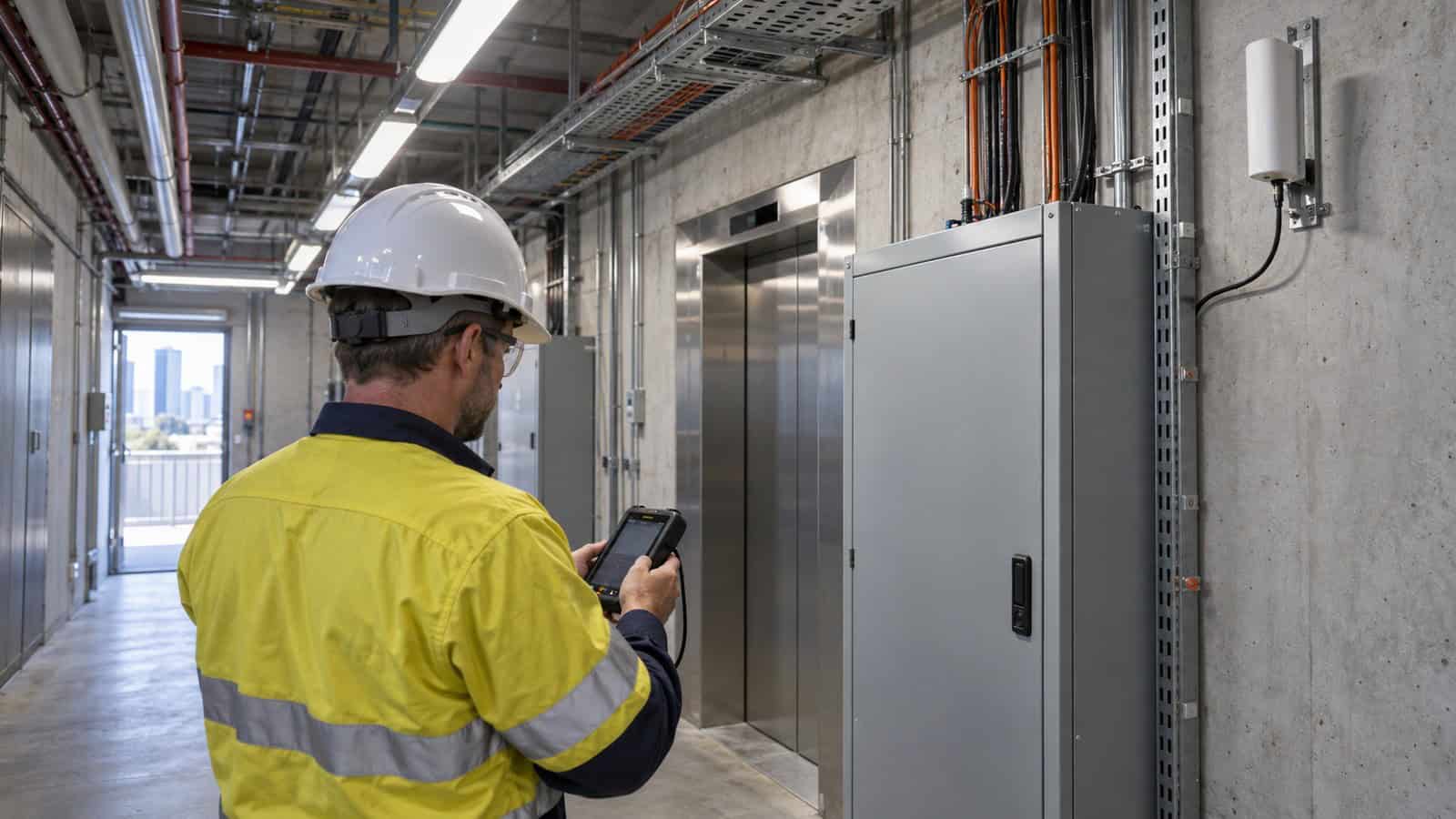
The Robustel EV8100 Elevator Voice Gateway has an ANZ order-code option, RCM-listed variant information, an FXS interface and documented VoIP/VoLTE voice functions. Those facts make it relevant to Australian lift-phone migrations, but generic LTE attachment does not prove VoLTE service. The gateway, firmware, SIM, carrier profile, bands, antenna position, monitoring centre and emergency-call routing have to work as one commissioned path.
Use this checklist across procurement, bench validation, site work and monitoring-centre acceptance.
Before Purchase
- Obtain the exact EV8100 ANZ current datasheet.
- Verify RCM and any project-specific lift evidence for that exact variant.
- Confirm the chosen carrier or service provider supports the device, SIM and intended voice profile.
- Record LTE bands and coverage assumptions for the building.
- Confirm whether normal calls use SIP/VoIP, VoLTE or another defined route.
- Check the existing lift phone’s FXS, loop, DTMF, caller-ID and wiring requirements.
- Agree who owns the SIM, SIP account, monitoring-centre record and ongoing tests.
Do not base the purchase on a handset showing 4G at the front entrance. The installed gateway may sit in a basement, machine room or metal enclosure with a different radio environment.
On the Bench
Connect the actual or representative lift autodialler to the FXS port. Test number dialling, DTMF modes, caller identification, two-way speech, call clearing and return calls where the workflow requires them. Verify that the monitoring centre receives the correct site and lift identity.
Repeat on the intended SIM and firmware. Confirm registration after reboot and after loss of the preferred service. If SIP is used, check credentials, encryption requirements, NAT behaviour and the response to server unavailability.
Robustel’s PSTN replacement with EV8100 application example describes the exact-model migration pattern: retain compatible analogue equipment through FXS while moving the transport to mobile/IP voice. It is architecture guidance, not automatic carrier acceptance.
At the Building
Survey signal where the gateway and antennas will actually be installed. Record the networks and bands in use and complete several calls at representative times. Where coverage is marginal, improve placement or antenna design rather than declaring a weak test acceptable because one call connected.
Inspect power, earthing, cable segregation and access. The EV8100 documents a 9–30 VDC input and battery provision, but the integrator must select and maintain the complete supply under the lift project’s requirements.
During Mains-Failure Testing
Install only the documented compatible battery type and follow the current manual. The product information states that batteries are not included by default and that operating and charging temperature limits change when batteries are fitted.
Remove mains under controlled conditions, then initiate a full call. Observe gateway state, handset operation, speech, monitoring-centre handling and remote visibility. Restore power and confirm normal service and charging. An idle battery timer is not enough evidence.
Monitoring-Centre Acceptance
Agree the calling-line identity, site record, escalation instructions and periodic test process. Check how the centre distinguishes a real alarm, scheduled test, repeated call and failed communication. Retain time-stamped records from both ends.
Another Robustel’s case study, the TSARO EV8100 case study, provides field evidence for an integrator using EV8100 in lift emergency-call modernisation. It reinforces the need for complete system and compliance ownership but does not certify every Australian carrier or monitoring centre.
How the Robustel EV8100 Elevator Voice Gateway Fits an Australian VoLTE Deployment
The Robustel EV8100 Elevator Voice Gateway documents one FXS port, SIP over UDP, SIPs, SRTP, VoIP and VoLTE with VoLTE described as a backup voice line. It provides dual physical SIM slots, two Ethernet ports, serial/CAN, four digital inputs, a relay and RCMS management. Optional Wi-Fi/Bluetooth and certifications depend on exact variant.
The ANZ ordering information lists RCM for the documented model. Treat that as component evidence, then verify the complete installation against current AS 1735 obligations and project requirements. Do not state that LTE data support alone proves VoLTE interoperability, 000 call behaviour or monitoring-centre acceptance.
Use RCMS platform for gateway-level status, signal, configuration and update operations. Keep call-test and battery evidence in the systems that actually perform or record those functions.
Handover Pack
Include exact order code, firmware, SIM/service, band and signal record, antenna location, power/battery design, FXS settings, SIP/VoLTE path, monitoring-centre confirmation, test-call result and support owners. Schedule the next verification before leaving site.
Walk the handover with the technician who will take the next fault call. They should be able to identify the normal voice route, confirm which network the gateway registered on, locate the antenna and power source, and find the monitoring-centre record without contacting the commissioning engineer. If that cannot be done from the pack, the installation may work today but is not yet supportable.
The Robustel’s EV8100 Quick Pitch video below can help brief installers and stakeholders. It does not replace the current manual or as-installed evidence.
Foire aux questions
Q1. Can elevator phones be VoIP?
Yes. A gateway can connect an existing analogue lift phone to a SIP/VoIP service through an FXS interface. Compatibility, monitoring-centre handling, power and regulatory requirements still need end-to-end validation.
Q2. Can you call 000 without reception in Australia?
A mobile call requires usable service from a supported network and device profile. Do not assume an emergency number can overcome absent RF coverage; survey and test the installed lift communication path under current provider requirements.
Q3. How can I tell if my phone has VoLTE?
Consumer indicators can provide a clue, but a lift gateway needs confirmation from its exact model, firmware, SIM and carrier service, followed by a completed call test. A 4G icon alone is not proof.
Q4. Where can I buy a SIM card for a lift phone?
Choose a provider that can document the intended VoLTE or managed voice service, Australian network support, lifecycle and escalation. Avoid assuming a generic data SIM will meet the call requirement.
Q5. What must be checked on the Robustel EV8100 Elevator Voice Gateway before an Australian deployment?
Check the exact ANZ order code, current RCM evidence, carrier/SIM and firmware support, FXS compatibility, voice route, RF survey, battery design and monitoring-centre acceptance.
Conclusion
The Robustel EV8100 Elevator Voice Gateway provides the interfaces and regional product options needed to build a modern VoLTE or VoIP lift-phone solution in Australia. Its suitability is proven by the exact carrier and call path at the installed building, not by a generic 4G statement.
Complete the checks in sequence—from variant and SIM through FXS, RF, mains failure and monitoring-centre response—and retain the evidence. That gives lift owners and service teams a supportable emergency-call service after legacy voice access has been replaced.
Field acceptance should end with one witnessed normal call and one controlled degraded-condition call, both tied to the exact lift identity and as-installed configuration. That record provides a baseline for later troubleshooting and avoids relying on a generic Australian coverage statement when the service depends on one building, antenna position and carrier profile.
Explore More Articles About Robustel Lift Connectivity




À propos de l'auteur
Robert Liao | Technical Support Engineer
Robert is an IoT Technical Support Engineer at Robustel, specializing in industrial networking and edge connectivity. A certified Networking Engineer, Robert focuses on the deployment and troubleshooting of large-scale IIoT infrastructures. His work centers on architecting reliable, scalable system performance for complex industrial applications, bridging the gap between field hardware and cloud-side data management.