
Lift Phone Outage Response Plan Guide: Detection, Escalation and Service Restoration
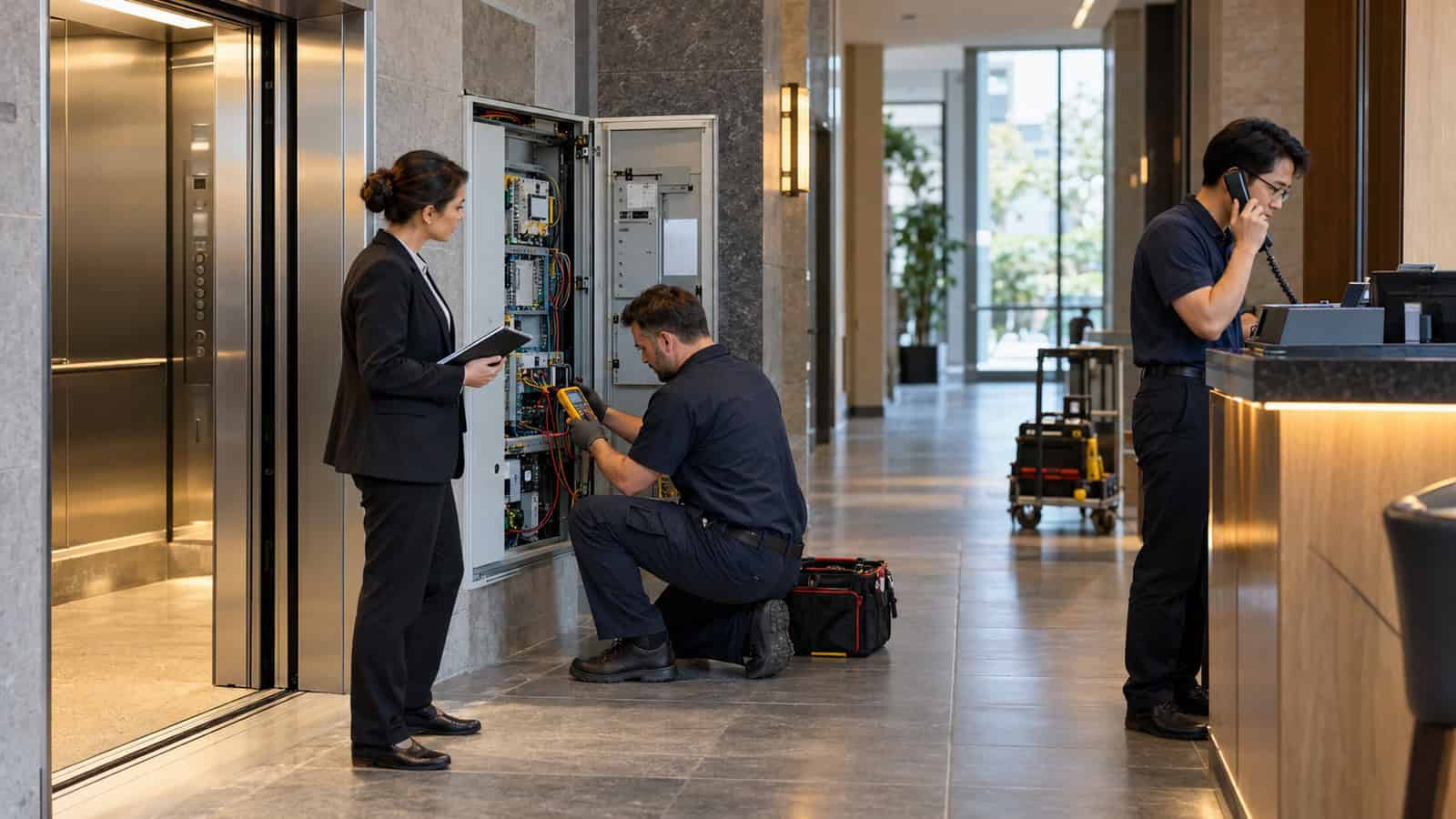
The Robustel EV8100 Elevator Voice Gateway can expose useful local and remote states for a lift-phone outage response, but restoration must follow the complete path from power and FXS through mobile/voice service to a witnessed monitoring-centre call.
Detect and Classify the First Symptom
| Symptom | First discriminating check | Initial owner |
|---|---|---|
| no gateway power | input, battery and local supply | electrical/lift contractor |
| powered, no line behaviour | FXS wiring and handset | lift-phone maintainer |
| mobile registered, no call | VoLTE/SIP registration and route | carrier/voice provider |
| call connects, no audio/DTMF | media path and receiver | voice/monitoring centre |
| remote alarm only | compare live field state | gateway operations |
Record timestamps while the symptom exists. A screenshot after recovery cannot show which layer failed first.
Escalate by Ownership, Not by Visibility
The gateway is often the most visible component, so it is frequently blamed first. Preserve power, FXS, mobile registration, voice registration and receiver evidence, then send the incident to the owner of the first failed boundary.
Robustel’s smart-elevator application example shows how gateway and network information can support wider lift operations. Use that visibility to shorten triage while retaining the lift contractor and monitoring centre’s statutory/site procedures.
Send a compact evidence bundle with every escalation: first symptom and time, power/FXS state, mobile and voice registration, last successful call, changes since that call and the checks already completed. The receiving owner can then continue from the failed boundary instead of restarting the diagnosis. If the live state conflicts with a remote alarm, preserve both observations and escalate the discrepancy rather than choosing the more convenient one.
How the Robustel EV8100 Elevator Voice Gateway Supports Outage Response
Robustel EV8100 Elevator Voice Gateway combines FXS, SIP/VoLTE, dual SIM, battery-related functions and RCMS support. Local indicators and authorised remote visibility can help distinguish power, device and mobile-network states before a visit is dispatched.
Use those states as a diagnostic sequence rather than a single health score. Power without FXS behaviour keeps the first check at the analogue endpoint; mobile registration without voice registration moves it to service configuration; a completed call without audio or recognised identity points towards media, signalling or receiver handling. Robustel RCMS visibility can give the remote team an earlier branch in that sequence and help decide whether a site visit needs a lift technician, network support or both.
The Robustel EV8100 Quick Pitch video below helps response teams identify the product boundaries, then the runbook should direct them to the exact live checks and contacts. Close the incident only after a witnessed call confirms identity, audio, signalling and receiver response under the required power condition. Robustel EV8100 fits operations that will maintain that layered runbook; remote status alone is insufficient where nobody owns the analogue endpoint or final call result.
Restore in a Controlled Sequence
Stabilise approved power first, then FXS/handset, cellular and voice registration, destination and monitoring response. Change one layer at a time and retain the previous configuration for rollback. If a SIM switch is part of the authorised procedure, confirm voice—not only data—after the transition.
Robustel’s TSARO case study provides deployment evidence for standardised EV8100 records across an estate. During an outage, that standard makes deviations visible and gives the next responder a known baseline.
Close on a Witnessed Service Outcome
Repeat the original failure condition where safe, place the approved test call from the lift, confirm site identity, two-way audio, DTMF/signalling and receiver response, then verify remote status and normal power. Record repair, changed settings, parts, participants and next review.
If service cannot be restored, activate the building’s pre-agreed temporary controls and escalation. The blog cannot define those local or statutory measures; the response plan must name them before an incident.
For intermittent or no-fault-found incidents, retain the failure window, power and signal observations, call destination and monitoring-centre evidence. Do not replace the most visible device simply because the symptom has cleared; use the preserved record to set the next observation or safe reproduction test.
Foire aux questions
Q1. What should happen if a lift phone stops working?
Follow the site’s emergency and outage procedure, classify the failed layer, notify the responsible lift/monitoring parties and apply approved temporary controls until service is verified.
Q2. How can a remote gateway outage be detected?
Management alerts and device/network status can show loss of visibility or abnormal states. Compare them with field and voice-path evidence before assigning the cause.
Q3. What is an escalation procedure?
It defines who is notified, in what order, with what evidence and authority when a service cannot be restored within the agreed response path.
Q4. How do you confirm an emergency phone is back in service?
Complete an approved witnessed call that verifies identity, audio, signalling and receiver response under the required power conditions.
Q5. How does the Robustel EV8100 Elevator Voice Gateway help outage response?
It brings FXS, cellular voice, dual-SIM and managed device states into one platform, helping authorised teams locate the failed layer before the end-to-end retest.
Conclusion
The Robustel EV8100 Elevator Voice Gateway fits lift estates that need clearer evidence across the analogue and cellular voice boundary during an outage. Its device and network states help responders choose the right owner and next check.
Practise the response before the first incident, including loss of remote visibility and an unsuccessful repair. The plan is complete only when it explains temporary controls, escalation and the witnessed result required to return the lift phone to service.
Explore More Articles About Robustel Lift Connectivity



À propos de l'auteur
Robustel Editorial Team
The Robustel Editorial Team publishes practical articles on industrial connectivity, edge computing, LoRaWAN and device management, focusing on deployment considerations, technical limitations and long-term operation.