
Lift Emergency Phone Modernisation Tender Checklist for Building Owners
The Robustel EV8100 Elevator Voice Gateway provides a useful evidence example for a lift-phone modernisation tender because it combines an FXS analogue-phone interface, SIP/VoLTE paths, dual SIM, backup-battery provision and remote management; the contract must still prove the complete emergency service under the applicable building, lift, carrier and jurisdiction requirements. Hardware alone does not establish project compliance.
Building owners should tender an operating chain: passenger call initiation, analogue interface, voice route, carrier, monitoring centre, identification, two-way audio, backup power, routine testing, fault response and lifecycle ownership. If any link is excluded, the lowest hardware price can create the highest operational risk.
Survey the existing service before requesting bids
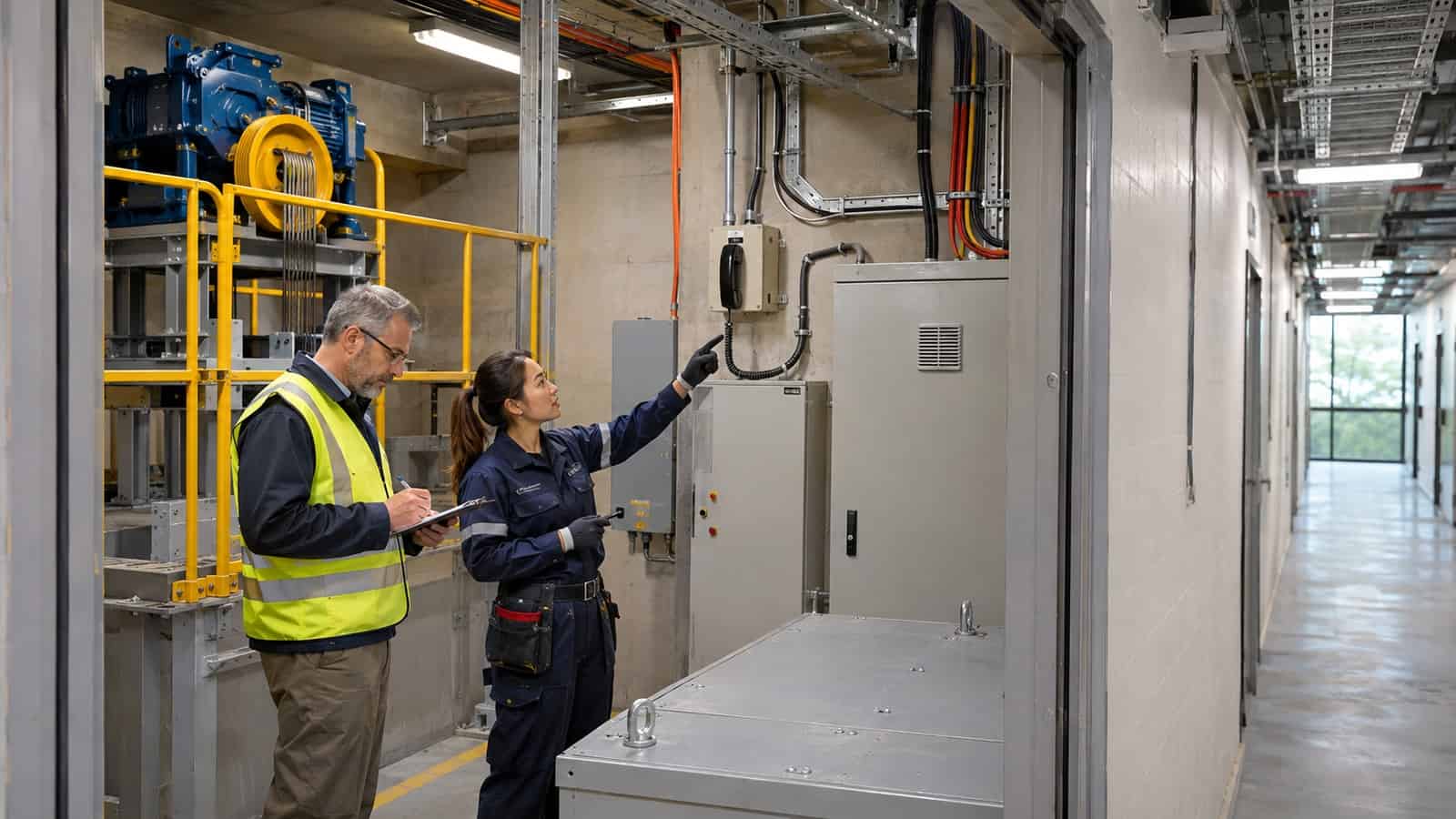
Record every lift, phone model, wiring route, machine-room location, existing line type, monitoring destination, identification method, power source, battery, carrier coverage, building network dependency and test process. Note inaccessible areas and the permitted maintenance window.
The Robustel EV8100 Quick Pitch video is useful for installer and stakeholder orientation. It should be followed by a site survey and a line-by-line scope, not treated as a compliance certificate.
Score the complete emergency path
| Tender category | Suggested weight | Required evidence |
|---|---|---|
| end-to-end voice path | 20% | supervised call from car phone to approved centre |
| carrier and route design | 12% | SIM/operator plan, SIP/VoLTE ownership and failure behaviour |
| analogue phone compatibility | 10% | FXS voltage/current/resistance fit and DTMF test |
| backup power | 12% | cell specification, charging limits and witnessed outage call |
| monitoring and routine tests | 12% | scheduled test, fault alert, log and escalation workflow |
| cybersecurity and access | 10% | accounts, remote access, updates and audit controls |
| installation and isolation | 8% | wiring, antennas, power, mounting and safe work method |
| maintenance and response | 8% | named owner, severity, attendance and spare process |
| lifecycle and exit | 8% | updates, carrier change, replacement and record export |
Require a pass on every safety- or compliance-critical category before using the weighted score. A strong monitoring proposal cannot compensate for a failed call path.
Demand evidence, not generic compliance language
Ask each bidder to name the exact device, firmware, SIM/carrier, SIP provider, monitoring centre, phone and battery configuration. Require the applicable standard and jurisdiction review to be signed by the responsible qualified parties. Do not accept a product-page statement as proof that the installed system, wiring and operating procedure comply.
Robustel’s EV8100 and Tsaro case study shows an end-to-end operating model with daily test calls and compliance logs across more than 400 elevators. A tender can use that mechanism as an evidence pattern while requiring results from the proposed local service and jurisdiction.
How Robustel EV8100 Elevator Voice Gateway can be evaluated in the tender
The Robustel EV8100 Elevator Voice Gateway provides one FXS port, SIP over UDP/SIPS/SRTP, VoLTE backup capability, dual SIM, two Ethernet ports, internal provision for two flat-top 18650 cells and RCMS management. These features address a defined part of the emergency-phone architecture: connecting a legacy analogue phone to managed IP/cellular voice paths.
| Site pain | Verified Robustel EV8100 capability | Architectural effect | Acceptance evidence |
|---|---|---|---|
| legacy phone must remain | FXS interface with documented loop limits | preserve the analogue phone while replacing the line | off-hook, ringing, audio and DTMF test |
| voice paths must be separated | SIP/VoIP and VoLTE capability | design primary/backup routes according to provider support | witnessed failure and recovery sequence |
| mains loss threatens service | holder for two flat-top 18650 cells | provide a local battery boundary | cell record, charging check and outage call |
| portfolio needs evidence | RCMS call/device monitoring functions | centralise status and test records where configured | exported log and escalation workflow |
The gateway does not prove carrier coverage, phone compatibility, monitoring-centre decoding, runtime or compliance by itself. Those dependencies belong in the bid and witnessed test.
Include disqualifiers and witnessed acceptance
Disqualify a bid that cannot name the carrier and voice route, omits battery maintenance, relies on unsupervised self-declaration, exposes shared default credentials, or cannot demonstrate identification and two-way audio from every lift. Treat an untested “automatic fallback” statement as a gap.
Robustel’s IoT-enabled smart elevators application example illustrates voice and operational data sharing one managed gateway. If a bidder includes monitoring or telemetry, require network separation, data ownership and proof that those functions do not compromise the emergency call service.
Witness mains loss, primary-route failure, SIM/carrier impairment where safe and approved, monitoring-centre identification, DTMF handling, two-way speech, callback/return-call procedure and fault escalation. Record date, people, configuration, firmware and result for each lift.
Contract the operating handover
The owner should receive as-built wiring, gateway/SIM inventory, carrier and SIP contacts, account ownership, battery details, configuration backup, test schedule, failure response, update process and retirement route. Make the party responsible for each recurring task explicit.
Set review triggers for carrier or PSTN changes, firmware updates, monitoring-centre changes, battery replacement and lift-phone replacement. A modernised service is complete when those changes can be managed without rediscovering the design.
Foire aux questions
Q1. What should a lift emergency-phone tender include?
It should cover the end-to-end call path, carrier and monitoring centre, phone/FXS compatibility, backup power, supervised testing, fault monitoring, cybersecurity, maintenance, records and lifecycle ownership.
Q2. Can a cellular gateway alone make a lift phone compliant?
No. Compliance applies to the installed service under the relevant jurisdiction, including the phone, wiring, power, carrier, monitoring process, procedures and witnessed tests.
Q3. How should backup power be accepted?
Record the approved cells and temperature conditions, remove mains under supervision, confirm the gateway remains registered and complete the required emergency call. Runtime must be measured for the installed load.
Q4. How often should lift emergency phones be tested?
The interval should follow applicable standards, authority requirements, the building’s risk plan and service contract. The tender should state who runs the test, what is checked and how failures are escalated.
Q5. What role can the Robustel EV8100 Elevator Voice Gateway play in modernisation?
It can connect an existing analogue phone through FXS to SIP/VoIP and VoLTE-capable paths, with dual SIM, battery provision and RCMS management. The complete local service still needs project-specific design and acceptance.
Conclusion
The Robustel EV8100 Elevator Voice Gateway is best suited to modernisation projects that retain an analogue lift phone while moving the external voice path to managed IP/cellular services. Its verified interfaces and monitoring options provide tender evidence, but system compliance depends on the complete installed chain.
Award only after hard gates pass and the proposed configuration completes witnessed calls under normal, power-loss and route-failure conditions. Carry the same evidence into maintenance so the service remains defensible after handover.
Explore More Articles About Robustel Lift Connectivity


À propos de l'auteur
Robustel Editorial Team
The Robustel Editorial Team publishes practical articles on industrial connectivity, edge computing, LoRaWAN and device management, focusing on deployment considerations, technical limitations and long-term operation.