
How to Choose an Industrial 5G Router: 10-Point Selection Checklist

The Robustel R5020 Industrial 5G Router is a practical fit for sites that must connect several IP and legacy devices through one managed cellular link. It should still be approved only after the project team verifies radio conditions, interfaces, failure behaviour and the long-term operating model.
A factory connecting PLCs, a remote energy cabinet operating without local staff and a transport system carrying cameras and onboard equipment may all require 5G. Their risks are different. The cost of choosing the wrong router may appear later as extra converters, failed recovery, site visits or redesign work.
Use the following 10 checks before approving an industrial 5G router for a pilot or adding it to a procurement specification. For each item, record a clear result:
- Pass
- Conditional
- Fail
Why Industrial 5G Router Selection Depends on the Deployment
An industrial 5G router may act as the primary WAN, a backup to fixed broadband, a temporary connection or the main network platform for local equipment. Each role requires a different combination of interfaces, network functions and recovery behaviour.
This range of requirements is reflected across the Robustel industrial 5G router portfolio. Some models provide a focused 5G handoff for an existing firewall or SD WAN appliance. Others add multiple Ethernet ports, serial interfaces, digital I O, WiFi, GNSS or PoE capabilities for sites where the router must also connect local equipment.
The correct product is not necessarily the model with the most features. It is the model that fits the site without creating avoidable equipment, configuration or maintenance work.
Start with the Workload Not the Datasheet
1. Define the Router’s Role
Begin by deciding whether 5G will be the primary connection, a backup WAN or a temporary link used while fixed broadband is being installed.
A primary router must carry normal site traffic continuously. A backup device may remain idle for long periods but must recover correctly when the preferred WAN fails. A temporary deployment may place greater value on fast installation and relocation.
Without this distinction, teams compare products before agreeing on the task the router must perform.
2. Calculate the Real Data Flow
Do not select 5G on the assumption that every industrial application needs maximum speed. Estimate the traffic that will actually cross the cellular link, with particular attention to uplink demand.
Periodic sensor readings and basic telemetry may operate comfortably over LTE. Multiple video streams, large file transfers, passenger WiFi and data-rich edge applications create a different requirement.
The assessment should include peak traffic, simultaneous sessions and expected expansion. It should explain why 5G changes the project outcome rather than simply stating that 5G is preferred.
Robustel’s real-world example: Robustel’s managed vehicle Wi-Fi architecture shows why bandwidth requirements should be defined before selecting 5G. Mobile users may connect laptops, phones, entertainment systems or work equipment while moving through areas with changing cellular conditions. Robustel R1520 can support 4G/LTE service models, while Robustel R5020-Lite 5G Router provides a higher-performance option where the service genuinely requires greater mobile broadband capacity. RCMS adds remote visibility across the distributed router fleet. The lesson is not that every vehicle needs 5G, but that the cellular platform should match the expected user load and service model.
3. Map Every Local Connection
Draw the local network before counting router features. Record which devices use Ethernet, WiFi, RS232, RS485 or digital input and output. Identify any equipment that requires Power over Ethernet.
A router connected to one existing firewall does not need the same interface set as an industrial cabinet serving several IP devices and legacy serial equipment.
Missing interfaces usually lead to additional switches, converters, power supplies and commissioning work. Unused interfaces increase cost and configuration scope without improving the system.
Rule Out What Cannot Work at the Site
4. Verify the Exact Regional Model
General 5G support is not enough for a multi-country deployment. The exact order code must support the frequency bands, cellular technologies and approvals required in each target market.
Check the regional SKU rather than relying only on a product-family overview. Models within the same series may differ by market, and certification requirements can change according to the country and application.
This check should be completed before pilot hardware is ordered. A successful test with the wrong regional version provides little evidence for the intended rollout.
5. Survey Coverage and Antenna Conditions
Test operator performance where the router will actually be installed. A mobile phone held elsewhere in the building is not an adequate site survey.
Metal cabinets, plant rooms, vehicles, underground locations and equipment enclosures can produce very different radio conditions from an open office. Antenna type, placement, cable length and separation also affect the result.
Where practical, record signal and connection behaviour over time. A short test during a quiet period may not reveal congestion or coverage variation during normal operations.
6. Check Power Mounting and Environmental Limits
Confirm how the router will be powered, mounted and protected at the final site.
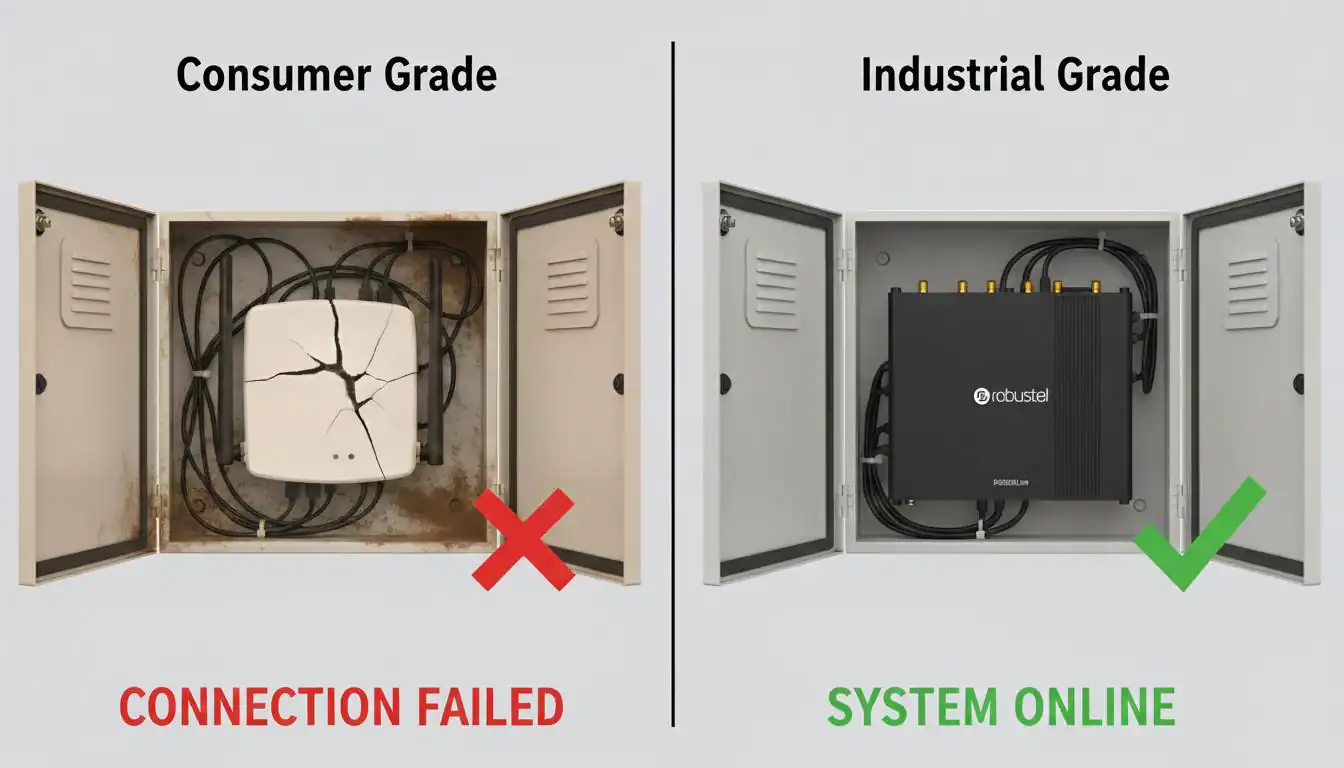
A cabinet deployment may require DIN rail mounting and a suitable DC input range. A vehicle introduces vibration, ignition behaviour and approval requirements. An outdoor enclosure still needs appropriate thermal and ingress protection even when the router itself has industrial environmental ratings.
Robustel tips: Decision makers should include mounting accessories, antennas, power supplies and enclosure work in the total deployment cost. The router price alone does not represent the complete installation.
Decide What Must Happen When Connectivity Fails
7. Confirm the Fallback Path
5G may be unavailable at some sites or may vary as equipment moves between locations. The router should therefore be evaluated as part of a multi-generation cellular design rather than as a 5G-only device.
The Robustel 5G router range supports LTE fallback, but the project still needs to verify which network is available at the installation point and what performance remains after fallback.
The application must remain usable at LTE speeds. Otherwise, fallback exists as a specification but not as an effective recovery path.
8. Understand What Dual SIM Actually Does
Dual SIM provides access to a second cellular subscription. It does not automatically create two continuously active links or guarantee uninterrupted service.
In a cold-backup design, the secondary WWAN connection is activated after the primary path is judged to have failed. Recovery depends on link detection, SIM registration, operator availability and the configured restoration policy.
Ask how the switching sequence works and test it. Dual SIM should form part of a documented recovery design rather than remain an unchecked feature in the specification.
9. Test Application Recovery Not Only Router Recovery
A router may reconnect while the business application remains unavailable. VPN tunnels, cloud sessions, field devices and remote applications may respond differently when the cellular path or public IP address changes.
During testing, interrupt the primary connection and measure:
- Failure detection time
- Backup SIM registration time
- IP connectivity recovery
- VPN tunnel recovery
- Field application reconnection
- Delayed or lost data
- Return to the preferred path
The meaningful result is restored operation. A green router status indicator is not enough.
10. Match the WAN and LAN Architecture
Decide whether the 5G device will act as the main site router or provide connectivity to an existing firewall, SD WAN appliance or local network platform.
The Robustel R5010 Industrial 5G Router represents the focused handoff approach. It provides one 2.5 Gigabit Ethernet interface and USB modem connectivity for architectures that already have another device handling firewall, routing and LAN functions.
A deployment connecting several devices directly may require a multiport router such as Robustel R5020. More ports are valuable only when the network topology uses them.
See the architecture in practice: The Robustel R5010 Quick Pitch provides a concise overview of how the R5010 can be used for primary 5G connectivity, SD-WAN backup and other deployments where the cellular device provides a focused WAN connection rather than serving as the complete local network platform.
Robustel’s real-world example: This focused WAN role is used in Robustel’s case study with UK managed service provider Jones Technology. Across a large quick-service restaurant estate, the network architecture retained an SD-WAN firewall as the main network platform, with the Robustel R5010 5G Router providing the secondary cellular WAN. The design supported store systems including POS terminals, ordering kiosks, kitchen displays and guest Wi-Fi, while also providing connectivity when leased-line installations were delayed. Robustel RCMS supported centralised provisioning and management across the distributed estate.
The example shows why router selection should follow the WAN architecture. The R5010 did not need to become the store’s main LAN platform; its value came from providing a focused 5G handoff that integrated with the existing SD-WAN design.
How the Robustel R5020 Industrial 5G Router Supports Multi-Interface Industrial Sites
The previous checks determine whether a router is technically compatible with the project. The next step is to connect those requirements to a practical product architecture.
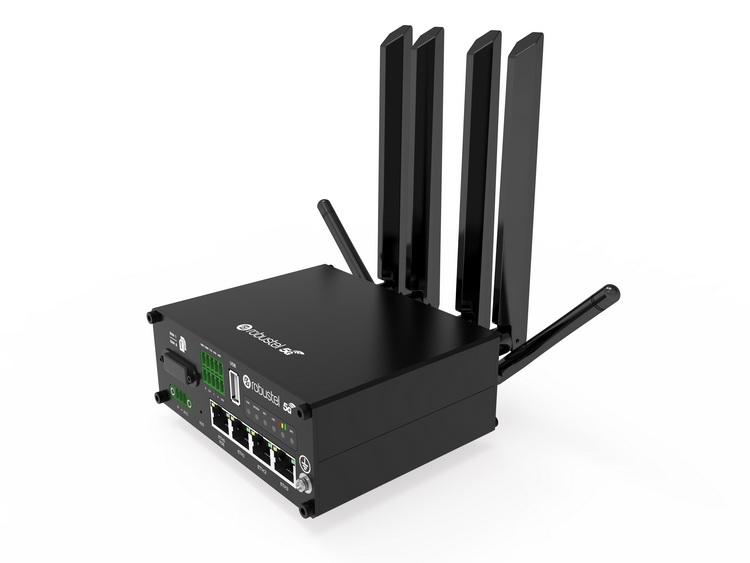
The Robustel R5020 Industrial 5G Router fits fixed and mobile industrial sites where one managed device must provide cellular WAN connectivity while also connecting several local IP and legacy devices.
Connect IP and Legacy Equipment Through One Router
Many industrial sites combine modern Ethernet equipment with installed serial devices. A cabinet may contain an industrial computer, camera or switch alongside a meter, controller or other RS232 or RS485 equipment.
The R5020 provides four Gigabit Ethernet ports together with separate RS232 and RS485 interfaces. This allows suitable deployments to connect several local devices without automatically adding an external Ethernet switch or serial converter.
Digital input and output can also support basic status or alarm integration. These interfaces do not replace PLC logic or a dedicated control system, but they can reduce unnecessary supporting hardware where the router is expected to serve several local connections.
Maintain Connectivity Across Changing Network Conditions
A remote cabinet, vehicle or temporary site may experience variable 5G coverage. The R5020 combines 5G connectivity with LTE fallback and dual SIM support, allowing the project to define an alternative cellular path.
These capabilities address two different risks:
| Deployment problem | R5020 capability | Project responsibility |
| 5G service is unavailable | LTE fallback | Confirm acceptable application performance over LTE |
| Preferred operator fails | Dual SIM support | Select suitable subscriptions and configure failure detection |
| Application sessions break after switching | Cellular recovery functions | Test VPN and application reconnection |
| Installation point has weak reception | External antenna support | Survey and validate final antenna placement |
The product provides the technical options. The project must still configure, test and document how recovery should work.
Support Remote Operations Across Distributed Sites
When routers are installed across multiple factories, infrastructure sites or vehicles, local configuration becomes difficult to control.
RCMS supports central visibility, device configuration, firmware maintenance and troubleshooting for Robustel router fleets. This can help operations teams identify whether a problem is related to cellular status, configuration or a wider deployment change before arranging field intervention.
Remote management does not repair damaged cables, antennas or power supplies. Its business value is that distributed sites can be managed through a repeatable process rather than through isolated local actions.
Know When the R5020 Is More Than the Site Needs
The R5020 should not be selected simply because it provides a broad interface set.
A branch that already uses a firewall and only needs a 5G WAN handoff may be better served by a focused product architecture. A low-volume telemetry site may not benefit from 5G if stable LTE already meets its workload. A project requiring PoE PSE output for several cameras may need a different Robustel model.
The R5020 is the stronger fit when its Ethernet, serial, digital I O, cellular and remote-management capabilities solve requirements that genuinely exist at the site.
Foire aux questions
Q1. Is 5G always necessary for an industrial router deployment?
No. LTE may be sufficient for applications that transmit small amounts of telemetry and do not require high uplink capacity. 5G becomes more relevant for video, dense local networks, mobile systems and other data-rich workloads. The decision should also account for site coverage, operating cost and fallback performance rather than treating 5G as an automatic upgrade.
Q2. Does a dual SIM industrial 5G router provide uninterrupted connectivity?
Not by itself. Dual SIM gives the router access to another cellular subscription, but recovery still depends on failure detection, backup network availability, registration time and application reconnection. Projects that cannot tolerate interruption should measure the complete failover sequence using the intended operators, antennas, VPNs and applications.
Q3. Which interfaces should an industrial 5G router have?
The required interfaces depend on the equipment connected at the site. Ethernet is common for IP devices, while RS232 or RS485 may be needed for legacy controllers and meters. Digital I O, GNSS, WiFi and PoE should be selected only when the installation uses them. A network diagram is generally more useful than choosing the longest feature list.
Q4. When is the Robustel R5020 Industrial 5G Router a suitable choice?
The Robustel R5020 Industrial 5G Router fits deployments where one router must connect several Ethernet and legacy serial devices while providing managed 5G and LTE connectivity. Its four Gigabit Ethernet ports support local IP equipment, separate RS232 and RS485 interfaces support compatible installed devices, and RCMS supports remote monitoring and configuration. It may be unnecessarily complex for a site that only needs a simple cellular WAN handoff.
Q5. What should be tested before deploying industrial 5G routers at scale?
Test cellular coverage, sustained traffic, LTE fallback, dual SIM behaviour, VPN recovery and the applications behind the router. The pilot should also cover remote configuration, firmware updates, power recovery and troubleshooting. Use the planned SIMs, antennas, field equipment and installation position so the test represents the intended system rather than a simplified laboratory setup.
Conclusion
The Robustel R5020 Industrial 5G Router is a practical fit for industrial sites that need to connect multiple IP and legacy devices while maintaining a centrally managed cellular WAN. Its value comes from matching Ethernet, serial, cellular and management capabilities to verified site requirements rather than selecting the highest specification by default.
A router should move forward only when the regional model, interfaces, radio conditions, recovery behaviour, security design and management process have been verified. Complete that work at a representative site before committing to a wider rollout. The final choice should be based on evidence from the intended system, not on a collection of attractive but disconnected features.
Explore more articles about Robustel industrial 5G routers:


À propos de l'auteur
Robert Liao | Technical Support Engineer
Robert is an IoT Technical Support Engineer at Robustel, specializing in industrial networking and edge connectivity. A certified Networking Engineer, Robert focuses on the deployment and troubleshooting of large-scale IIoT infrastructures. His work centers on architecting reliable, scalable system performance for complex industrial applications, bridging the gap between field hardware and cloud-side data management.