
Connecting Mobile Internet Services: Managed Vehicle Wi-Fi over 4G/LTE and 5G with the R1520, R5020-Lite and RCMS
Exemple d'application Robustel
Exemple d'application – Faits marquants
Industrie
Transportation, Managed mobile connectivity, recreational travel, mobile office, service fleets
Produit(s)
Robustel R1520, Robustel R5020-Lite, RCMS
Défis
Managed vehicle Wi-Fi and mobile internet services must operate across constantly changing real-world conditions. Users may move between strong and weak coverage areas, rely on different mobile operators, connect multiple personal or work devices, and expect a simple experience even when the underlying network environment is highly variable. For service providers, the challenge is not only delivering connectivity, but also supporting installations across different vehicle types, diagnosing problems remotely, maintaining visibility across a growing router fleet and scaling the service without turning every customer issue into a manual support case.
Résultats attendus
By combining the R1520 for 4G/LTE deployments, the R5020-Lite for 5G requirements and RCMS for remote device management, managed connectivity providers can build a more scalable foundation for mobile internet services. The solution supports reliable cellular connectivity for recreational and mobile users, while giving providers a more repeatable way to deploy, monitor and support routers in the field. This helps create clearer service tiers, improves remote troubleshooting and enables MNOs, ISPs, MVNOs and specialist providers to manage vehicle Wi-Fi as an operational service rather than a one-off hardware installation.
Keeping Recreational and Mobile Users Connected When Fixed Broadband Is Not Available
Reliable internet access is no longer only expected at home, in the office or at fixed business locations. Recreational travellers, mobile workers, fleet operators and temporary site users increasingly expect connectivity to travel with them. Whether the environment is a caravan, motorhome, campervan, service vehicle, mobile office, temporary works unit or remote operating site, users want to stay connected for work, entertainment, communication, navigation, payments and access to cloud-based services.
Depending on where you are in the world some users search for RV Wi-Fi, caravan Wi-Fi, motorhome internet, portable Wi-Fi, mobile broadband, mobile hotspot or vehicle Wi-Fi. For managed connectivity providers, however, the underlying requirement is the same: a dependable cellular router platform that can support mobile internet services across many different recreational and mobile environments.
Robustel’s R1520, R5020-Lite and RCMS provide a practical platform for managed vehicle Wi-Fi and mobile internet services. The R1520 supports reliable 4G/LTE service models, while the R5020-Lite provides a pathway for 5G requirements where higher performance, future-ready service tiers or stronger mobile broadband positioning are needed. RCMS provides the operational management layer that allows service providers to monitor, support and scale deployed routers across a distributed customer base.
Together, these products help MNOs, ISPs, MVNOs and specialist managed connectivity providers move beyond standalone hardware sales and build mobile internet services that can be installed, supported and managed as part of a recurring service model.
Défis commerciaux
- Mobile users expect home-like internet in unpredictable environments: Recreational and mobile users often expect connectivity to behave like fixed broadband, even though mobile signal quality, network congestion, coverage availability and local installation conditions can vary significantly from one location to another.
- Consumer hotspots are often difficult to scale into managed services: A mobile hotspot or portable Wi-Fi device may be suitable for casual personal use, but managed service providers need a more robust platform for repeatable installation, remote support, service tier management and long-term operation.
- Vehicle and mobile environments create installation variability: Each vehicle or mobile site may have different power availability, mounting requirements, antenna placement, cable routing, internal layout and user expectations. Connectivity hardware must be flexible enough to support repeatable deployment without turning every installation into a bespoke engineering project.
- Support teams need visibility after the router has been installed: Once a customer is on the road or operating remotely, it can be difficult for support teams to diagnose connectivity issues from a phone call alone. The issue may relate to signal strength, SIM status, local Wi-Fi behaviour, customer device configuration, operator coverage or router settings.
- Service providers need to support both 4G/LTE and 5G requirements: Many recreational and mobile connectivity services still depend on broad 4G/LTE coverage, while some users and regions require 5G performance. Providers need a product pathway that supports current deployments while allowing premium or future-ready service models to develop.
- Managed mobile internet requires operational control at scale: For an MNO, ISP, MVNO or managed connectivity provider, the commercial challenge is not simply connecting one vehicle. The real challenge is managing many deployed routers across different users, locations, cellular conditions and service packages while maintaining a consistent support experience.
- Subscription-based connectivity requires more than hardware: A managed mobile internet service may involve hardware supply, cellular service, installation, configuration, support, remote diagnostics, upgrades and ongoing customer management. As the installed base grows, the service provider needs tools that support repeatable operations rather than one-off troubleshooting.
Présentation de la solution
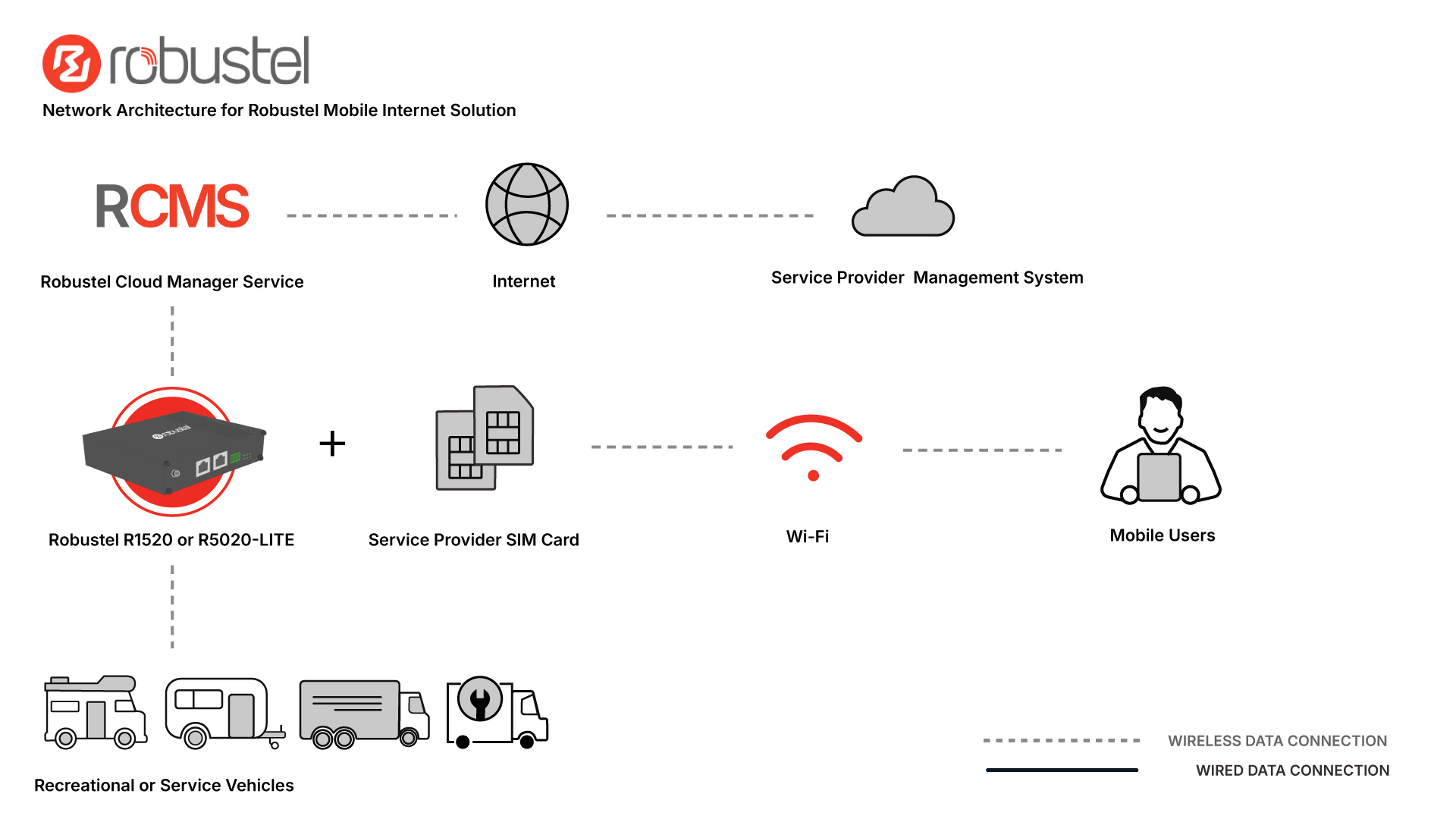
In a managed vehicle Wi-Fi deployment, Robustel cellular routers provide the connectivity gateway between the mobile environment and the cellular network, while RCMS provides the operational management layer for the service provider. Together, the R1520, R5020-Lite and RCMS create a scalable platform for delivering mobile internet services across recreational vehicles, mobile offices, service fleets and temporary operating environments.
For 4G/LTE requirements, the Robustel R1520 provides a compact industrial cellular router suitable for managed mobile internet services. For 5G requirements, the Robustel R5020-Lite provides a higher-performance option for providers building premium connectivity packages or preparing for increased mobile data expectations.
RCMS is central to the managed service model. It allows support teams to monitor router status, review connectivity information, manage configuration and troubleshoot deployed devices remotely. This helps providers operate the installed base as a managed service, rather than treating each router as an isolated hardware installation.
- Cellular backhaul for mobile internet services: The Robustel router provides the cellular WAN connection between the vehicle or mobile environment and the wider internet, reducing reliance on public Wi-Fi, campsite networks, venue infrastructure or fixed-line services.
- Managed vehicle Wi-Fi architecture: The router can sit at the centre of the onboard network, supporting internet access for user devices, entertainment systems, work equipment, payment terminals or other connected systems depending on the service design.
- 4G/LTE and 5G service flexibility: The R1520 can support dependable 4G/LTE service models, while the R5020-Lite can be used where 5G connectivity is required for higher-performance mobile internet services.
- Remote management through RCMS: RCMS gives the service provider visibility across deployed routers, helping teams check device status, assess connectivity behaviour, manage configuration and support customers remotely.
- Support for professional installation models: Robustel routers can be integrated into repeatable installation packages that may include antennas, cabling, mounting, power connection, SIM configuration and customer handover processes.
- Operational scalability for service providers: By combining industrial cellular router hardware with RCMS, providers can create clearer service packages, more repeatable support processes and a stronger foundation for long-term subscription-based mobile connectivity services.
- Pathway beyond recreational use cases: The same architecture can support mobile offices, service vehicles, temporary worksites, event operations, emergency response vehicles and other environments where fixed connectivity is unavailable or impractical.
Why Choose the R1520, R5020-Lite and RCMS?
- R1520 for 4G/LTE managed mobile internet: The R1520 is suited to recreational and mobile connectivity deployments where reliable 4G/LTE backhaul, compact installation and professional router management are required.
- R5020-Lite for 5G service requirements: The R5020-Lite provides a 5G option for providers who need higher mobile broadband performance, future-ready service tiers or stronger support for evolving cellular network expectations.
- RCMS as the managed service operations layer: RCMS helps service providers monitor, configure and support deployed routers remotely, making it easier to operate a distributed router fleet as part of a recurring mobile connectivity service.
- Industrial router platform for mobile environments: Unlike basic consumer hotspot devices, Robustel routers are designed for professional connectivity applications where reliability, configuration control, remote management and long-term support matter.
- Support for MNO, ISP and MVNO service models: The combination of R1520, R5020-Lite and RCMS can support service providers that need to deliver packaged mobile internet services across multiple customers, vehicles and service tiers.
- A product pathway for broader mobile connectivity services: The same basic architecture can support recreational Wi-Fi, mobile offices, service vehicles, temporary worksites, event operations, emergency response vehicles and other environments where fixed connectivity is unavailable or impractical.
Résultats attendus pour les clients
For MNOs, ISPs, MVNOs and Managed Connectivity Providers
- A stronger platform for subscription-based mobile internet services: Robustel routers and RCMS can form part of a managed service model that includes hardware, connectivity, installation, support and ongoing customer management.
- Fleet-level visibility across deployed routers: RCMS helps providers monitor and manage routers across a distributed installed base, supporting a more scalable operational model than standalone hardware deployments.
- More repeatable service deployment: Standardising around the R1520 for 4G/LTE and the R5020-Lite for 5G helps providers create clearer service packages, more consistent installation processes and more predictable support workflows.
- Improved remote support capability: Support teams can remotely check device status, review connectivity information and manage router configuration, helping reduce avoidable troubleshooting delays and improving the quality of customer support.
- Clearer migration path from 4G/LTE to 5G: Providers can support customers who need dependable 4G/LTE connectivity today while also offering 5G options for premium or future-ready service tiers.
- Opportunity to expand beyond recreational use cases: The same managed connectivity model can be adapted for mobile offices, service fleets, transport assets, emergency vehicles, temporary worksites and other mobile internet applications.
For Installers and Service Partners
- More consistent installation processes: A standard router platform helps installers develop repeatable methods for power, mounting, antenna placement, cabling and configuration.
- Better handover from installation to support: When routers are visible in RCMS, installers and service teams can work from a clearer shared view of the deployed device, helping reduce ambiguity after the installation is complete.
- Fewer avoidable support escalations: Remote device visibility can help service teams distinguish between router status, cellular signal, SIM/network behaviour, local installation issues and end-user device problems.
- Flexible deployment across different vehicle types: The architecture can be adapted for caravans, motorhomes, campervans, mobile offices, service vehicles and other mobile or semi-mobile environments.
- Better support for managed service packages: Installers and service partners can work within a more structured service model, rather than treating each mobile internet installation as a one-off hardware project.
For Recreational and Mobile Users
- More reliable internet access while travelling or operating remotely: Users can access cellular-based mobile internet from vehicles or temporary locations without depending entirely on public Wi-Fi or fixed broadband.
- A simpler customer experience: The connectivity provider can package the router, service, installation and support into a managed solution that is easier for non-technical users to understand and operate.
- Support for work, entertainment and connected services: Depending on the service design, users can connect laptops, tablets, phones, media devices, payment systems or other equipment through the local vehicle network.
- Better support when problems occur: Remote diagnostics can help the provider identify whether the issue is likely to be related to router status, signal quality, configuration, SIM/network behaviour or the local user environment.
- A service model that can grow with user needs: Customers can begin with a 4G/LTE service model and, where available and appropriate, move toward higher-performance 5G connectivity options.
For Fleet, Mobile Office and Temporary Site Operators
- Connectivity for locations where fixed broadband is unavailable: The same architecture can support mobile offices, field service units, temporary operating sites, event locations and other environments where wired connectivity is not practical.
- A scalable model for distributed assets: Operators managing multiple vehicles or mobile sites can benefit from a more consistent router platform and remote management approach.
- Support for future service growth: The combination of 4G/LTE and 5G router options gives providers and operators flexibility as mobile data requirements increase.
- Improved operational visibility: RCMS helps service providers maintain visibility across router deployments, supporting more consistent service delivery across distributed users and mobile environments.
Produits phares
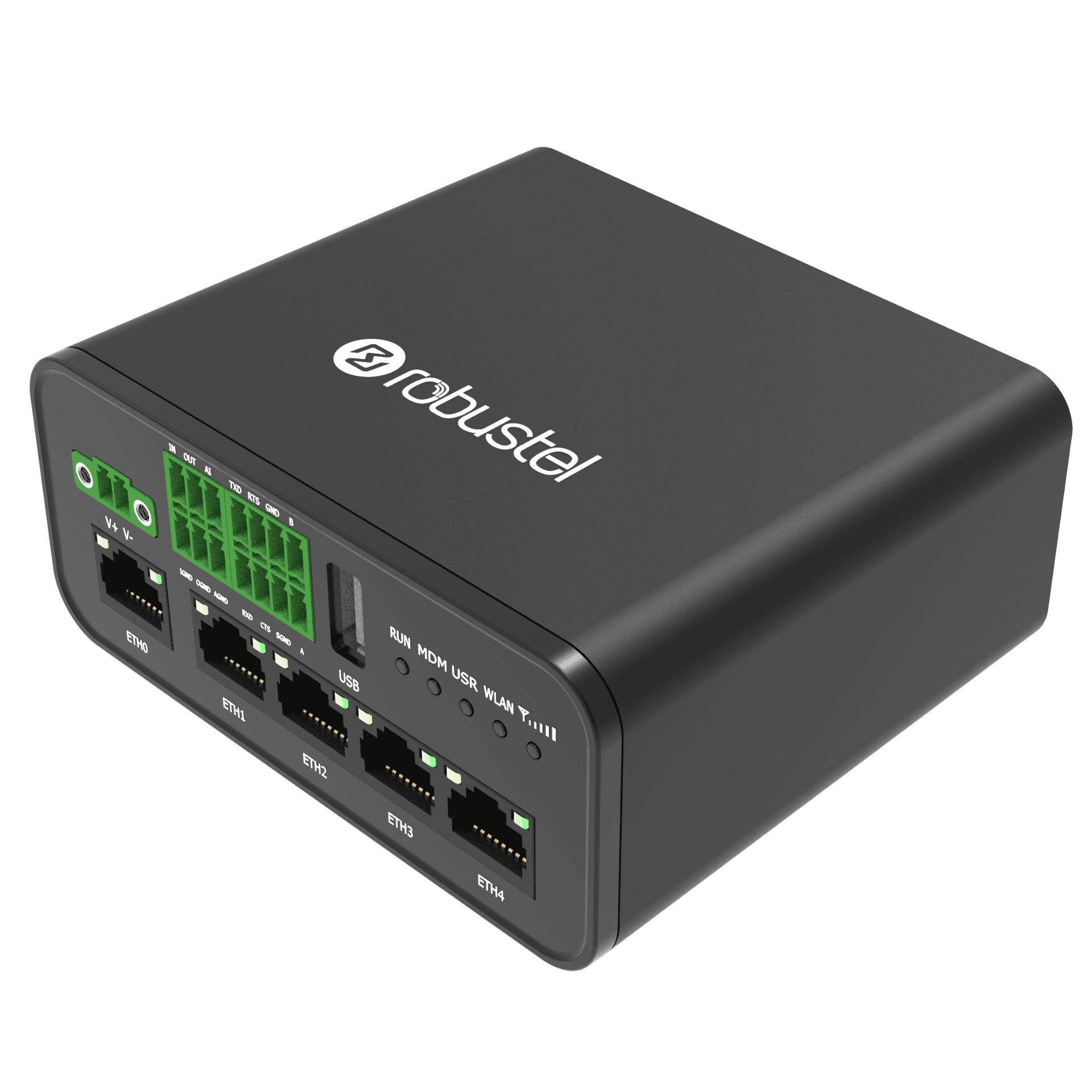
Routeur Robustel R1520 4G/LTE
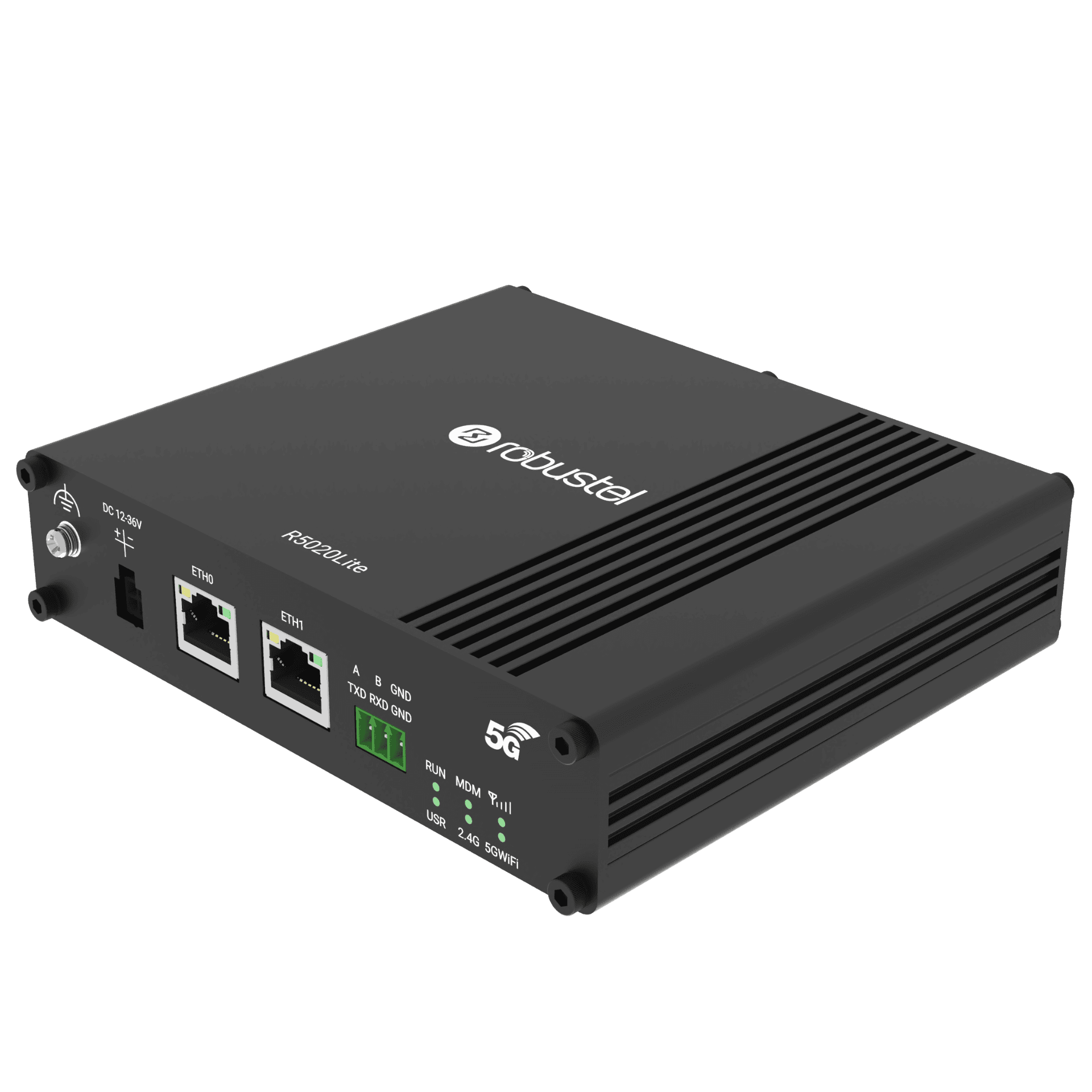
Routeur 5G Robustel R5020-Lite
Gestion des appareils RCMS Cloud

Parlez à un expert
If you are building a managed vehicle Wi-Fi, mobile internet or recreational connectivity service, Robustel can help you design a scalable 4G/LTE and 5G router architecture with remote management built in. Speak with our team about how the R1520, R5020-Lite and RCMS can support reliable mobile internet services across recreational, commercial and temporary operating environments.