
Elevator IoT Gateway Architecture: Voice, Telemetry, Remote Monitoring and Secure Access
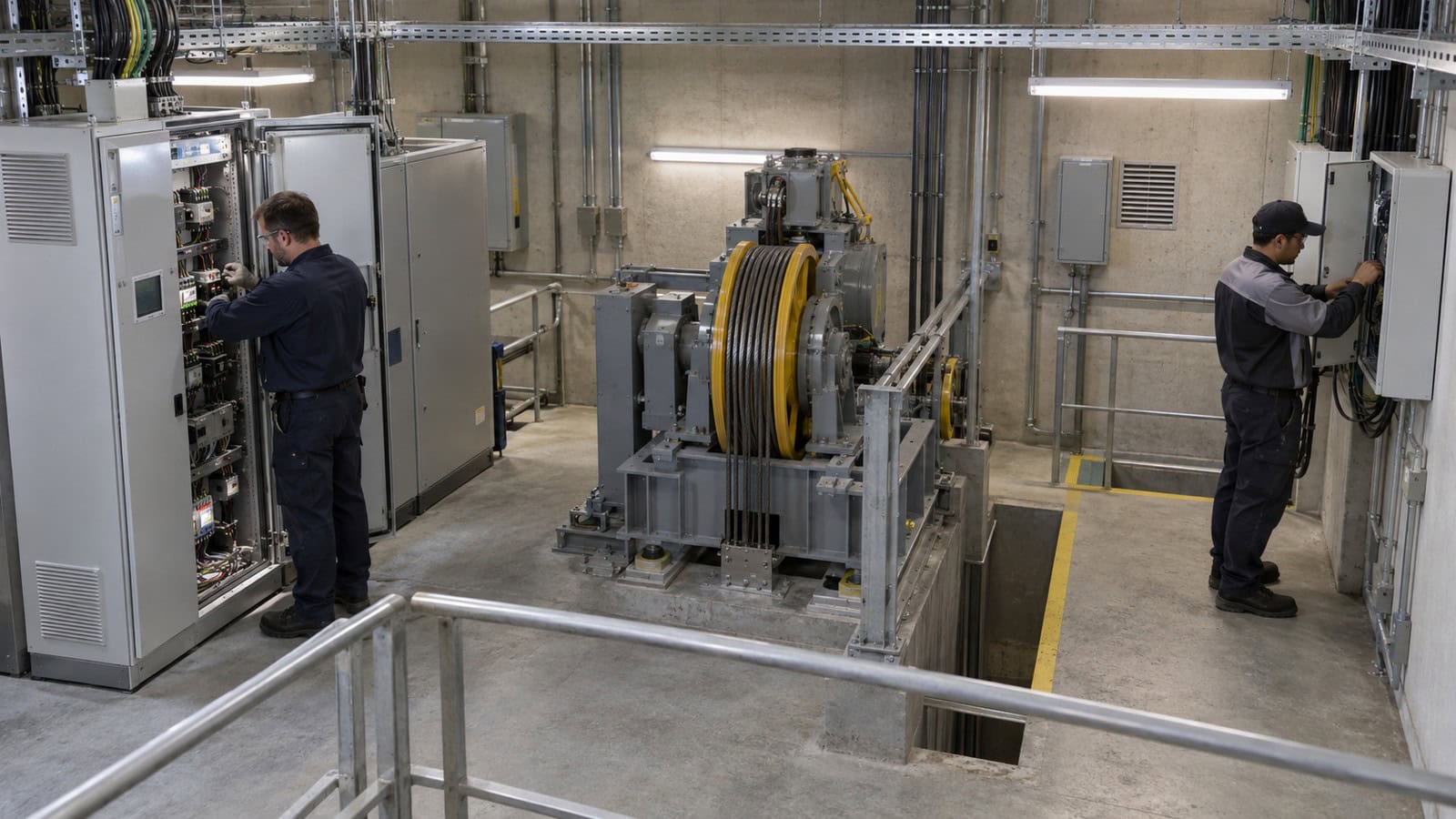
The Robustel EV8100 Industrial VoIP Gateway can place analogue emergency voice, cellular or SIP transport and approved lift data interfaces on one managed platform without treating them as one undifferentiated network. The architectural goal is not maximum connectivity; it is clear separation between the passenger call path, controller telemetry, maintenance access and gateway administration.
That separation makes fault diagnosis easier. When a lift call fails, the team should know whether the problem lies at the car phone, FXS interface, mobile or SIP service, destination or local power. When telemetry stops, the event should not automatically be interpreted as a voice failure.
Draw Trust Zones Before Drawing Data Flows
Use at least four logical zones: the lift safety equipment, the voice service, the controller or sensor data source, and the remote operations environment. A fifth zone may be needed when a building LAN or third-party cloud platform sits between the gateway and service provider.
Each boundary needs a named interface and an owner. Avoid diagrams that show a general line from “lift” to “cloud”; they hide whether the connection is FXS, serial, CAN, digital input or Ethernet and whether information can travel in one or both directions.
| Boundary | Permitted purpose | Evidence required before connection | Default caution |
|---|---|---|---|
| Lift phone to gateway | emergency voice | electrical/interface compatibility and witnessed calls | do not alter passenger operation without approval |
| Controller to gateway | approved telemetry | OEM protocol and point-list approval | prefer read-only scope initially |
| Gateway to monitoring centre | call delivery and identity | route, codec/dial plan and operator acceptance | test each relevant failure state |
| Gateway to service platform | telemetry and management | authentication, destination and retention policy | minimise exposed services |
| Technician to gateway | controlled maintenance | named users, approved access route and logging | avoid shared permanent credentials |
Preserve a Dedicated Voice Logic
The emergency call begins with the device in the lift car. Robustel EV8100‘s FXS port can present an analogue line interface to suitable legacy equipment, while the upstream service may use VoLTE or SIP/VoIP. This preserves a familiar local interface without pretending that the upstream network is still copper PSTN.
Document how the monitoring centre identifies the site and car. Caller ID, destination routing and operator records have to agree. A successful call to a technician’s mobile does not prove that the production monitoring workflow can identify and handle an emergency.
Where SIP is used, verify registration, authentication, DTMF handling, audio behaviour and recovery after a WAN or service interruption. Where VoLTE is used, confirm the selected SIM, operator service and installed antenna support the required calling behaviour. In either design, commissioning should include calls from the actual lift car.
Robustel’s PSTN elevator emergency-phone replacement Application Example provides a useful view of the two voice paths. It is a reference architecture rather than evidence that a particular monitoring centre has accepted a project configuration.
Add Telemetry Through an Approved Point Contract
An elevator IoT project should start with questions maintenance staff can act on. “Is the car unavailable?”, “Has a named alarm input changed?” and “Has communications been lost?” are more useful than collecting every accessible register without a response plan.
Robustel EV8100 Industrial VoIP Gateway provides RS-232, RS-485, CAN, Ethernet and four wet-contact digital inputs. The exact data available depends on the connected controller or approved sensors. Protocol documentation, electrical characteristics, isolation requirements and controller warranty conditions belong in the integration file.
For each point, specify normal state, alarm state, update interval, timestamp source and behaviour when the source is unavailable. If a dashboard cannot distinguish a genuine zero from stale or missing data, remote monitoring can create false confidence.
Robustel’s IoT-enabled smart elevators Application Example illustrates how gateway connectivity can support voice and operational data. It does not establish universal lift-controller compatibility or authorise command functions.
Keep Remote Access Narrow and Recoverable
Remote access should follow a defined maintenance task, not exist as a broad route into the lift environment. Name the system a technician needs to reach, the identity used, the approval process, the session record and the person who can revoke access.
RobustVPN within the RCMS ecosystem can support managed remote connectivity, but the network design still needs policy. Place the gateway and any connected equipment into explicit address and trust zones; expose only required services; and prevent a route to the wider building network unless it is deliberately approved.
The most revealing test is replacement. Install a clean spare or factory-state unit and measure whether authorised staff can restore network settings, voice configuration, certificates and telemetry mapping from controlled records. If recovery depends on one engineer’s laptop, the architecture is not yet operationally secure.
How the Robustel EV8100 Industrial VoIP Gateway Separates Voice and Elevator IoT Responsibilities
Robustel EV8100 Industrial VoIP Gateway combines one FXS port, dual SIM cellular capability, two Fast Ethernet ports and industrial data interfaces on RobustOS Pro. The ANZ A34AU variants are listed with RCM, while the B variant adds the documented Wi-Fi and Bluetooth option. Choose an exact order code rather than treating optional interfaces as standard.
For voice, the published SIP features include RFC 3261 over UDP, SIPs, SRTP and several DTMF modes. For gateway management, RCMS, web, CLI and SMS are documented. These capabilities support an engineered design, but the project still owns credential policy, certificate handling, destination configuration and ongoing tests.
Local input power is 9–30 V DC, and the device includes a holder for compatible flat-top 18650 batteries that are not supplied by default. The battery system should be selected and tested against the lift site’s temperature and autonomy requirement; it should not be described as an automatically complete backup-power solution.
The Robustel EV8100 Quick Pitch video can orient voice, IT and lift teams before design review. The review should then replace every generic arrow with the real interface, owner and failure response.
Commission by Breaking One Boundary at a Time
Begin with the normal emergency call and verify voice, destination and identity. Then remove the preferred cellular service or IP path as applicable and observe the designed response. Disconnect normal power and repeat the call at the required point in the backup period.
Next, interrupt the telemetry source while leaving voice intact. The remote platform should show that data is unavailable without presenting the condition as a healthy lift. Restore the source and confirm timestamps and event order remain useful.
Finally, revoke a technician’s access and recover a replaced gateway. Those two tests show whether remote access is genuinely controlled and whether the configuration can survive staff turnover or hardware failure.
Interface approval checklist
- exact lift controller and firmware identified;
- OEM-approved protocol or physical point list attached;
- direction of data flow and command capability stated;
- voice operation shown to remain independent of telemetry failure;
- addressing, credentials and certificate owner recorded;
- expected behaviour for WAN, SIM, power and source-data loss tested; and
- change and rollback procedure accepted by the lift service provider.
Foire aux questions
Q1. What does an elevator IoT gateway do?
It connects approved lift or sensor data to remote applications and may provide managed communications. Its role depends on the interfaces and software implemented; it does not automatically replace the lift controller or emergency phone service.
Q2. Can elevator monitoring use the same gateway as the emergency phone?
It can when the gateway and system design support both, but voice and telemetry should remain distinct services with separate tests, alarms and ownership. A telemetry fault should not be allowed to hide a voice-path fault.
Q3. Is remote access to a lift controller safe?
It can be controlled safely only with OEM approval, restricted network scope, named identities, logging and a tested revocation process. Read-only monitoring is often the appropriate first stage.
Q4. Which lift data should be monitored remotely?
Choose data tied to an operational decision, such as a defined alarm, availability state or communications health. Confirm the source and meaning with the lift OEM before using it for maintenance decisions.
Q5. Which interfaces does the Robustel EV8100 Industrial VoIP Gateway provide for elevator IoT?
It documents FXS, Ethernet, RS-232, RS-485, CAN, digital inputs and a relay, alongside cellular connectivity. Actual controller compatibility and every telemetry point require project-specific approval and validation.
Conclusion
The Robustel EV8100 Industrial VoIP Gateway supports an elevator IoT architecture in which emergency voice, approved telemetry, remote access and gateway management share a platform but retain clear trust and failure boundaries. Its value is strongest when the project needs both an analogue phone interface and managed cellular/IP connectivity without extending an uncontrolled corporate LAN into the lift environment.
The design should remain deliberately conservative around the controller. Use only approved interfaces and points, begin with read-only outcomes where practical, and treat every remote route as something that must be limited and revoked. The gateway can carry and manage communications; the lift OEM and responsible service organisations still define what may be connected and how safety functions are verified.
Before rollout, commission the architecture by breaking voice, telemetry, WAN, power and access boundaries separately. A design is ready to scale when the team can explain each resulting alarm, preserve the passenger call path and restore a replacement unit from controlled records.
Explore More Articles About Robustel Lift Connectivity


À propos de l'auteur
Robert Liao | Technical Support Engineer
Robert is an IoT Technical Support Engineer at Robustel, specializing in industrial networking and edge connectivity. A certified Networking Engineer, Robert focuses on the deployment and troubleshooting of large-scale IIoT infrastructures. His work centers on architecting reliable, scalable system performance for complex industrial applications, bridging the gap between field hardware and cloud-side data management.