
4G Lift Phone Installation Checklist: Signal, Antenna, SIM and Call Testing
The Robustel EV8100 Elevator Voice Gateway provides the FXS, dual-SIM and VoLTE/VoIP boundary for a 4G lift phone retrofit, but installation acceptance depends on RF at the final antenna, compatible analogue signalling, stable power and a supervised call from the lift to the intended monitoring centre. Complete this work with the authorised lift and electrical personnel under the site’s safety procedure.
Before Arriving on Site
- Confirm the applicable AS 1735 and project requirements with the responsible parties.
- Record building, lift/car, existing phone or autodialler, monitoring destination and current line behaviour.
- Select the exact EV8100 regional order code and confirm bands, RCM status and intended mobile service.
- Obtain approved SIM/APN or SIP details, caller identity and monitoring-centre test window.
- Bring the specified power supply, approved batteries where required, antennas, cables, mounting hardware and test record.
Do not rely on a generic “4G SIM”. Data activation does not establish VoLTE service, and carrier acceptance can depend on the specific profile and device combination.
The Robustel EV8100 Quick Pitch video below is useful pre-job orientation for the installer and monitoring team. Follow it with the current hardware and software manuals, the approved project method statement and the exact site test record; those documents govern the work on the day.
Survey Signal With the Building in Its Normal State
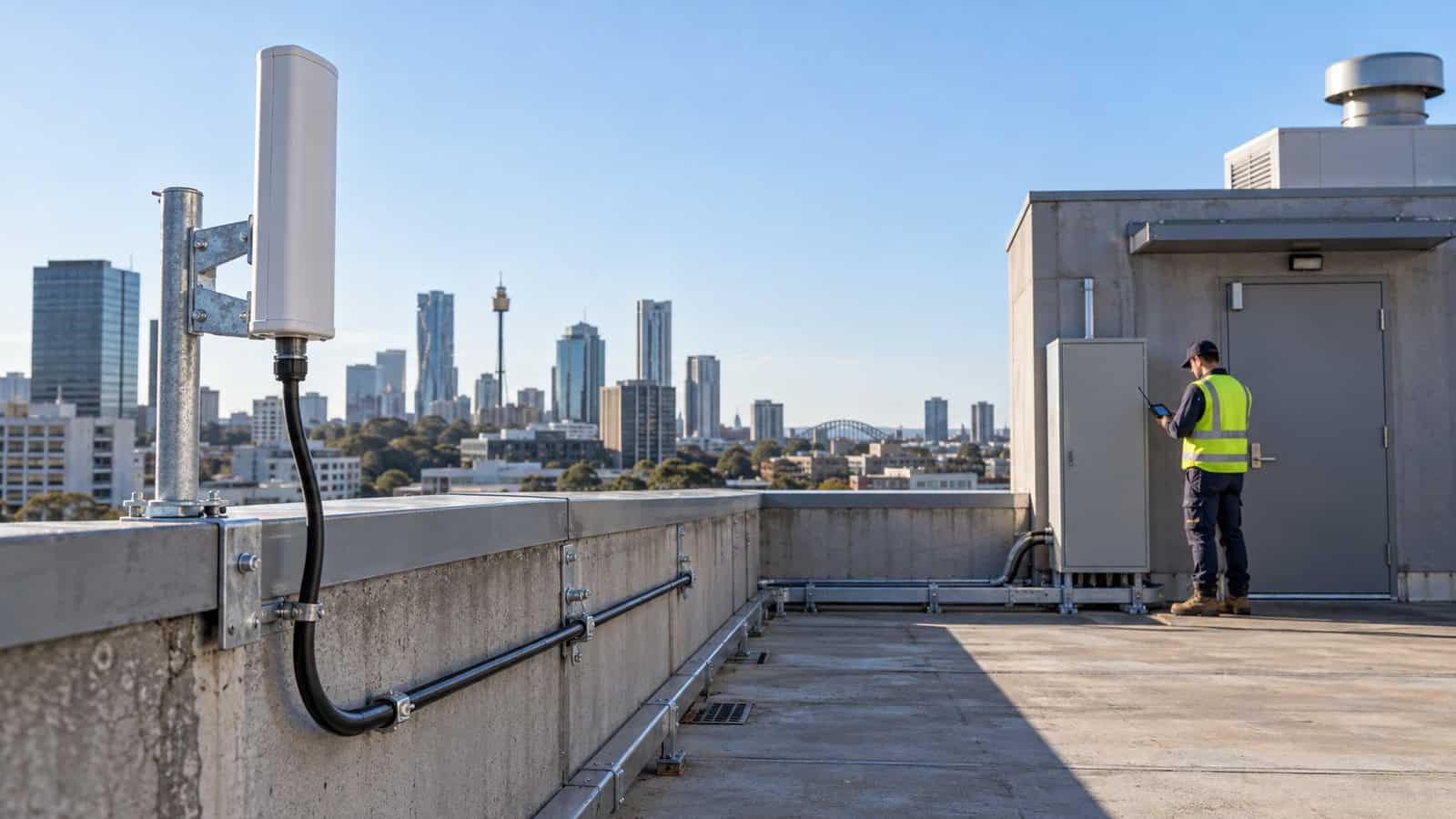
Measure at candidate antenna positions with machine-room doors, cabinet covers and lift operating conditions representative of service. Basements, shafts, reinforced concrete and metal panels can create large changes over a short distance. Keep the antenna away from noisy conductors and provide mechanical protection and strain relief.
The Robustel EV8100’s RSSI indication is useful for placement, but an LED cannot prove call setup, audio or network stability. Record radio metrics available through the system and complete repeated supervised calls from relevant car positions.
Robustel’s PSTN replacement application example illustrates the intended migration path from an analogue phone through the EV8100 to mobile or IP voice. The installation test must still qualify the actual building and service.
Install Power, Gateway and FXS Deliberately
The Robustel EV8100 elevator voice gateway accepts 9–30 VDC and supports DIN-rail, wall or desktop mounting. Confirm source capacity, protection, polarity and isolation; route low-voltage, antenna and phone wiring according to the project rules. Maintain access to indicators, SIMs, battery holder and terminals.
Before moving the existing line, photograph and label TIP/RING and any parallel equipment. Robustel EV8100 FXS boundary is documented at -48 VDC loop voltage, up to 20 mA loop current and 800 ohms maximum loop resistance. Measure or verify the installed line and phone rather than assuming every analogue device behaves alike.
Physical handover checks
| Item | Pass evidence |
|---|---|
| Mounting | Secure, accessible, labelled |
| DC supply | Voltage under normal and call load |
| Antennes | Final position, cable and connector record |
| FXS | Correct pair, seizure, dial and clear |
| Batteries | Approved model, position, date and condition |
| SIMs | Identity, service, owner and fallback policy |
Activate the Voice Service Before Testing Failover
Confirm registration for the intended primary voice method. For VoLTE, verify outgoing call routing and presented identity on the selected network. For SIP, verify server reachability, authentication, codec and DTMF behaviour. Call the monitoring centre and confirm the exact building and car record.
Only then test alternate SIM or voice-path behaviour where it forms part of the approved design. Note the observed transition and redial process. Avoid saying the call is “redundant” when gateway, antenna, power or monitoring destination remain shared.
Our smart-elevator application example shows emergency voice coexisting with selected telemetry through one managed gateway. Keep the voice and data acceptance records separate: a healthy telemetry session can help diagnosis, but only the supervised call proves that the passenger-to-monitoring-centre path works.
How the Robustel EV8100 Elevator Voice Gateway Supports a Repeatable 4G Installation
The Robustel EV8100 elevator voice gateway combines one FXS interface, dual SIM, VoIP/VoLTE support, two Ethernet ports and industrial interfaces with Robustel RCMS device management. That gives installers a common hardware and remote-status platform while allowing the lift phone and monitoring-centre workflow to remain familiar where they are compatible.
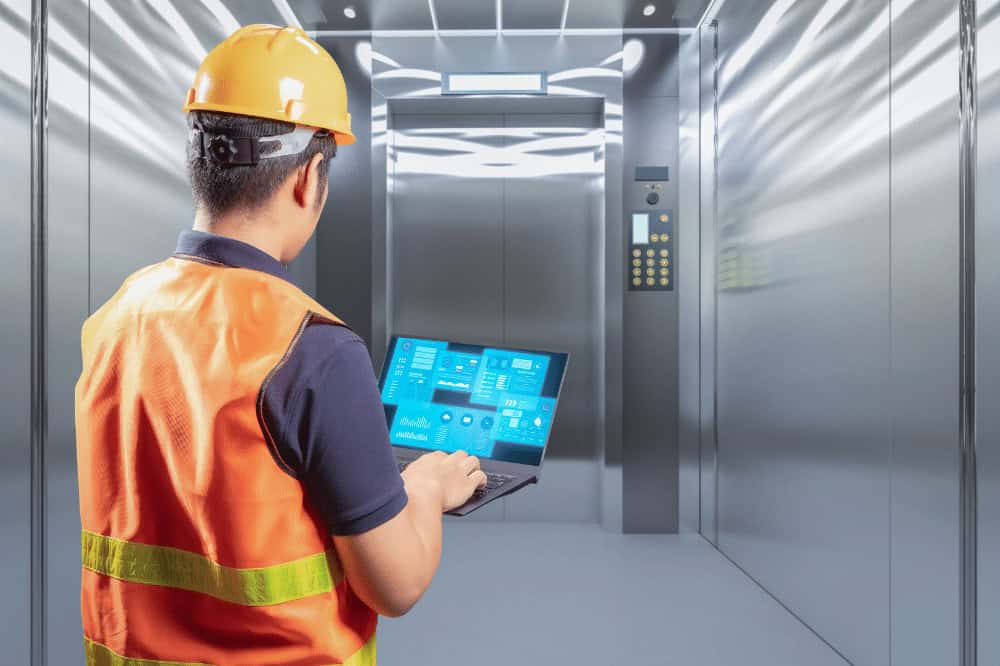
Place normal calls from the approved lift positions. Confirm two-way audio, identity, operator response and clearing. Remove mains using the authorised method, repeat the call on battery and observe recovery after power returns. Test the agreed loss-of-network or alternate-path scenario without disrupting live emergency service.
Save the serial number, firmware, SIM identifiers, antenna location, RF evidence, phone model, voice settings, battery record and signed call results. Close temporary accounts and remove unused test routing. A future engineer should be able to understand the installed call path without guessing from cable colours.
Foire aux questions
Q1. Where should a lift phone antenna be installed?
Place it where the approved survey and supervised calls show usable service, with suitable separation, cable protection and access. The best location is often outside a metal cabinet or RF-shielded machine space.
Q2. Does a 4G lift phone need a special SIM?
It needs a service accepted for the intended voice method, regional bands and operational contract. A data-only SIM does not prove VoLTE calling.
Q3. Can signal bars prove an emergency phone works?
No. They help diagnose RF, but only a completed supervised call proves routing, caller identity, two-way audio and monitoring-centre response.
Q4. Who should install a 4G lift phone gateway?
Work should be coordinated and performed by appropriately authorised lift, electrical and communications personnel under the site’s safety and compliance procedures.
Q5. What should be commissioned on the Robustel EV8100 Elevator Voice Gateway?
Commission power, batteries, antenna and mobile service, FXS compatibility, DTMF/caller identity, normal and power-loss calls, alternate paths where approved, RCMS status and the complete handover record.
Conclusion
The Robustel EV8100 Elevator Voice Gateway gives installers a consistent 4G/VoIP migration platform, yet every building still presents a unique combination of RF, wiring, power and monitoring-centre behaviour. Installation is complete only when the supervised call succeeds from the real lift under normal and mains-failure conditions.
Leave the next service engineer an as-built path and witnessed evidence, not a photograph of signal LEDs. That is the difference between fitted hardware and an accepted emergency communication service.
Explore More Articles About Robustel Lift Connectivity


À propos de l'auteur
Robustel Editorial Team
The Robustel Editorial Team publishes practical articles on industrial connectivity, edge computing, LoRaWAN and device management, focusing on deployment considerations, technical limitations and long-term operation.