
Scaling Managed 5G FWA: How MSPs Can Drive ROI and Slash OpEx in 2026
The shift from 5G FWA as a “product” to a “Managed Service” is the single most important evolution for modern service providers. In this guide, we explore how to break through the scalability wall by moving away from reactive hardware sales and toward a proactive, high-margin connectivity-as-a-service model.
By orchestrating high-performance CPE with cloud-native management, MSPs and WISPs can finally deliver fiber-like reliability without the traditional operational overhead.
Core Insights for Service Providers:
- The Scalability Pivot: Why “Managed” 5G is the only way to deploy thousands of nodes without an exponential increase in operational costs (OpEx).
- The Orchestration Engine: How RCMS enables Zero-Touch Provisioning (ZTP) and remote fleet management, eliminating the need for costly “truck rolls.”
- Hardware Synergy: Why the move to Wi-Fi 6 (802.11ax) in devices like the R5030 is critical for maintaining SLAs in high-density business and transit environments.
- New Revenue Streams: Identifying the most lucrative applications, from
- Failover-as-a-Service (FaaS) to managed transit Wi-Fi, that drive recurring monthly revenue (RMR).
Introduction: The Scalability Wall—Why 5G FWA Must Be “Managed”
In my recent conversations with Wireless ISPs (WISPs) and Managed Service Providers (MSPs) worldwide, the enthusiasm for 5G Fixed Wireless Access (FWA) is undeniable. We’ve finally reached the point where wireless can deliver genuine fiber-like performance. However, beneath the excitement lies a persistent, high-stakes anxiety: “This works for one site, but how do I deploy and maintain a thousand nodes without my operational overhead exploding”?
It’s a valid concern. Any business model that relies on “truck rolls”—sending a technician to a customer site for every minor configuration tweak or connection glitch—is inherently broken. It’s a logistical bottleneck and a financial drain that kills your margins.
Let’s be clear: the future of this industry isn’t just about the 5G signal; it’s about Managed 5G FWA. The difference between the two is the difference between a high-maintenance experiment and a profitable, scalable enterprise service. In this guide, we’ll break down the architecture required to turn 5G FWA into a seamless managed service.
From Hardware to Outcome—The Evolution of 5G FWA
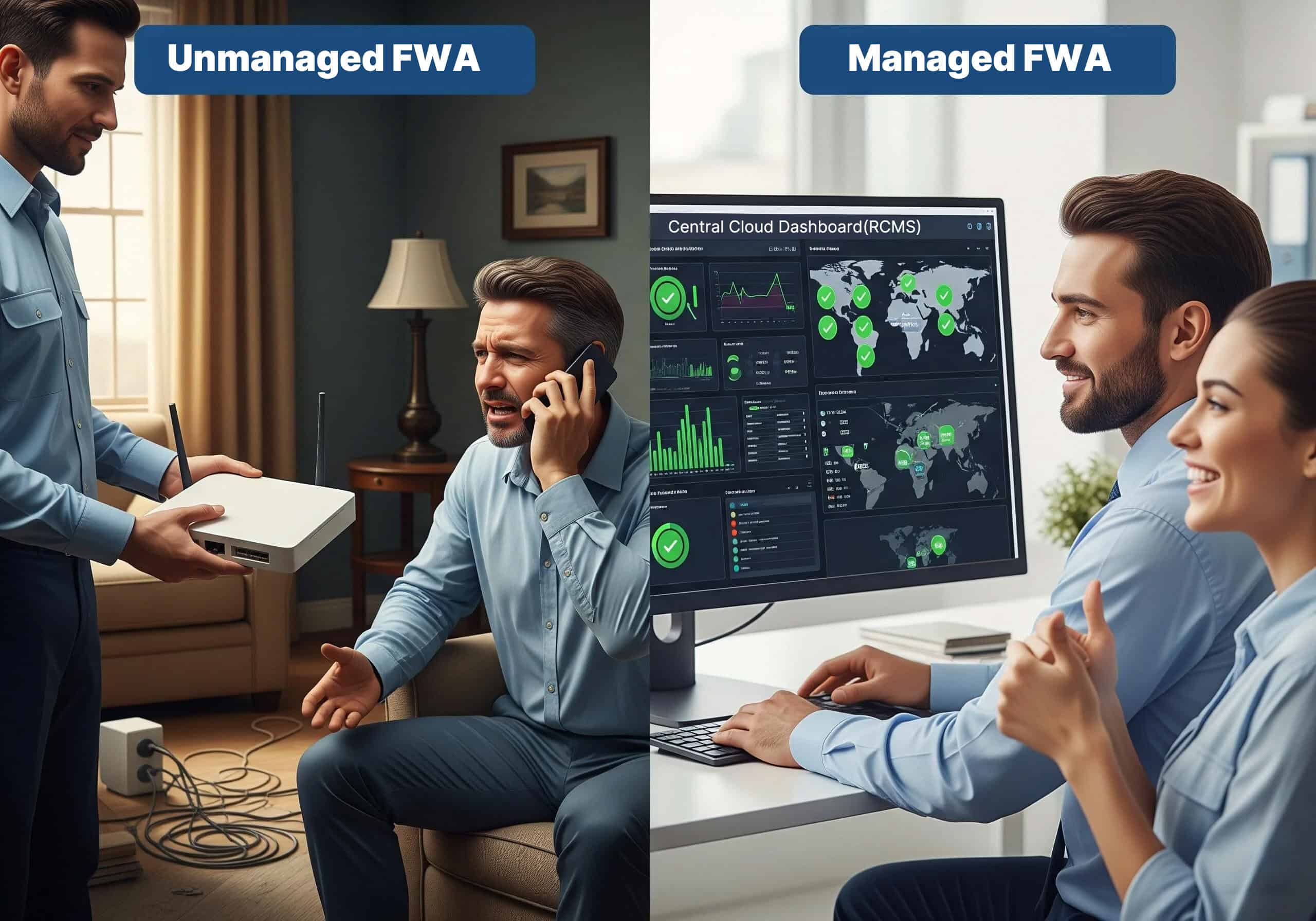
To understand why “Managed” is the only path forward, we have to look at how the delivery model has evolved. The traditional approach is built around selling a “box” (the router) paired with a data plan. In this reactive model, if a connection drops, the customer calls to complain, and you are forced to deploy a technician. It is a cycle of inefficiency that erodes your bottom line.
Managed 5G FWA flips this script. You are no longer just shipping hardware; you are delivering a comprehensive, monitored, and proactive connectivity service.
This evolution shifts the focus from the device to the outcome:
- For the Customer: They receive a high-performance connection backed by a guaranteed Service Level Agreement (SLA). They aren’t buying a router; they are buying 99.9% uptime.
- For the Provider: You gain a high-margin, scalable business model. By leveraging cloud-based orchestration, you can resolve issues remotely—often before the customer even notices—slashing your operational costs and eliminating unnecessary truck rolls.
The Engine of Scalability—Cloud-Native Orchestration
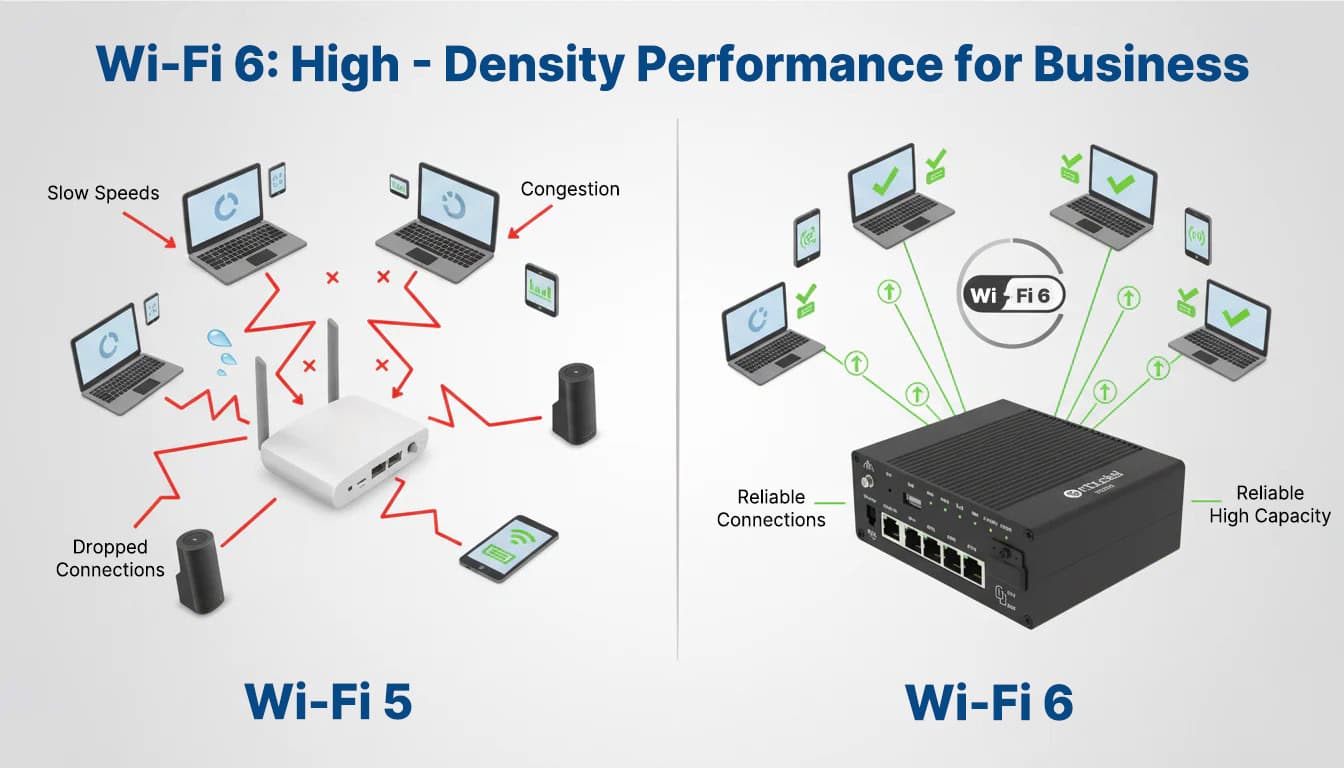
How do you bridge the gap between “one successful site” and “one thousand profitable sites”? The answer lies in the sophistication of your management architecture. For leading service providers, the real “aha!” moment is discovering how a platform like Robustel Cloud Manager Service (RCMS) transforms from a simple utility into the high-speed engine of their entire operation.
1. Zero-Touch Provisioning (ZTP): Scaling Without Friction
Scaling shouldn’t be synonymous with hiring more technicians. With ZTP, you can ship a 5G Industrial Router (like the R5030) directly to the customer’s doorstep. The moment they power it up, the device autonomously check-ins with RCMS, pulls its pre-defined configuration and security certificates, and goes live in minutes.
The Business Impact: You eliminate manual staging and onsite setup costs, allowing you to onboard hundreds of new subscribers simultaneously.
2. Real-Time Visibility: Moving from Reactive to Proactive
The RCMS dashboard serves as your “mission control.” Instead of waiting for a support ticket, your team has a live view of the entire network’s health. By monitoring 5G signal-to-noise ratios, data consumption patterns, and latency in real-time, you can identify a degrading link and optimize it before the customer’s service is even impacted.
3. Remote Orchestration: Killing the “Truck Roll”
In the managed service world, a technician’s van is a cost center. When a complex issue arises, RCMS allows your support engineers to securely access the device’s web GUI or CLI via RobustVPN from your central office. Solving 95% of connectivity issues remotely is the single most effective way to protect your margins.
4. Fleet-Wide Lifecycle Management
Security is a continuous process, not a one-time setup. With RCMS, pushing critical security patches or firmware updates across your entire global fleet is a single-click operation. This ensures that every node in your Managed 5G FWA network remains compliant, secure, and optimized with the latest feature sets.
The Edge Performance Pillar—Why Hardware Choice Dictates Service Quality
If the cloud platform is the “brain” of your operation, the Customer Premises Equipment (CPE) is its “muscle.” To your customer, the physical router is the only tangible part of your service; therefore, its performance is your service’s reputation. This is exactly why we engineered the Robustel R5030—not just as another router, but as a high-performance terminal designed to uphold the most demanding Service Level Agreements (SLAs).
For a premium Managed 5G FWA offering, the R5030 serves as the ideal anchor by focusing on two critical performance vectors:
1. Future-Proofed 5G Throughput
By leveraging the latest 5G NR standards, the R5030 maximizes spectrum efficiency. For a service provider, this means delivering the “fiber-like” speeds you promised, even at the edge of cell towers where legacy hardware might struggle.
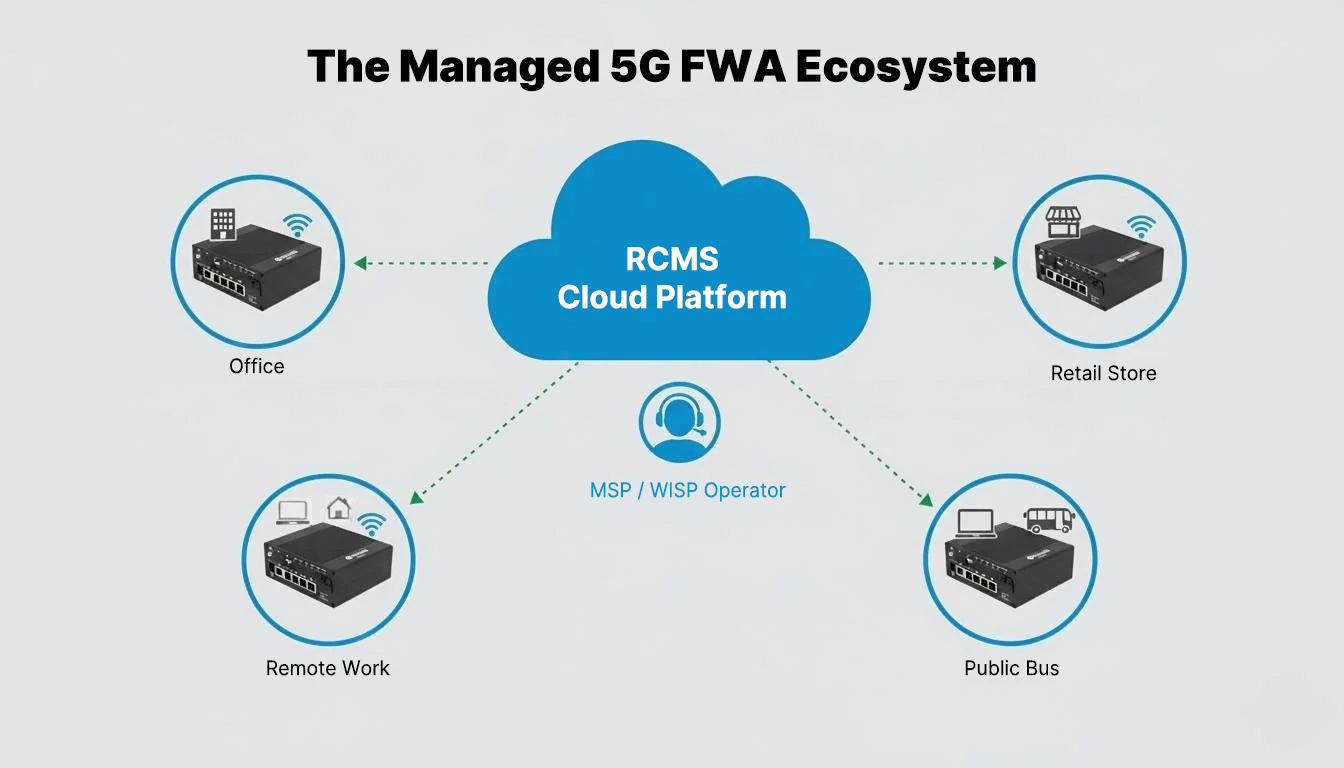
2. Wi-Fi 6 (802.11ax): Solving the High-Density Bottleneck
The move to Wi-Fi 6 is a strategic upgrade for any Managed 5G service. Unlike older standards, Wi-Fi 6 is built for high-density environments.
- The Scenario: In a busy medical clinic, a modern co-working space, or a retail flagship during peak hours, dozens of devices fight for bandwidth simultaneously.
- The Advantage: Wi-Fi 6 utilizes OFDMA and MU-MIMO to handle massive concurrent connections without the “latency spikes” that plague older networks. This ensures that your managed service feels snappy and reliable to every end-user, regardless of the device count.
Unlocking High-Margin Revenue Streams with Managed 5G FWA
When you combine a carrier-grade cloud platform with high-performance CPE, you aren’t just selling “internet”—you are creating a portfolio of specialized, high-margin services. From my field experience, here are the three most lucrative applications for a Managed 5G FWA offering today:
1. The Managed Fiber-Alternative
In underserved industrial zones or rapidly expanding suburban areas, trenching fiber is often too slow or too costly.
- The Opportunity: MSPs can now deploy a “managed-from-day-one” primary connection that competes directly with leased lines.
- The Advantage: By bundling the R5030 with your own SLA-backed support, you provide an enterprise-grade experience that consumer-grade FWA simply cannot match.
2. Failover-as-a-Service (FaaS)
Enterprises with hundreds of branch offices—such as retail chains or bank branches—cannot afford a single minute of downtime.
- The Opportunity: Instead of a simple backup router, you offer a fully managed and monitored 5G failover solution.
- The Advantage: With RCMS, you can guarantee that the backup link is always “warm” and secure. The enterprise pays for the peace of mind that comes with a managed SLA, transforming a simple hardware sale into a recurring service contract.
3. Managed Transit & Passenger Connectivity
Modern transit operators are under pressure to provide more than just basic Wi-Fi; they need secure, high-density portals.
- The Opportunity: Use the R5030’s Wi-Fi 6 capabilities paired with the RCMS Captive Portal manager to deliver a premium passenger experience on buses, trains, or ferries.
- The Advantage: You can remotely manage advertising, user authentication, and data limits across an entire fleet. This turns connectivity into a managed asset that can be monetized or used to drive passenger loyalty scores.
Conclusion: Scaling the Edge—The Future of Managed Connectivity
Managed 5G FWA is more than just a technology upgrade; it is the strategic framework that unlocks the true commercial potential of fixed wireless technology. By shifting the focus from “selling a device” to “orchestrating a service,” MSPs and WISPs can finally overcome the scalability wall that has historically limited wireless deployments.
The path to a profitable 5G era requires a seamless hardware-software synergy. The combination of next-generation CPE, such as the Robustel R5030, and a robust cloud orchestration platform like RCMS, provides the complete toolkit necessary to build a resilient, high-margin connectivity business.
As the digital landscape evolves, the winners will be those who prioritize operational automation and proactive service delivery. With the right infrastructure in place, you aren’t just providing internet—you are building the reliable, scalable backbone that powers the modern enterprise.
Curious about the global 5G rollout? Discover how Robustel and GSL are paving the way for 5G adoption in Türkiye.
Häufig gestellte Fragen
Q1: Who is Managed 5G FWA for?
A1: While any business can benefit, the “managed” model is specifically designed for Managed Service Providers (MSPs) , Wireless Internet Service Providers (WISPs) , and larger enterprises that need to manage their own connectivity across many sites. It’s a platform for delivering a service, not just using a connection.
Q2: What is Wi-Fi 6 and why does it matter for FWA?
A2: Wi-Fi 6 (802.11ax) is the latest generation of Wi-Fi. Its biggest advantage is its ability to handle a much higher density of connected devices much more efficiently. For an FWA deployment in a business office, retail store, or on a bus where dozens of people are connecting at once, Wi-Fi 6 ensures a smooth, fast experience for everyone, which a Wi-Fi 5 router would struggle with.
Q3: Can I manage customer data plans and get alerts through RCMS?
A3: Yes, absolutely. RCMS allows you to monitor the real-time and historical data usage of every single device. You can set customized alerts, so you are automatically notified if a customer is approaching their data limit. This is a crucial feature for any service provider managing data plans.
Über den Autor
Robert Liao | Technischer Support-Ingenieur
Robert Liao is an IoT Technical Support Engineer at Robustel, specializing in industrial networking and edge connectivity. A certified Networking Engineer, Robert focuses on the deployment and troubleshooting of large-scale IIoT infrastructures. His work centers on architecting reliable, scalable system performance for complex industrial applications, bridging the gap between field hardware and cloud-side data management.