
Edge Computing Applications in Industrial IoT: A Field-to-Workflow Map for Practical Deployment

Edge computing applications in industrial IoT are not all the same. A factory may use an edge gateway to collect PLC data for production visibility. A remote utility site may use edge processing to reduce unnecessary site visits. A BESS project may need selected equipment data from multiple site-side systems. An EV charging location may need gateway-level visibility, charger connectivity, and selected energy data paths.
All of these projects can involve edge computing, but they do not create the same engineering requirements.
That is why it is more useful to map industrial edge computing applications by the work the edge layer performs. In some projects, the edge gateway mainly collects data. In others, it prepares data, buffers it, generates local events, supports remote diagnostics, or forwards selected information to cloud platforms.
This article provides a practical map of common edge computing applications in industrial IoT. It also explains where an industrial edge gateway such as Robustel EG5120 may fit when projects require field-side data access, local processing, cellular connectivity, cloud forwarding, and remote management through RCMS.
Edge Computing Applications Should Be Classified by Function
Industrial edge computing is often described through broad benefits: lower latency, reduced bandwidth, better reliability, and improved visibility. Those benefits are useful, but they are not specific enough for engineering decisions.
A more practical way to classify edge computing applications is to ask what the edge layer is actually doing at the site.
In industrial IoT projects, the edge layer usually performs one or more of the following functions:
| Edge function | What it means in practice |
| Data access | Connecting to PLCs, meters, sensors, controllers, chargers, BMS equipment, or other field-side systems |
| Data preparation | Mapping tags, converting protocols, filtering values, formatting data, or preparing selected information for upstream systems |
| Local resilience | Buffering selected data, handling temporary connection interruptions, or keeping site-side workflows more stable |
| Event generation | Turning raw signals into alarms, status changes, inspection events, machine states, or maintenance-related indicators |
| Remote visibility | Helping teams understand equipment status, gateway health, network conditions, and site-level operating information |
| Application hosting | Running selected edge applications, protocol bridges, data flows, analytics, or containerized workloads near the equipment |
This classification matters because two projects may both be called “edge computing,” but the gateway requirements can be very different. A simple telemetry project may only need data access and forwarding. A factory integration project may need protocol handling and tag mapping. A remote asset project may need buffering, cellular backhaul, and fleet management. An AI-related project may need validated local inference and a clear model maintenance process. The application should define the edge requirements, not the other way around.
Industrial Edge Computing Application Map
The table below maps common industrial edge computing applications to their real site problem, typical edge role, and practical engineering considerations.
| Anwendung | Site problem | Edge role | Engineering considerations |
| Factory data collection | Production data exists inside machines, PLCs, meters, or local systems but is not easily visible outside the cell | Collect selected data, handle protocols, prepare values, forward useful data to upper-layer systems | PLC access, tag mapping, network segmentation, protocol support, data ownership, and avoiding interference with control logic |
| PLC-to-cloud workflows | PLC data is useful for dashboards or reporting, but direct cloud exposure is often impractical | Sit between PLC-side systems and cloud platforms to prepare and forward selected data | Data point selection, protocol conversion, buffering, cloud endpoint configuration, cybersecurity boundaries |
| Remote industrial asset monitoring | Sites are difficult to visit and may rely on cellular connectivity | Collect equipment status, buffer selected data, support remote diagnostics, forward alarms or summaries | Signal coverage, antenna installation, power stability, SIM strategy, remote access policy, site visit escalation rules |
| BESS remote monitoring | Multiple systems such as BMS, PCS, EMS, meters, and sensors produce different types of site data | Aggregate selected data paths and support remote visibility without replacing control or protection systems | System boundaries, data priority, cybersecurity, ownership between BMS/PCS/EMS/vendor systems |
| EV charging infrastructure | Operators need visibility into charger connectivity, site status, and related energy infrastructure | Support selected site-side data paths, gateway health visibility, and remote diagnostics where allowed | OCPP backend boundaries, charger controller role, meter data, payment system separation, site network design |
| Distributed energy and infrastructure sites | Multiple remote locations need centralized monitoring and maintainable connectivity | Provide a site-side layer for data access, cellular backhaul, event forwarding, and remote management | Fleet visibility, firmware updates, access control, lifecycle ownership, alarm design |
| Machine condition monitoring | Machine signals may indicate abnormal behavior, but raw values alone may not be actionable | Filter data, generate events, support selected analytics or anomaly indicators near the machine | Sensor placement, sampling needs, data quality, false alarms, maintenance workflow integration |
| Vision or inspection-related edge AI | Image or video data may be too heavy to send continuously to the cloud | Run selected local inference, send results, snapshots, counts, or events upstream | Lighting, camera position, model size, validation, inference frequency, model update process |
This map also shows why a single “edge computing application” label can be misleading. The same gateway platform may be used in different projects, but the reason for using it changes.
In one project, edge computing is mainly about protocol access. In another, it is about reducing raw data movement. In another, it is about maintaining visibility across distributed sites. In another, it is about running a local application near the equipment.
The engineering value comes from matching the edge function to the site problem.
Factory Data Collection: Making Production Data Usable
Factory data collection is one of the most common industrial edge computing applications. Machines, PLCs, sensors, meters, and local controllers may already generate valuable operational data, but that data is often locked inside local systems or exposed through protocols that are not directly ready for dashboards, MES-related workflows, or cloud platforms.
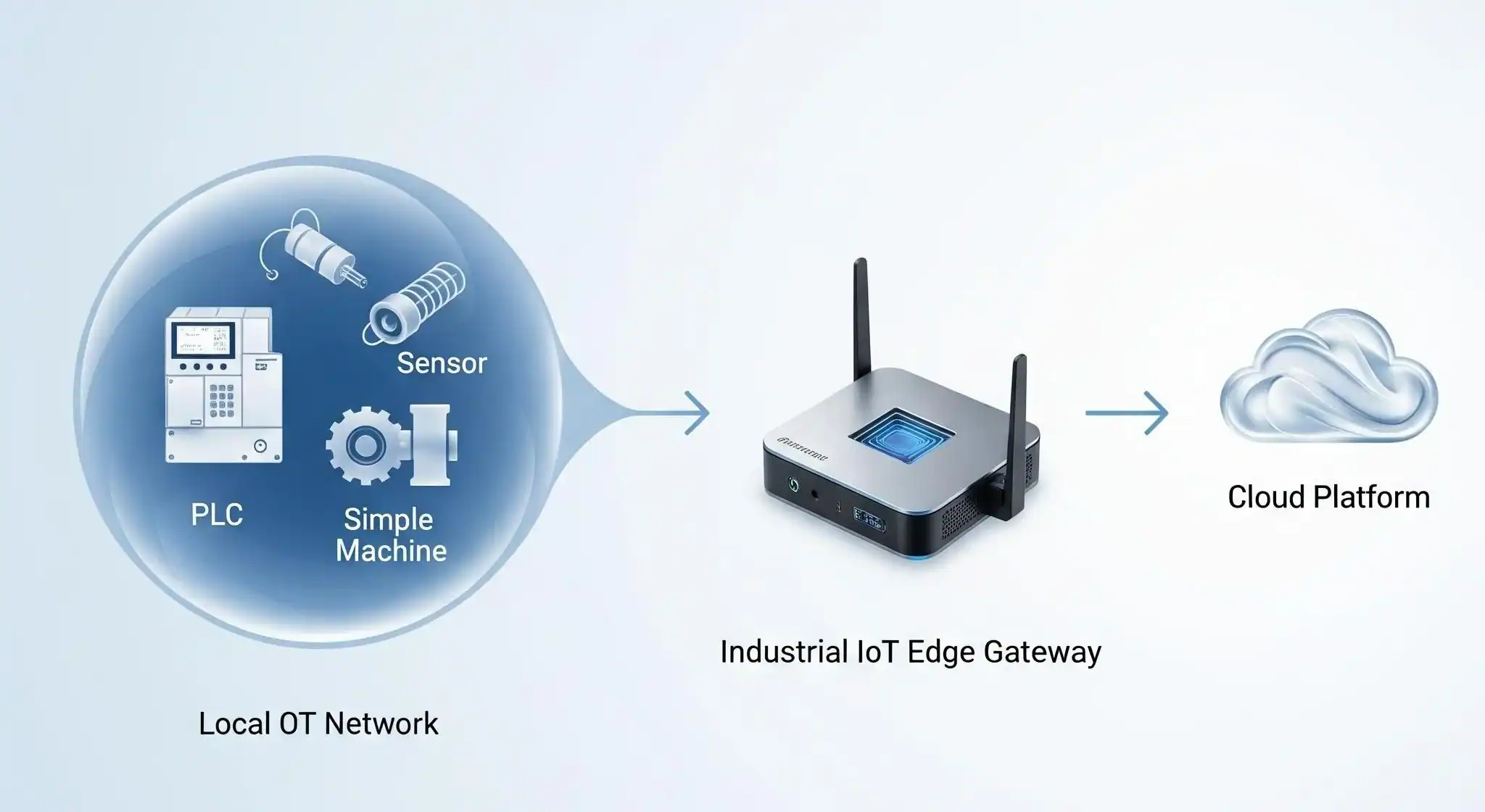
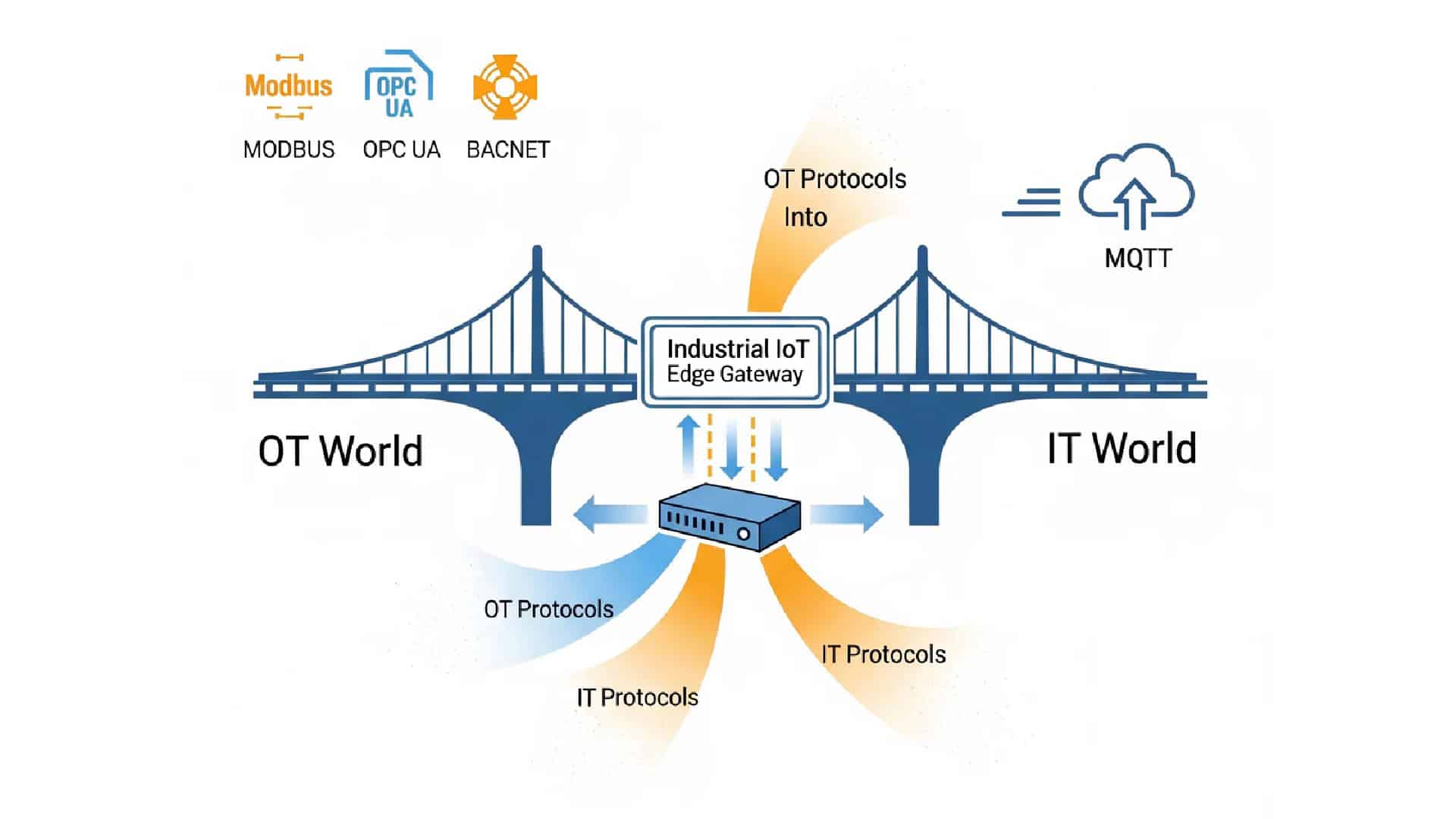
An edge gateway can provide a practical bridge between production equipment and upper-layer systems. Its role may include collecting selected PLC-side or machine-side data, converting protocols, mapping tags, filtering repeated values, buffering selected data, and forwarding useful information to a cloud platform or monitoring system.
The gateway should not interfere with PLC control logic or machine safety functions. Its value is in the data layer around the production process.
A common mistake in factory data collection is trying to collect too much too early. Not every PLC register or sensor value is useful for remote visibility. A stronger approach is to define the monitoring objective first: production status, energy usage, alarm visibility, downtime analysis, quality tracking, or maintenance planning. Once that objective is clear, the project team can decide which data points should be collected and how they should be represented.
For this application, edge computing is less about “moving intelligence to the edge” and more about making production data structured, accessible, and usable.

PLC-to-Cloud Workflows: The Middle Layer Matters
PLC-to-cloud communication is often described as if the only task is sending PLC data upward. In real projects, the difficult work happens in the middle.
PLCs are built for local control. Cloud platforms are built for storage, dashboards, analytics, and broader access. Between those two layers, the data usually needs preparation. Register values may need names, units, context, scaling, filtering, or mapping before they become useful to a remote system.
An industrial edge gateway can sit between the PLC-side network and the upstream platform. It can collect selected values, prepare them locally, and forward the right information through a defined path such as MQTT or another project-specific communication method.
The engineering risk is not only whether the gateway can connect. It is whether the project team knows which data should be sent, how often it should be sent, what happens during connection loss, and who maintains the data mapping after deployment.
A PLC-to-cloud project becomes more maintainable when the edge layer is treated as part of the data architecture, not just as a network accessory.
Remote Industrial Assets: Reducing Uncertainty Before Site Visits
Remote industrial assets create a different set of edge computing requirements. These sites may include utility cabinets, pumps, water facilities, roadside infrastructure, transportation equipment, energy assets, outdoor machines, or unmanned industrial equipment.
The problem is often not just data collection. It is uncertainty.
Is the device online? Is the cellular signal weak? Is the equipment reporting an alarm? Did the gateway lose power? Is the data path interrupted? Does the site need a technician, or can the issue be reviewed remotely first?
In this application, edge computing can support local data collection, connection status visibility, buffering during temporary network interruptions, remote diagnostics, and event-based reporting. Instead of sending every raw value continuously, the gateway may forward selected alarms, equipment status, gateway health information, or periodic summaries.
This does not eliminate field maintenance. Some failures still require physical inspection. But a well-designed edge layer can help teams understand the situation before deciding whether a site visit is necessary.
For remote asset monitoring, long-term maintainability is just as important as the initial connection. Teams should define how devices will be configured, monitored, updated, and troubleshot after installation.
BESS Remote Monitoring: Keeping System Boundaries Clear
Battery Energy Storage System projects often involve several site-side systems. Data may come from BMS, PCS, EMS, meters, thermal systems, protection devices, sensors, or local controllers. These systems do not all have the same purpose, and their data should not be treated as one flat stream.
An edge gateway can support BESS remote monitoring by collecting selected data, preparing it locally, and forwarding useful information to remote platforms. This may help operators view equipment status, alarms, meter readings, environmental information, or selected site conditions.
The most important engineering point is boundary control. The gateway does not replace the BMS, PCS, EMS, or protection systems. It supports the communication and monitoring layer around them.
This distinction matters because BESS sites can involve different owners, vendors, and responsibilities. A project may include battery system suppliers, PCS vendors, EMS providers, site operators, and remote monitoring teams. If data ownership and system boundaries are unclear, the gateway may become a point of confusion rather than a useful integration layer.
For BESS monitoring, edge computing is valuable when it improves visibility without blurring control, protection, or energy management responsibilities.
EV Charging Infrastructure: Monitoring the Site, Not Replacing the Charger Platform
EV charging sites may include chargers, meters, solar PV, battery storage, site controllers, routers, gateways, and remote service platforms. Operators may need visibility into charger connectivity, gateway health, site energy data, alarms, and related infrastructure status.
An edge gateway can support selected site-side data paths and remote diagnostics where the site design and access policy allow. It may also help monitor network conditions, device status, and related energy infrastructure.
However, an edge gateway should not be positioned as a replacement for the charger controller, OCPP backend, billing system, payment platform, or energy management logic. These systems have their own roles.
The edge layer is useful when the project needs better visibility into the physical site and its connected systems. For example, a charging operator may want to know whether a problem is related to charger communication, site networking, gateway connectivity, or another local condition.
In EV charging infrastructure, edge computing should support operational clarity. It should not create overlapping responsibilities between gateway management, charger management, billing, and user-facing services.
Distributed Energy and Infrastructure Sites: Making Many Small Sites Manageable
Distributed infrastructure projects often share the same operational challenge: many sites, limited physical access, variable connectivity, and multiple local systems that need some level of centralized visibility.
This can apply to renewable energy assets, roadside cabinets, water utilities, remote industrial stations, transportation infrastructure, and outdoor equipment deployments.
In these applications, the edge gateway becomes a site-side coordination layer. It may collect selected data from local systems, support cellular backhaul, buffer data during network instability, forward events, and give remote teams visibility into gateway status.
The value here is operational scale. One remote site may be manageable with manual effort. Hundreds or thousands of sites require a more disciplined approach to configuration, monitoring, firmware updates, access control, and troubleshooting.
This is where remote management becomes part of the application, not just an after-sales feature. Without a management workflow, distributed edge deployments can become difficult to support over time.
Where Robustel EG5120 and RCMS Fit Across These Applications
Across these industrial edge computing applications, the gateway layer has to do more than provide connectivity. It may need to access field-side data, run local workflows, support secure communication, maintain cellular backhaul, and remain manageable after deployment.
Robustel EG5120 may be suitable for projects where the application requires a site-side industrial edge gateway with local computing, industrial data access, Docker-based application support, cellular connectivity, and cloud-forwarding capability. Depending on the project configuration, it can be used in workflows involving PLC-side data, Modbus TCP/RTU devices, serial equipment, Ethernet-connected systems, MQTT-to-cloud data paths, and selected edge applications.
For projects involving distributed sites, RCMS can support visibility and management for Robustel gateway deployments. This matters when teams need to monitor device status, manage configurations, support remote access workflows, update firmware, and maintain gateway fleets after installation.
EG5120 should still be evaluated against the actual application requirements. Project teams should check interfaces, supported protocols, data volume, local workload, cellular coverage, cybersecurity policy, thermal environment, application support, and maintenance ownership.
The gateway provides the site-side platform. The application design defines what the platform should actually do.
What Engineers Should Check Before Choosing an Edge Computing Application Pattern
Before treating a project as an edge computing application, teams should confirm what problem the edge layer is expected to solve.
| Question | Warum es wichtig ist |
| What field equipment needs to be connected? | Interface and protocol requirements come from the actual equipment, not the application label |
| What data is useful upstream? | Sending everything can create noise, cost, and maintenance problems |
| What must happen locally? | Some tasks need site-side access, buffering, filtering, or event generation |
| What can safely remain in the cloud? | Dashboards, reporting, storage, and multi-site analysis often belong upstream |
| What should the gateway not control? | PLCs, BMS, PCS, EMS, chargers, and safety systems need clear boundaries |
| How will the system be maintained? | Configuration, firmware, data mapping, access control, and edge applications need ownership |
| What happens when connectivity is unstable? | Remote sites may need buffering, retry logic, or event-based reporting |
| Who uses the data after deployment? | Operators, maintenance teams, system integrators, and platform owners may need different outputs |
These questions help prevent a common problem: selecting an edge gateway before the application has been properly defined.
Edge computing works best when the project team can explain the site problem, the data path, the local task, the upstream destination, and the long-term support model.
What Edge Computing Applications Should Not Be Expected to Do
Edge computing can make industrial IoT workflows more practical, but it should not be treated as a shortcut around engineering design.
An edge gateway should not replace PLC control, safety logic, BMS functions, PCS control, EMS coordination, charger control, SCADA systems, MES platforms, or cloud analytics. It should support the data access, local preparation, communication, and management layers around those systems.
Edge computing also does not automatically make data meaningful. If tags are unclear, protocols are unsupported, sensor data is unreliable, or ownership is undefined, moving processing closer to the equipment will not solve the core problem.
The same applies to remote monitoring. A gateway can help teams see selected site data, device status, network health, or alarms. It cannot remove every site visit or resolve every field issue remotely.
A strong industrial edge computing application has clear boundaries. It defines what the gateway collects, what it processes locally, what it forwards upstream, what remains in the cloud, and what stays under the responsibility of existing control or management systems.
Application Map Takeaway
Industrial edge computing applications should be understood through the work they perform at the site.
Factory data collection uses edge computing to make production data accessible and usable. PLC-to-cloud workflows use the edge layer to prepare selected control-side data for upper-layer systems. Remote asset monitoring uses edge computing to reduce uncertainty before site visits. BESS and EV charging projects use edge gateways to support selected site-side data paths while keeping system boundaries clear. Distributed infrastructure uses the edge layer to make many remote sites easier to monitor and maintain.
Robustel EG5120 and RCMS can support this type of industrial edge computing architecture when the application requirements are clearly defined. EG5120 can provide a site-side gateway layer for selected data access, local processing, Docker-based applications, cellular backhaul, and cloud forwarding. RCMS can support remote visibility and management for distributed Robustel gateway deployments.
The practical goal is not to apply edge computing everywhere. It is to identify which field-side workflow becomes more useful, manageable, or resilient when selected tasks happen closer to the equipment.
Häufig gestellte Fragen
Q1. What are common edge computing applications in industrial IoT?
Common edge computing applications in industrial IoT include factory data collection, PLC-to-cloud workflows, remote industrial asset monitoring, BESS remote monitoring, EV charging infrastructure, distributed energy sites, machine condition monitoring, and selected edge AI or inspection workloads. The right application depends on what the edge layer needs to do at the site.
Q2. How is edge computing used in factory data collection?
In factory data collection, edge computing can help collect selected data from PLCs, machines, sensors, or meters, prepare the data locally, and forward useful information to cloud platforms, dashboards, SCADA-related systems, or MES-related workflows. The gateway supports the data layer around production equipment, but it should not replace PLC control or machine safety logic.
Q3. How does edge computing help remote industrial assets?
Edge computing helps remote industrial assets by collecting selected site data, buffering information during connection interruptions, supporting cellular backhaul, forwarding alarms or summaries, and improving gateway-level visibility. This can help teams understand site conditions before deciding whether a physical visit is required.
Q4. Are BESS and EV charging good examples of industrial edge computing?
Yes, BESS and EV charging can be good examples when the project needs selected site-side data access, remote visibility, gateway health monitoring, or integration with related infrastructure. However, the edge gateway should not replace BMS, PCS, EMS, charger controllers, OCPP backends, billing systems, or safety-related functions.
Q5. Where does Robustel EG5120 fit in industrial edge computing applications?
Robustel EG5120 can serve as a site-side industrial edge gateway for applications that require selected field data access, local processing, Docker-based edge applications, cellular connectivity, and cloud forwarding. It may fit factory data collection, remote asset monitoring, BESS visibility, EV charging infrastructure, and distributed site workflows where the interfaces, protocols, workload, and deployment environment match the project requirements.
Related Reading on Edge Computing in Industrial IoT:
Über den Autor
Robert Liao | Technical Support Engineer
Robert is an IoT Technical Support Engineer at Robustel, specializing in industrial networking and edge connectivity. A certified Networking Engineer, Robert focuses on the deployment and troubleshooting of large-scale IIoT infrastructures. His work centers on architecting reliable, scalable system performance for complex industrial applications, bridging the gap between field hardware and cloud-side data management.