
How to Configure Multi-WAN Priority Across Ethernet, Wi-Fi and 5G
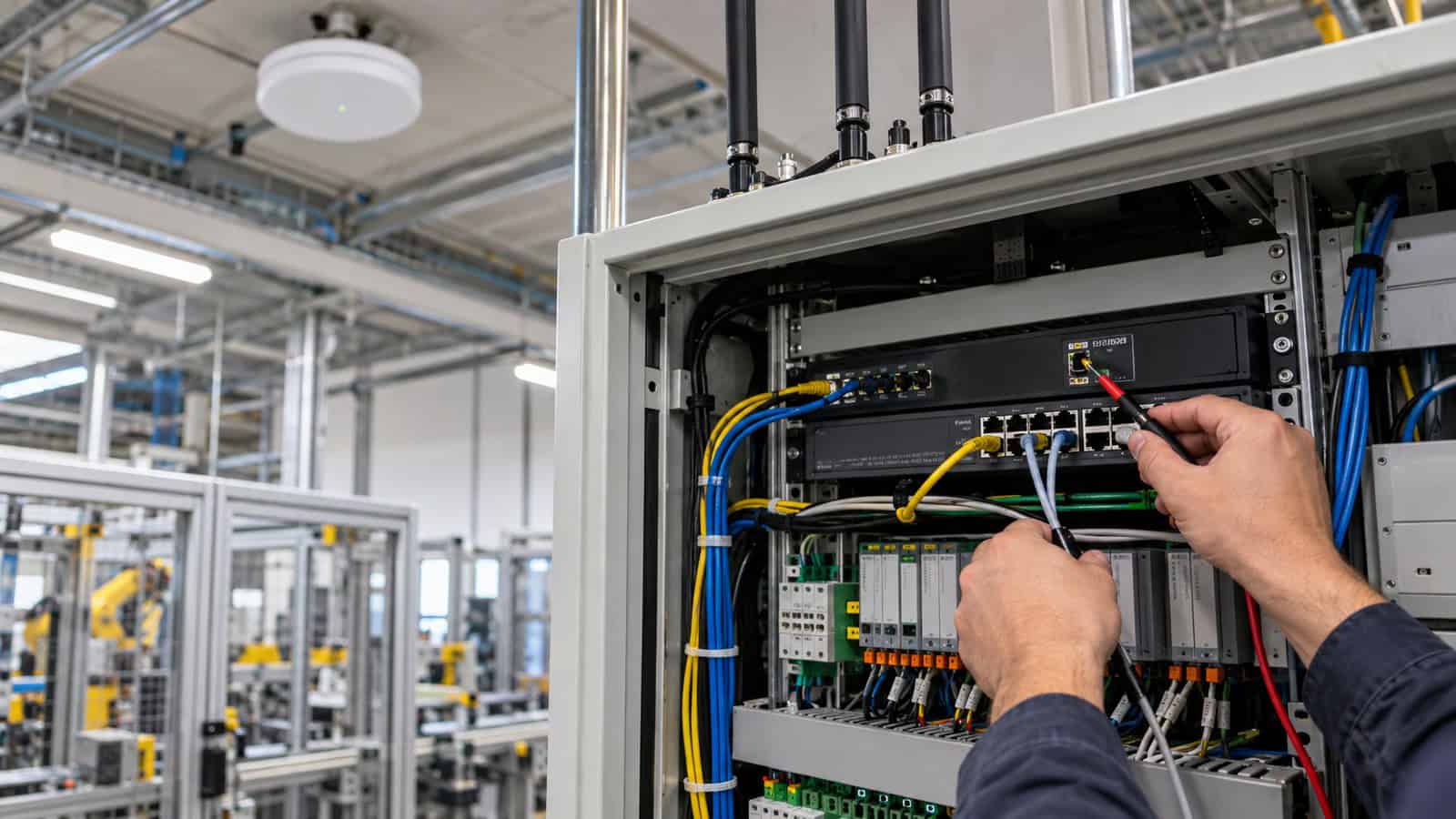
The Robustel R5020 Industrial 5G Router can use Ethernet, Wi-Fi and cellular connectivity in an auto-failover design, making it a practical platform for deterministic multi-WAN priority. The important word is deterministic: the team must define what counts as a failed path, how long to wait, what sessions break and when a recovered primary link is trusted again.
A Multi-WAN Design Is a State Machine
For a multi-site estate, the important commercial promise is repeatability. I would rather approve a modest policy that every regional team can explain and rehearse than a sophisticated policy whose failback behaviour is understood by one installer. The state model becomes part of the operating contract, not merely a router configuration.
Do not begin by clicking interface priorities. Draw the states the site is allowed to enter. A common design prefers Ethernet, then a managed Wi-Fi uplink, then 5G. That order is valid only if each path leads to the required destination and the Wi-Fi network is operationally owned.
| State | Active path | Entry condition | Exit condition |
|---|---|---|---|
| Normal | Ethernet | Health target succeeds | Consecutive qualified failures |
| Degraded | Wi-Fi | Ethernet failed; Wi-Fi healthy | Ethernet passes recovery threshold or Wi-Fi fails |
| Emergency | 5G | Higher-priority paths failed | A preferred path is stable long enough to return |
| Isolated | None | No path reaches the required service | Manual or automatic recovery policy succeeds |
The isolated state matters. Without it, a router may keep oscillating among links that have local connectivity but cannot reach the application.
Health Checks Must Reach the Service
A physical Ethernet link proves only that two interfaces can see carrier. A ping to the nearest gateway proves little about DNS, VPN or the application. Use more than one appropriately controlled target and bind probes to the interface being evaluated. Avoid a public target that could be blocked or rate-limited without the WAN being unusable.
Set failure and recovery thresholds from the application’s tolerance. Very short timers can move traffic during a momentary loss and break sessions unnecessarily; long timers extend a real outage. Failback should be slower than failover so an unstable primary link does not pull traffic back repeatedly.
Robustel’s Fixed-Line Backup over 5G with the R5010 Application Example illustrates why the router’s route change and the upstream appliance’s recovery are separate events. Use the same distinction here: measure when the selected WAN changes, when the VPN returns and when the business service is usable.
Treat Wi-Fi Client Mode as a WAN with Its Own Failure Modes
Wi-Fi may be convenient at temporary or shared sites, but it adds authentication, RF congestion and access-point ownership to the chain. Document SSID and credential rotation, association timeout, DHCP behaviour and what happens when the access point remains visible but loses upstream service.
If guest or local Wi-Fi is also needed, keep its role separate from Wi-Fi-as-WAN. The security policy should make clear which radio interface is upstream, which users or devices are downstream and whether traffic can ever cross between them.
The Robustel R5020 Industrial 5G Router Inside a Mixed-Uplink Architecture
Robustel R5020 industrial 5G router provides 5G/4G/3G cellular connectivity, dual physical SIM slots, four Gigabit Ethernet ports, Wi-Fi, GNSS, RS-232, RS-485 and digital I/O. Its product documentation describes Ethernet or Wi-Fi as primary internet paths with cellular available for failover. RCMS adds central monitoring and configuration capabilities for distributed fleets.
Those interfaces allow one enclosure to own several uplinks, but they do not remove shared failure domains. Ethernet, Wi-Fi and 5G still share the router and its power. Dual SIM shares the same hardware and antennas. Where router or power failure must be survived, a second device and power architecture may be required.
| Design question | R5020 capability | Release evidence |
|---|---|---|
| Can the site rank wired, Wi-Fi and cellular paths? | Ethernet, Wi-Fi and cellular with auto-failover | Forced loss of each uplink in order |
| Can local equipment remain connected? | Four Gigabit Ethernet ports | LAN continuity during every WAN transition |
| Can operations see and change the fleet? | RCMS management | Role-based process and configuration rollback |
| Can two subscriptions be used? | Dual physical SIM | Tested operator transition and application recovery |
The Robustel R5020 overview video gives commissioning teams a concise view of the platform before they build the interface map. Use the exact deployed variant and current firmware as the final configuration reference.
Commission the Transitions, Not Only the Links
Robustel’s Jones Technology retail resilience case study shows why distributed sites need repeatable recovery processes while still accounting for local conditions. For acceptance, remove each WAN at its real boundary: disconnect upstream Ethernet, make the Wi-Fi path lose internet while keeping the SSID visible, and disable or isolate the cellular subscription.
During each test record probe results, route selection, NAT or address changes, VPN state, application errors and recovery time. Restore the primary path in an unstable pattern before allowing it to remain healthy. This exposes route flapping and failback timers that a clean demonstration misses.
Use a release checklist with explicit owners:
- network owner approves probes, priorities and thresholds;
- security owner confirms zone and VPN behaviour on every path;
- application owner validates retry and session state; and
- operations owner receives alarms, rollback steps and escalation contacts.
FAQs
Q1. What is multi-WAN failover?
Multi-WAN failover moves traffic to another uplink when the preferred path fails a defined health test. It does not guarantee uninterrupted sessions, so application and VPN recovery must be measured separately.
Q2. How do I set WAN priority on a router?
Rank the eligible interfaces, bind meaningful health checks to each path, and define failure and recovery thresholds. Then force each failure and confirm the selected route and application outcome.
Q3. What is the difference between failover and load balancing?
Failover normally keeps lower-priority links in reserve, while load balancing deliberately uses more than one path. Load balancing adds session distribution and path-asymmetry considerations that a simple priority design may avoid.
Q4. Should a router switch back to the primary WAN automatically?
Usually yes, but only after the primary has remained healthy for a suitable recovery period. A stable failback timer prevents repeated switching when the preferred link is intermittent.
Q5. When is the Robustel R5020 Industrial 5G Router suitable for multi-WAN priority?
It suits sites that need Ethernet, Wi-Fi and cellular paths in one managed industrial router, plus several local Ethernet connections. Validate health checks and session recovery with the exact network services used at the site.
Conclusion
The Robustel R5020 Industrial 5G Router fits mixed-uplink sites that need Ethernet, Wi-Fi and cellular paths within one managed router architecture. Its interfaces create the options; the state machine and health checks decide whether those options behave predictably.
A design is ready to scale when every transition—including failback—has a measured service consequence and a named owner. Link availability on its own is not the acceptance result.
Explore More Articles About Robustel 5G Routers
About the Author
Robert Liao | Technical Support Engineer
Robert is an IoT Technical Support Engineer at Robustel, specializing in industrial networking and edge connectivity. A certified Networking Engineer, Robert focuses on the deployment and troubleshooting of large-scale IIoT infrastructures. His work centers on architecting reliable, scalable system performance for complex industrial applications, bridging the gap between field hardware and cloud-side data management.