
5G Router Deployment Architecture: Primary WAN, Failover, Remote Access and Fleet Operations
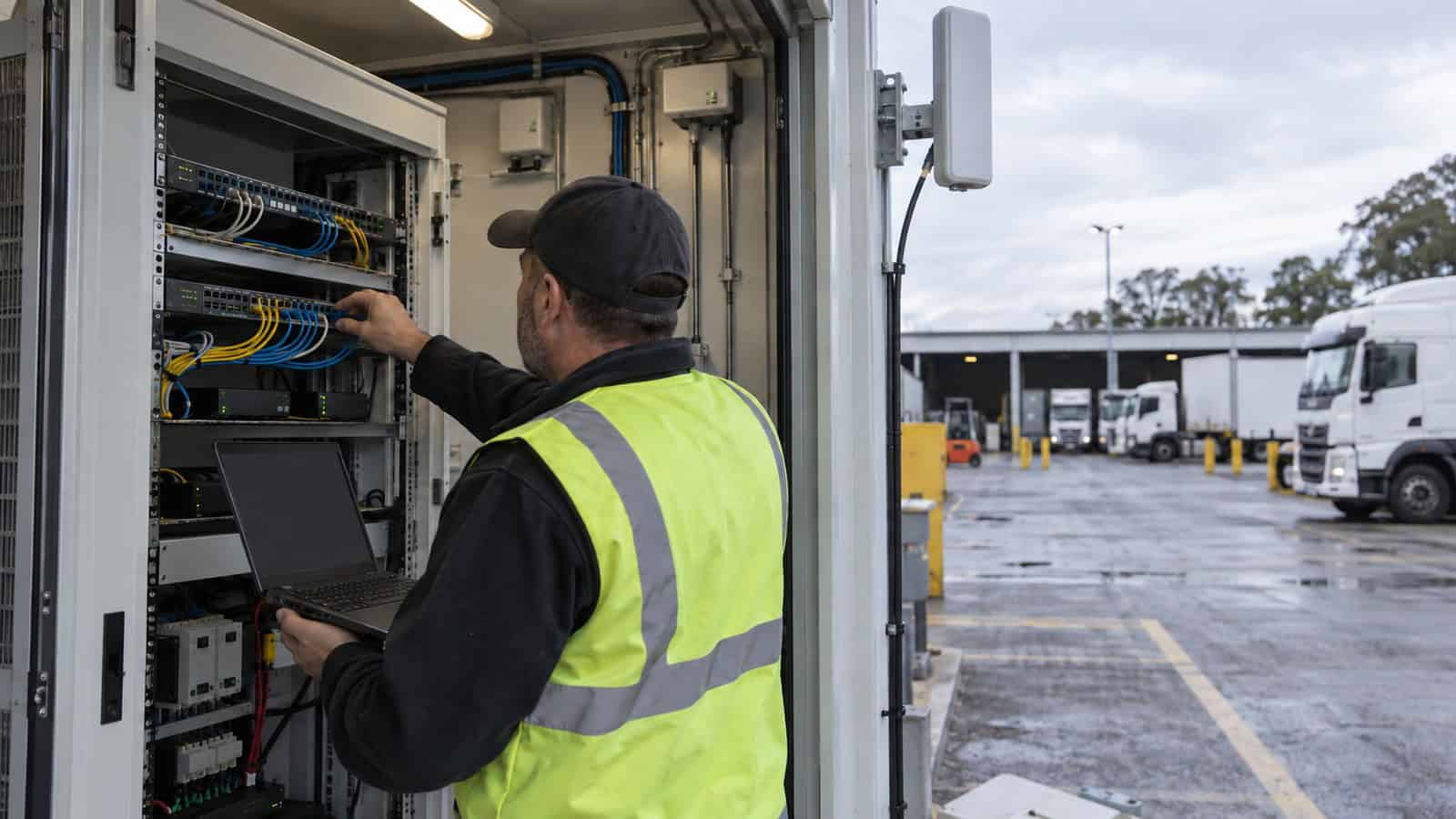
For a site where one device must own primary or backup cellular access, connect several local systems and remain visible to a central operations team, the Robustel R5020 Industrial Dual-SIM 5G Router provides a coherent deployment centre. The hardware choice is only one layer: the deployment succeeds when failover, remote access and fleet management are designed as separate operating paths and tested together.
A router can recover mobile registration while the site remains unavailable. DNS may still point to a failed resolver, a VPN may not rebuild, or an application may keep a stale session. For that reason, a deployment architecture should describe the complete service state, not stop at “WAN connected”.
Name the WAN Role Before Configuring It
When 5G is the primary WAN, traffic policy, data allowance and recovery all depend on the mobile service. The antenna position becomes part of the production design, and any fixed line is the secondary path. This arrangement is useful where a site must open before fibre arrives or where fixed connectivity is commercially impractical.
When 5G is backup, the router spends most of its life proving that the standby path is ready. A SIM can be active and still fail the real test because the VPN credentials, route priorities or upstream firewall rules have drifted. Scheduled proving traffic is more useful than a green cellular icon.
Some sites need a third pattern: Ethernet or Wi-Fi serves as the preferred access while 5G/4G takes over automatically. The Robustel R5020 product page explicitly describes this primary-access and cellular-failover role. The project still has to define which sessions are allowed to move and which must restart cleanly.
| Deployment role | Normal path | Failure decision | What must be retested after transition |
|---|---|---|---|
| 5G primary | cellular to operator core | loss of usable cellular service or application reachability | VPN, DNS, northbound application and management path |
| 5G backup | Ethernet or Wi-Fi primary | primary path fails for the approved detection period | route preference, security policy, data cap and application sessions |
| Dual-SIM cellular | preferred SIM/operator | defined registration, signal or reachability failure | APN, addressing, VPN and whether the alternate operator is genuinely independent |
| Temporary 5G | cellular until fixed circuit handover | fixed service passes acceptance | routing ownership, rollback and removal of temporary exceptions |
Trace Failover as a Sequence of States
The first state is fault detection. Link-down works for a pulled Ethernet cable, but it does not identify an upstream outage beyond an active port. Reachability probes can see further, yet their destination and interval determine what “failure” means. A single public target can also create false decisions if that target is unavailable while the business application is healthy.
The second state is route change. A new default route does not guarantee that existing stateful sessions can migrate. NAT, firewall and VPN peers may hold state against the old source address. Applications with long retry timers can appear frozen even though new traffic would use the surviving path.
The third state is service recovery. Check a business transaction or protocol exchange, not only a ping. Then test failback. An unstable primary link can pull traffic back too early and create repeated transitions, so recovery timers and stability thresholds belong in the acceptance record.
Robustel’s High Speed Branch Office Routing over 5G with the R5020 Application Example illustrates a router-owned branch pattern with cellular service, segmentation and central operations. It is useful architecture guidance, but its expected outcomes are not a measured availability result for another branch or operator.
Keep Remote Access Independent From Public Addressing
Inbound access through a mobile network is often complicated by carrier-grade NAT or changing addresses. Buying a public address is not the only design, and exposing management directly to the internet is rarely the desirable one. An outbound VPN from the site can create a controlled path without relying on unsolicited inbound mobile traffic.
Decide who may reach the router, who may reach attached OT or IT assets, and whether those permissions are permanent or time-limited. Router administration and access through the router are separate privileges. A support engineer who needs an HMI should not automatically receive configuration rights on the WAN edge.
The recovery path also needs scrutiny. If the same VPN is used for monitoring, administration and application traffic, one negotiation fault can remove every remote diagnostic view. Local logs, SMS where approved, or an independent management channel can reduce the chance that the team loses all evidence with the tunnel.
How the Robustel R5020 Industrial Dual-SIM 5G Router Supports a Recoverable Site Architecture
The Robustel R5020 industrial 5G router has four Gigabit Ethernet ports, dual SIM, 5G/4G/3G support, serial interfaces and central management through Robustel RCMS platform. For a compact industrial or branch site, those verified capabilities allow the router to own both the cellular path and a useful portion of the local connectivity without requiring a separate switch for a small fixed device set.
Its official page also lists Ethernet or Wi-Fi as primary access with automatic failover to 5G/4G. The architectural benefit is not simply “more WANs”. It lets the designer keep the local device map constant while changing which upstream service is preferred. That is particularly useful during staged fixed-line installation or where a branch needs cellular continuity after an Ethernet service fault.
Dual SIM should be treated as two configured service profiles, not as proof of uninterrupted service. Confirm operator coverage at the final antenna position, SIM and APN provisioning, switch criteria, addressing, VPN renegotiation and commercial data policy. If both subscriptions share the same infrastructure or outage domain, the second SIM may add little protection against that incident.
RCMS can provide fleet visibility, configuration and update functions for the router estate. Operations still need approval rings, rollback criteria and a record of which site template applies. A central tool makes controlled work possible; it does not decide the change policy on behalf of the organisation.
| Robustel R5020 deployment check | Verified product capability | Project evidence required |
|---|---|---|
| Local attachment | four Gigabit Ethernet ports and industrial interfaces | named port map, VLAN/security ownership and spare-port policy |
| WAN resilience | cellular plus Ethernet/Wi-Fi primary-access options; dual SIM | final-site transition and failback results under real application load |
| Secure connection | IPsec, OpenVPN and DMVPN options are listed | approved cryptographic profile, peer configuration and access scope |
| Fleet operations | RCMS-enabled management | onboarding, role model, audit, staged update and recovery procedure |
| Vehicle variant use | optional GNSS and ignition-sense are model-dependent | exact ordering code and installation review; do not assume every R5020 variant has them |
Make Fleet Operations Part of Commissioning
A field engineer should not finish commissioning with a device that only their laptop can identify. The asset record needs serial number, exact model and variant, firmware, SIM identities, operator, antenna arrangement, power source, site owner, configuration template and the application service being protected.
Before a large rollout, build a canary group that represents the difficult sites, not the easiest office bench. Apply firmware and configuration changes there first, watch the agreed service metrics and retain a rollback path. A router restart that looks harmless can still interrupt a long-running industrial session.
Robustel’s Jones Technology retail case study is deployment evidence for centrally operated cellular connectivity across distributed stores. It supports the value of repeatable fleet operations and remote visibility, while local RF and carrier behaviour still remain site-specific.
Run a Failure Drill Before Handover
Start with the preferred WAN carrying normal application load. Remove upstream reachability without merely pulling the local cable, and time fault detection, route change, tunnel recovery and the first successful application transaction. Inspect what the operator sees at each point.
Repeat the drill for the preferred SIM, the management service and the remote-access tunnel. Restore dependencies one by one and watch for premature failback or stale sessions. A useful handover record states the observed interruption and recovery owner, not just “failover passed”.
The Robustel R5020 product video is a concise orientation to the platform. Use it to align the implementation team, then let the current product page, exact variant documentation and witnessed failure test control production acceptance.
FAQs
Q1. How do you deploy a 5G router?
Define whether cellular is primary or backup, survey the final antenna position, provision the correct SIM and APN, configure routing and security, then test the complete application path during failure and recovery. Record the exact variant, firmware and site configuration before handover.
Q2. Can a 5G router use Ethernet as the primary connection?
Some industrial routers can prefer Ethernet and use cellular when that path fails. The design must state how failure is detected, how routes and VPNs recover, and when traffic is allowed to return to Ethernet.
Q3. Does dual SIM mean automatic failover?
Dual SIM provides two subscription positions, but useful failover depends on configuration, operator independence, coverage, APNs and the recovery of higher-layer services. Test both directions with the actual applications.
Q4. How can I remotely access devices behind a cellular router?
An outbound VPN or managed private-access service can create a controlled path without exposing device management publicly. Separate router administration from access to attached assets and grant only the scope required for support.
Q5. When is the Robustel R5020 Industrial Dual-SIM 5G Router a good deployment fit?
It fits sites that need primary or backup 5G, several Gigabit Ethernet connections, industrial interfaces and central fleet operations in one router. Confirm the exact variant, regional bands, WAN policy and transition behaviour before rollout.
Conclusion
Where 5G must operate as a recoverable primary or backup WAN while the router also connects a compact local site, the Robustel R5020 Industrial Dual-SIM 5G Router earns its place through the combined WAN and local-interface role. Its value is clearest when the site team can operate one defined failure and recovery model instead of treating the modem, firewall, VPN and local switch as unrelated boxes.
The product choice does not remove upstream dependencies. Operator coverage, SIM policy, addressing, antennas, power and remote-platform access still determine which failures can be recovered without a visit. A secondary path is only useful when applications, management traffic and staff procedures actually follow it.
Approve the architecture after a witnessed transition and failback test under production-like load, then retain the timings, application symptoms and recovery steps. That evidence gives the service desk a usable runbook and procurement a repeatable deployment standard.
Explore More Articles About Robustel 5G Routers
About the Author
Robert Liao | Technical Support Engineer
Robert is an IoT Technical Support Engineer at Robustel, specializing in industrial networking and edge connectivity. A certified Networking Engineer, Robert focuses on the deployment and troubleshooting of large-scale IIoT infrastructures. His work centers on architecting reliable, scalable system performance for complex industrial applications, bridging the gap between field hardware and cloud-side data management.