
How to Estimate LoRaWAN Gateway Range Before Deployment
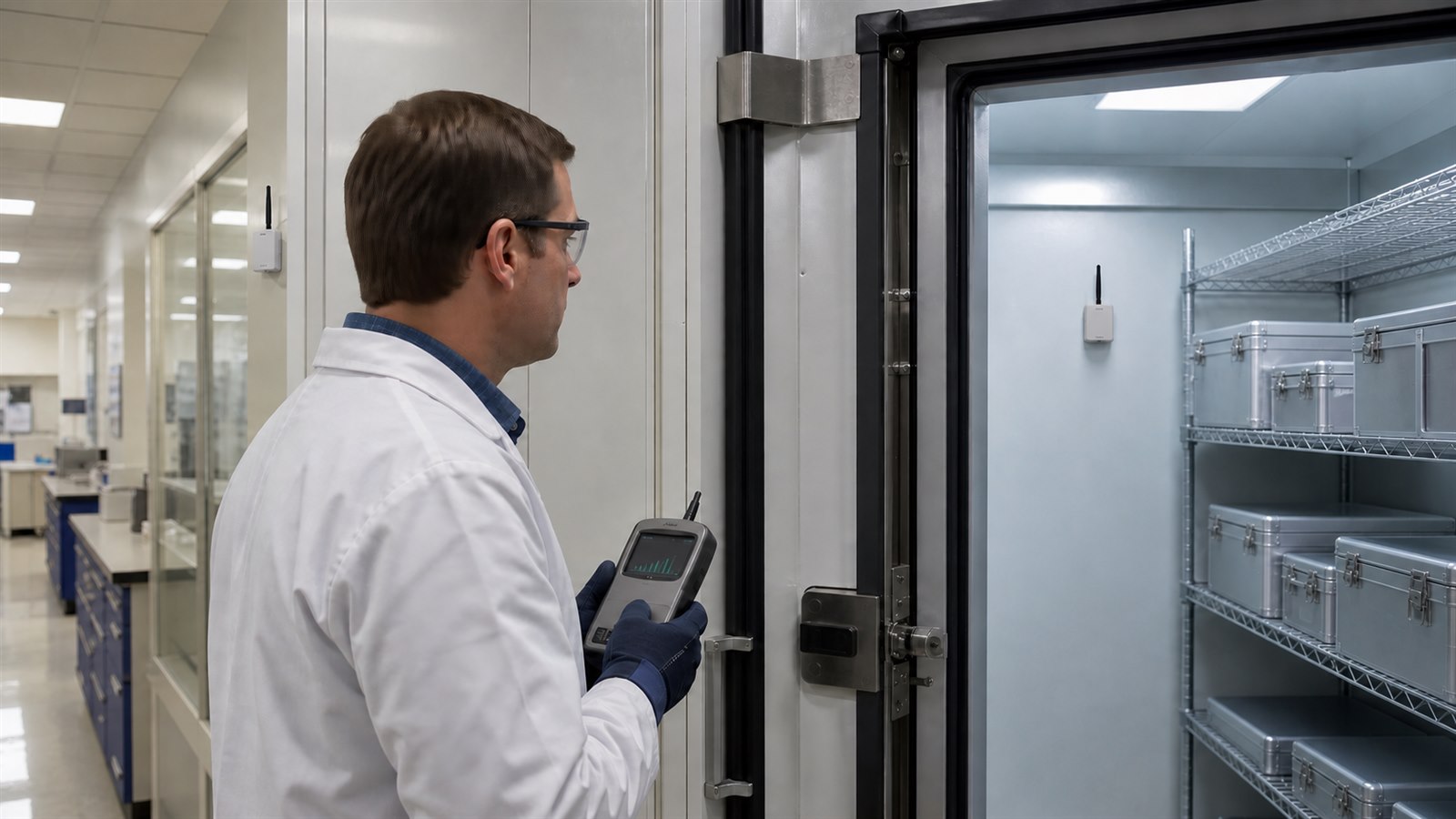
A useful LoRaWAN gateway range estimate starts with the hardest radio path on the site, not a headline distance from a product brochure. The Robustel R1520LG LoRaWAN Gateway provides a practical reference for this process because the same gateway can be installed in buildings and industrial sites while the actual coverage still depends on antenna position, obstacles, end-device settings and the local RF environment.
Consider a pharmaceutical facility planning wireless temperature monitoring. The furthest sensor may be only 80 metres from the gateway, but it sits inside a cold room behind insulated walls and metal shelving. Another sensor is 150 metres away with a relatively open path. Treating distance as the main indicator could lead the project team to test the wrong location first.
LoRaWAN range is therefore better treated as a site-specific radio condition to validate. Desktop planning can identify where a link is likely to be difficult, but representative field testing is what turns that estimate into an engineering decision.
Start with the Hardest Sensor, Not the Furthest Distance
On a site using a Robustel LoRaWAN gateway, begin by mapping endpoints according to their radio difficulty rather than simply drawing a circle around the proposed gateway position.
A long outdoor path with reasonable line of sight may be less demanding than a much shorter path through reinforced concrete, metal plant equipment or below-ground structures. The same principle applies inside buildings: floors, lift shafts, plant rooms, fire doors and dense mechanical equipment can produce very different propagation conditions within the same floor plan.
A useful first-pass map should identify:
- End-device location and mounting height
- Building materials or terrain between device and gateway
- Metal cabinets or machinery around the sensor
- Whether the endpoint is above or below ground level
- Candidate gateway and antenna positions
- Nearby RF equipment
- Whether the application requires uplink only or meaningful downlink communication
The purpose is not to predict an exact distance. It is to rank links as relatively straightforward, uncertain or difficult.
A Robustel deployment with KoolZone shows why this distinction matters.
Robustel Real-world example: LoRaWAN monitoring for vaccines and labs with the R1520-LG
KoolZone monitors medical refrigerators, ultra-low-temperature freezers and other cold-chain assets. In these environments, sensors may operate inside enclosures that substantially attenuate radio signals. The Robustel R1520-LG LoRaWAN Gateway sits outside the appliance and receives sensor traffic before forwarding it to the cloud over cellular connectivity.
For a range study, the useful lesson is not that the R1520-LG will cover a particular number of metres. It is the opposite: the physical barrier around the endpoint can matter more than the straight-line distance to the gateway.
If the project has twenty accessible sensors and two sensors inside heavily shielded plant areas, those two difficult endpoints should be tested first.
Draw the Radio Path Before Estimating Range
Once difficult endpoints have been identified, trace the complete RF path between each sensor and the proposed Robustel gateway position.
A simplified planning chain is:
End-device transmitter
→ device antenna
→ local obstruction
→ propagation path
→ walls terrain or equipment
→ gateway antenna
→ antenna cable and connectors
→ LoRaWAN gateway receiverEvery element can affect the resulting link.
A basic link-budget calculation can help determine whether the design appears plausible. It normally considers transmitter output, antenna gains, feeder losses and receiver sensitivity. The result is useful as a screening calculation, but it does not model every reflection, obstruction or interference source at the real site.
This is why theoretical link budget and practical range are not interchangeable.
For example, moving a gateway antenna above a row of machines may improve the path without changing the gateway itself. Conversely, relocating an antenna to a roof and introducing a long feeder cable may add enough cable loss to offset part of the benefit.
Frequency also matters. LoRaWAN uses regional channel plans rather than one global radio configuration, and the permitted frequencies and operating parameters vary by regulatory region. The LoRa Alliance maintains regional parameters for this reason, so the correct region and local regulatory requirements need to be established before radio planning begins. (RP2-1.0.2 LoRaWAN® Regional Parameters – LoRa Alliance®)
For the Robustel R1520LG, that also means selecting the appropriate regional product configuration rather than assuming one gateway radio is suitable everywhere.
Spreading Factor Helps the Link, but It Is Not Free Range
A range estimate also needs to account for how LoRa modulation is configured.
Higher spreading factors generally provide greater receiver sensitivity and robustness for difficult links, but they also increase time on air. Semtech describes spreading factor as a significant trade-off between sensitivity and symbol duration, rather than a setting that should simply be maximised for every device.
This distinction becomes important when a Robustel LoRaWAN gateway serves more than a handful of endpoints.
Suppose a remote meter only reaches the gateway reliably when using a high spreading factor. That may be acceptable for an endpoint sending a short message several times per day. If a large proportion of a dense sensor estate requires the same long airtime, the network-capacity question becomes more important.
The LoRa Alliance’s 2026 guidance on utility network capacity similarly treats spreading-factor use, gateway deployment and traffic behaviour as related optimisation decisions rather than independent settings.
For pre-deployment range planning, therefore, record more than “packet received.”
Capture:
| Observation | なぜそれが重要なのか |
|---|---|
| Device data rate / spreading factor | Shows how hard the radio is working to maintain the link |
| RSSI | Provides one indication of received signal level |
| SNR | Helps assess signal quality relative to noise |
| Repeated uplink reception | More useful than one successful packet |
| Required downlink performance | A good uplink does not automatically validate application behaviour |
| Time and operating conditions | Interference and site conditions may vary |
| Antenna and gateway position | Allows the test to be reproduced later |
Do not turn one RSSI or SNR reading into a universal pass/fail rule. Acceptance criteria should reflect the application and include enough margin for real operating variation.
For readers who want a short refresher on where the gateway sits in this radio and network path, Robustel’s What Is a LoRaWAN Gateway video provides a compact visual explanation. It is useful here because the range question concerns the sensor-to-gateway radio link; Ethernet or cellular backhaul begins after that link has already been established.
Turn the Desktop Estimate into a Field Test
A desktop study should produce a test plan, not a claim that coverage has already been proven.
For a project using the Robustel R1520LG LoRaWAN Gateway, install the gateway and antenna as close as practical to the intended final arrangement. Using an open cabinet, a temporary antenna beside the engineer or a gateway placed several metres away from its final position can make the result difficult to reproduce after installation.
The test should then begin with the endpoints identified as most difficult.
A useful sequence is:
- Install the intended regional gateway and antenna configuration.
- Place a representative end device at the real endpoint position.
- Confirm that frequency plan and device configuration are correct.
- Generate repeated application-representative traffic.
- Record reception, RSSI, SNR and data rate over a meaningful interval.
- Repeat the test at other difficult locations.
- Test required downlinks where the application uses them.
- Repeat after nearby machinery or building systems are operating normally.
- Record the final gateway, antenna and endpoint positions.
This process is deliberately different from walking around a site until one packet appears.
Robustel real-world example: cutting BMS cabling costs with LoRaWAN and the R1520-LG
Voytech Systems uses Robustel R1520-LG LoRaWAN Gateways in building automation deployments where wireless sensors may need to communicate through plant rooms, occupied areas and multiple floors. The published case includes project-specific results such as LoRa links across 14 floors in one proof of concept and more than 200 sensors in another three-storey deployment.
Those figures are useful evidence that LoRaWAN can work in complex buildings, but they should not be converted into a product range specification. The same case also notes that additional R1520-LG gateways can be added when coverage needs to be extended.
The engineering lesson is more useful than the distance figure: validate the actual building, and treat another receiving point as an architectural option when one location does not provide sufficient coverage.
That decision leads naturally into gateway placement and gateway-count planning, which is a separate problem from estimating the range of one candidate location.
Use One Gateway Configuration as the Test Reference
Changing multiple variables during a range trial makes the result difficult to interpret.
The Robustel R1520LG LoRaWAN Gateway can serve as a fixed gateway reference while the project evaluates site-dependent variables. Robustel lists the product with LoRaWAN connectivity, cellular and Wi-Fi backhaul, PoE-PD and support for external or embedded LNS architectures. Its backhaul options are useful operationally, but they do not increase the LoRa radio range by themselves.
During the RF test, keep the following elements stable where possible:
- Gateway model and regional configuration
- Firmware and LoRaWAN configuration
- Gateway antenna
- Antenna cable
- End-device model
- End-device antenna
- Payload and reporting behaviour
Then change one meaningful deployment variable at a time, such as:
- Gateway height
- Antenna position
- Endpoint location
- Orientation
- Route through the building
This makes it easier to identify *why* a radio path improved or deteriorated.
It also prevents a common mistake: solving a weak path by simultaneously changing antenna gain, gateway position, spreading factor and sensor hardware. The link may improve, but the engineering team no longer knows which change produced the improvement or whether the final configuration is repeatable across other sites.
Backhaul should also be verified separately. A Robustel R1520LG may receive the LoRaWAN packet correctly while poor cellular or Ethernet connectivity prevents the packet from reaching an external Network Server.
That is a backhaul fault, not a LoRaWAN range failure.
Define Coverage by Acceptance Criteria, Not Kilometres
The final output of a LoRaWAN gateway range study should not be:
“The gateway has a range of X kilometres.”
A stronger engineering conclusion is:
“From this proposed gateway position, the representative devices at the defined test locations met the project’s communication requirements under the tested site conditions.”
That conclusion is narrower, but it is much more useful.
For a Robustel LoRaWAN deployment, acceptance criteria might include:
- Reliable reception from all critical sensor locations
- Defined performance for non-critical locations
- Adequate margin at difficult endpoints
- Required downlink operation
- Acceptable spreading-factor distribution
- Repeatable results during normal site activity
- Correct regional configuration
- Documented antenna position
- Stable IP backhaul after radio reception
- A clear mitigation plan for failed locations
The mitigation does not always need to be “buy a higher-gain antenna.”
Depending on the failure, the appropriate response may be to move the existing antenna, relocate the gateway, reduce feeder loss, correct the end-device installation or introduce another gateway coverage point.
This is also why gateway range and gateway placement should remain separate planning stages. Range testing tells the engineer how individual paths behave. Placement design uses those findings to decide how the complete site should be covered.
よくある質問
Q1. What is the typical range of a LoRaWAN gateway?
There is no single deployment range that applies reliably across buildings, cities and rural sites. Terrain, building materials, antenna position, regional settings, spreading factor, interference and end-device installation all affect the radio path. Use published radio specifications for initial feasibility checks, then validate representative endpoints at the real site rather than budgeting coverage around one headline distance.
Q2. Does a higher spreading factor always increase LoRaWAN gateway range?
A higher spreading factor can improve sensitivity and robustness for difficult links, but it increases time on air. It should therefore be treated as a radio trade-off rather than free additional range. Dense deployments in which many devices operate at high spreading factors may also create different capacity considerations from a small network with infrequent messages.
Q3. Can the Robustel R1520LG LoRaWAN Gateway cover an entire building?
The Robustel R1520LG LoRaWAN Gateway can be used in building-scale deployments, but Robustel does not provide one building-size figure that guarantees coverage. Wall construction, floor layout, plant equipment, antenna location and endpoint position differ substantially between buildings. The correct approach is to test difficult locations and add or reposition gateway coverage where required.
Q4. Is RSSI enough to determine whether a LoRaWAN location has good coverage?
No. RSSI is useful but should be interpreted with SNR, data rate or spreading factor, repeated packet reception and application requirements. A single successful uplink is weak evidence for a production deployment. Test representative traffic over an appropriate interval and include downlink behaviour where the application requires it.
Q5. Does device density affect LoRaWAN gateway range?
Device density does not directly change the physical distance between a gateway and sensor, but network traffic can affect the usable performance of the deployment. Airtime, spreading-factor distribution, reporting frequency and confirmed traffic all influence capacity. This is why a radio path that works in a small pilot should also be evaluated under representative production traffic.
結論
Estimating LoRaWAN gateway range is not an exercise in selecting one kilometre figure. It is a process of identifying difficult endpoints, understanding the propagation path, making a reasonable desktop estimate and then validating that estimate under representative site conditions.
The Robustel R1520LG LoRaWAN Gateway provides a stable industrial gateway reference for this process, but the resulting range remains dependent on the complete RF path around it: end-device position, obstacles, antennas, spreading factor, interference and installation geometry.
Start with the sensor most likely to fail, keep the test configuration controlled and record enough evidence to reproduce the result. Once those individual radio paths are understood, the project can move to the next question: where should the gateways be placed, and how many coverage points does the site actually need?
Explore more articles about Robustel’s LoRaWAN gateway in industrial IoT:


著者について
Robert Liao | Technical Support Engineer
Robert is an IoT Technical Support Engineer at Robustel, specializing in industrial networking and edge connectivity. A certified Networking Engineer, Robert focuses on the deployment and troubleshooting of large-scale IIoT infrastructures. His work centers on architecting reliable, scalable system performance for complex industrial applications, bridging the gap between field hardware and cloud-side data management.