
Choosing the Right 5G Router for Small Business Branch Sites and Remote Equipment

A café with guest Wi-Fi, a branch using an existing firewall, and an unmanned pump station may all search for the best 5G router, but they are not buying the same network device. The Robustel R5030 Industrial 5G Router, Robustel R5010 Industrial 5G Router, and Robustel R5020Le eSIM Router represent three different answers to those requirements.
In this guide, “best” means the best fit for the site’s users, equipment, uptime target, physical environment, and support model. It does not mean the fastest consumer router or an overall market leader.
The buying decision becomes clearer once the site is placed into one of three groups:
- Customer-facing small business sites that need local Wi-Fi and several wired connections
- Branch sites that already have a firewall or SD-WAN appliance
- Remote equipment sites that need low-touch operation and direct equipment integration
Three Sites Can Require Three Different Router Architectures
A small business may expect one device to provide 5G, local Wi-Fi, Ethernet connectivity, and backup when fixed broadband fails. A branch with an established security platform may need only a clean cellular WAN handoff. An unmanned asset may have no local users at all but still require serial communication, dual SIM, and remote troubleshooting.
This is why the Robustel 5G router portfolio includes products with different interface and management priorities. Some models concentrate on Wi-Fi and multi-device local networking, some provide a focused connection to an existing firewall, and others balance cellular resilience with industrial equipment interfaces.
Before selecting a model, buyers should define six requirements:
| Selection area | Question to answer |
| Uptime | What stops working when the connection fails |
| Local equipment | What connects directly to the router |
| Wi-Fi | Are local staff customers or passengers using the router |
| セキュリティ | Where are firewall VPN and access policies controlled |
| Environment | Is the router installed in an office cabinet vehicle or remote enclosure |
| Management | Can the site be supported locally or must it be managed remotely |
The answer should narrow the architecture before individual specifications are compared.
Shortlist One Customer-Facing Small Business Sites
A shop, café, clinic, small office, temporary workspace, or service venue may use 5G as its primary connection, as temporary access while waiting for fixed broadband, or as backup after the wired service is installed.
These sites often need more than cellular backhaul. Local users may require Wi-Fi, while POS terminals, cameras, recorders, digital signs, or office equipment need Ethernet connections. The router may also need to move traffic to 5G when the primary WAN fails.
The buying priority is therefore a combination of:
- Sufficient Ethernet ports for local devices
- Wi-Fi capacity appropriate for the expected users
- Fixed and cellular WAN options
- VPN support for access to central systems
- Central management when several locations share the same design
The trade-off is complexity. A router with Wi-Fi, several ports, GNSS, and digital I/O is useful only when the site uses those capabilities. A very small office with one laptop and acceptable local support may not need an industrial multiport device.
For customer-facing locations where local Wi-Fi and several wired devices are part of the same network, the Robustel R5030 Industrial 5G Router provides the closest fit within the Robustel range.
Shortlist Two Branch Sites with an Existing Network Stack
A branch office, retail store, kiosk estate, or temporary commercial site may already use a firewall or SD-WAN appliance to control routing, VPNs, security policies, and internal network access.
In this architecture, the cellular router does not need to become the centre of the LAN. It needs to provide a dependable 5G path to the network platform that already owns those responsibilities.
The requirement may arise because:
- Fixed broadband will not be ready when the site opens
- The primary ISP connection needs a secondary WAN
- The cellular modem must be positioned away from a poor-signal communications room
- Network teams want one centrally managed 5G device across many branches
A router with five Ethernet ports and high-density Wi-Fi may duplicate equipment already installed at the branch. A focused WAN device can be simpler to integrate and easier to position for cellular reception.
The main trade-off is local connectivity. A WAN-focused router is not the right choice when several devices must connect directly or when the router must also provide branch Wi-Fi.
The Robustel R5010 Industrial 5G Router follows this focused architecture by supplying 5G through one 2.5 Gigabit Ethernet connection or USB modem mode to an existing firewall or SD-WAN appliance.
Robustel’s Real-world example: adding 5G resilience without replacing the branch network
A Robustel case study with UK managed service provider Jones Technology shows this architecture in practice. Across a large quick-service restaurant estate, Robustel R5010 5G Routers were integrated with an existing SD-WAN dual-WAN design to provide connectivity when leased lines were delayed and a secondary WAN after fixed connections became available. RCMS supported zero-touch rollout and centralised management across the estate. The case demonstrates why a focused cellular handoff can be more appropriate than adding another full branch-network platform when the firewall and LAN are already established.
Shortlist Three Remote Equipment and Unmanned Assets
Remote cabinets, utility assets, monitoring systems, kiosks, charging infrastructure, and distributed machines create a different operating problem. They may have few local users, but physical access can be slow and expensive.
A suitable router may need to connect one or two Ethernet devices together with a meter, controller, or other serial asset. It also needs enough remote visibility to help the operations team determine whether a fault belongs to the cellular link, configuration, or physical installation.
The key selection factors are:
- Dual SIM or another documented fallback path
- LTE fallback where 5G coverage is inconsistent
- Ethernet capacity matched to the connected equipment
- RS-232 or RS-485 where installed devices require serial communication
- VPN and firewall functions appropriate to the remote-access design
- Central configuration firmware maintenance and diagnostics
- Mounting power and environmental limits suitable for the enclosure
Remote management cannot repair a damaged antenna, failed power supply, or disconnected cable. Its value is that many configuration and network faults can be investigated before a technician is sent to the site.
SIM operations also affect the shortlist. Two removable SIMs may be sufficient when local connectivity contracts are stable. An eSIM model becomes more relevant when devices are widely distributed and operator profiles may need to change without replacing physical cards.
The Robustel R5020-Lite Industrial 5G Router fits sites that need two Gigabit Ethernet ports, dual physical SIMs, Wi-Fi 5, and one software-configurable RS-232 or RS-485 interface. The Robustel R5020Le eSIM Router uses a similar equipment-facing architecture but combines one physical SIM with an embedded eSIM for remote profile operations.
How Robustel Matches the Three 5G Router Shortlists
The three shortlists do not represent higher and lower versions of the same product. They represent different divisions of responsibility between the 5G router and the rest of the site network.
Robustel R5030 for Local Users and Multiple IP Devices
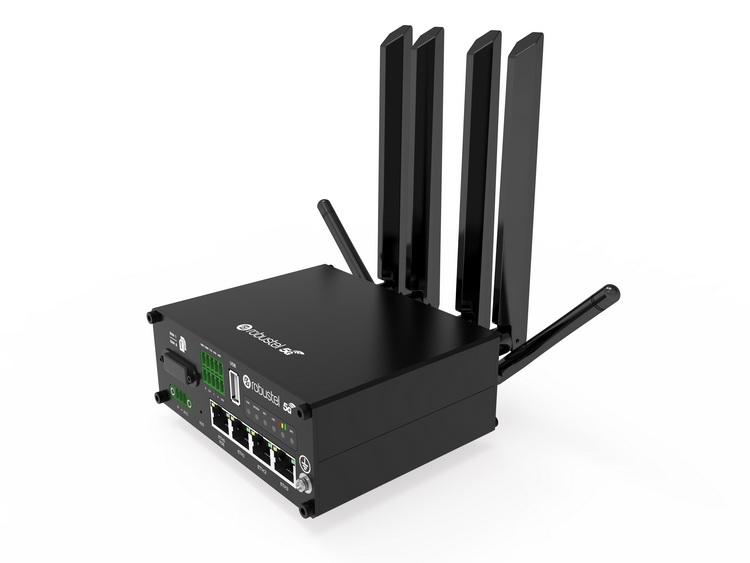
The Robustel R5030 Industrial 5G Router combines five Gigabit Ethernet ports with dual-band Wi-Fi 6, dual physical SIM support, GNSS, digital I/O, VPN functions, and RCMS management. Ethernet or Wi-Fi can serve as the primary access path with failover to cellular, or 5G can operate as the main WAN.
This architecture suits sites where the router must perform two jobs:
- Provide 5G connectivity
- Serve the local wired and wireless network
A retail site, public venue, vehicle, or temporary workspace may connect POS equipment, cameras, controllers, and user devices through one managed platform.
The boundary is equally important. The published physical interface set does not include RS-232 or RS-485, so a site requiring direct serial integration should evaluate another architecture. Its PoE capability is PoE-PD input for powering the router rather than PoE-PSE output for powering downstream cameras.
Robustel R5010 for an Existing Firewall or SD-WAN Platform
The Robustel R5010 Industrial 5G Router provides one 2.5 Gigabit Ethernet interface, USB modem functionality, dual physical SIM support, VPN functions, optional PoE-PD input, and RCMS fleet management.
It fits branches where security, LAN switching, Wi-Fi, and traffic policy are already controlled by another network appliance. The R5010 adds the cellular path without duplicating the wider branch network.
See the product architecture in a quick overview: Watch the Robustel R5010 Quick Pitch for a concise explanation of how the R5010 provides a focused 5G connection for existing firewall or SD-WAN architectures, including primary, temporary and backup WAN roles.
This can support three stages of a site lifecycle:
- Primary 5G while fixed broadband is unavailable
- Temporary connectivity during setup or relocation
- Secondary WAN after the fixed service is active
Its focused interface set is also its limitation. A site that expects the cellular router to connect several cameras, terminals, or serial devices directly should select a multi-interface model instead.
Robustel R5020-Lite and R5020Le for Remote Equipment
The Robustel R5020-Lite Industrial 5G Router provides two Gigabit Ethernet ports, dual physical SIMs, Wi-Fi 5, optional GNSS, and one serial port that can be configured as RS-232 or RS-485. Ethernet or Wi-Fi can be used as a primary path with cellular failover, while RCMS supports central monitoring, configuration, and updates.
The Robustel R5020Le eSIM Router adds a hybrid SIM architecture with one removable physical SIM and one embedded eSIM. Its eSIM capability supports remote profile provisioning, which can reduce physical SIM replacement when operator or regional connectivity requirements change.
The decision between them is operational:
- Choose the R5020-Lite direction when two removable SIMs fit the established service process.
- Choose the R5020Le direction when remote profile changes and reduced SIM logistics solve a real fleet-management problem.
Neither model should be selected for a site requiring several local Ethernet devices, separate simultaneous RS-232 and RS-485 connections, or high-density Wi-Fi.
Compare the Trade-Offs Before Approval
| Requirement | R5030 direction | R5010 direction | R5020-Lite or R5020Le direction |
| Primary site type | Customer-facing business venue or mobile site | Branch with existing firewall or SD-WAN | Remote equipment or unmanned asset |
| Router role | Local network and cellular WAN | Focused cellular WAN handoff | Equipment connectivity and remote WAN |
| Ethernet requirement | Several local IP devices | One connection to an existing appliance | One or two local IP devices |
| Wi-Fi | Important for local users | Usually provided elsewhere | Useful for limited local access or commissioning |
| Serial equipment | Not the primary fit | Not supported as a field interface | One configurable RS-232 or RS-485 connection |
| SIM model | Two physical SIMs | Two physical SIMs | Two physical SIMs or physical SIM plus eSIM |
| Management | RCMS fleet operations | RCMS fleet operations | RCMS device and supported eSIM operations |
| Main trade-off | More capability than a simple site may need | Limited local interfaces | Limited Ethernet and serial capacity |
A shortlist should remain conditional until the exact regional model, frequency bands, certifications, operator coverage, antennas, power arrangement, VPN design, and failure behaviour have been verified.
Dual SIM should not be scored as automatic uptime. Wi-Fi 6 should not be scored as useful when no local users exist. eSIM should not be selected unless remote profile operations reduce a real logistics or lifecycle problem.
よくある質問
Q1. What is the best 5G router for a small business?
The best fit depends on whether the router must provide only internet access or also serve local users and equipment. A customer-facing site may need Wi-Fi, several Ethernet ports, VPN access, and failover. A small office with modest traffic and easy local support may need less. Buyers should define the site topology and outage impact before selecting an industrial product.
Q2. Does a branch site need Wi-Fi on its 5G router?
Not necessarily. A branch may already have managed Wi-Fi connected through its firewall or switching infrastructure. In that case, the 5G router may only need to provide another WAN path. Integrated Wi-Fi is more relevant when the router itself serves staff, customers, temporary users, or local wireless equipment. Buying duplicate Wi-Fi capability can add cost without improving the branch design.
Q3. Is dual SIM enough to keep a remote site online?
No. Dual SIM provides a second subscription, but recovery still depends on failure detection, network availability, SIM registration, routing, VPN restoration, and application reconnection. The two subscriptions may also share infrastructure or roaming partners. A representative-site test should measure complete application recovery rather than checking only whether the router changes SIM.
Q4. Which Robustel 5G router fits a site with an existing firewall?
The Robustel R5010 Industrial 5G Router fits branches that already use a firewall or SD-WAN appliance and need a focused cellular WAN. Its 2.5 Gigabit Ethernet and USB modem options allow the existing platform to retain control of security, routing, and the LAN. Sites requiring several direct Ethernet connections, local Wi-Fi, or serial equipment should evaluate another Robustel architecture.
Q5. When does an eSIM router make sense for remote equipment?
An eSIM router is useful when operator profiles may need to change after deployment and physical SIM replacement would create travel, logistics, or service delays. The organisation still needs a provisioning process, compatible operator profiles, access controls, and a recovery plan. For stable, accessible sites with established removable SIM procedures, eSIM may add little operational value.
結論
The Robustel R5030 Industrial 5G Router fits customer-facing sites that need local Wi-Fi and several Ethernet connections. The Robustel R5010 Industrial 5G Router fits branches that already have a firewall or SD-WAN platform. The Robustel R5020-Lite Industrial 5G Router and Robustel R5020Le eSIM Router fit remote equipment sites where compact interfaces, cellular resilience, and central management matter more than high-density local networking.
The right 5G router is determined by the work assigned to it. A small business should not pay for industrial interfaces it will never use, while an unmanned asset should not depend on a consumer-style device simply because its local traffic is low.
Choose the architecture first. Then verify the regional model, operators, interfaces, VPN design, management workflow, installation conditions, and recovery behaviour at a representative site. That process creates a defensible shortlist without turning “best 5G router” into a generic product ranking.
Explore more articles about Robustel industrial 5G routers:

著者について
Robert Liao | Technical Support Engineer
Robert is an IoT Technical Support Engineer at Robustel, specializing in industrial networking and edge connectivity. A certified Networking Engineer, Robert focuses on the deployment and troubleshooting of large-scale IIoT infrastructures. His work centers on architecting reliable, scalable system performance for complex industrial applications, bridging the gap between field hardware and cloud-side data management.