Satellite redundancy for ATM transactions in Saudi Arabia:
How Amplicon Middle East reduced outage windows with automatic LTE failover
事例研究 – 概要
導入パートナー
Amplicon Middle East – https://ampliconme.com/
Amplicon Middle East is a Dubai-based industrial IoT and networking solutions provider. Since 2011, they’ve supported customers across the UAE, Saudi Arabia, and the wider Middle East with local engineering expertise, logistics, and on-the-ground delivery for mission-critical systems operating in harsh environments. Their portfolio spans industrial automation, networking, telemetry, SCADA (Supervisory Control and Data Acquisition), and wireless communications, with partnerships that include Robustel.
For this ATM satellite redundancy project, Amplicon Middle East’s value is in translating connectivity components into an operationally reliable rollout at scale scoping the architecture, coordinating delivery with the ATM system integrator, and ensuring deployments can be monitored and supported centrally. They bring proven experience delivering large industrial IoT deployments in the region and were recognised by Robustel as a Most Valuable Partner, reinforcing their capability in industrial connectivity programmes where uptime and consistent operations matter.
課題
ATM networks across Saudi Arabia relied heavily on satellite connectivity to communicate with backend banking systems, but intermittent satellite disruptions could lead to service outages and transaction interruption. Traditional cellular backup approaches often lacked the required failover behaviour and operational visibility for a large ATM estate. The customer required a practical redundancy approach that could fail over automatically and be managed remotely across thousands of locations.
結果
Over 5,000 ATMs were upgraded with backup connectivity. Transaction reliability increased significantly by reducing outage windows through automatic LTE failover during satellite disruptions, while RCMS enabled faster remote troubleshooting and reduced truck rolls. The customer continues to expand deployments, supported by centralised management and improved visibility for auditing and performance tracking.
Keeping ATM transactions online when satellite links are disrupted
In many Gulf-region ATM deployments, satellite is a practical primary communications path, especially where wired infrastructure is limited or inconsistent. The challenge is that satellite disruptions are not theoretical; they are operational events that can interrupt transaction processing, take machines out of service, and trigger reactive support cycles. For banks and payment operators, the cost is more than downtime. It is customer experience, SLA pressure, and real-world operational overhead.
What makes this problem hard is scale. When disruptions affect large numbers of machines spread across wide geographies, even short outages can compound into major service impact. The goal of this project was simple and non-negotiable: maintain transaction continuity by ensuring there is always a viable backhaul path, with automatic failover and centralised visibility so issues can be contained quickly.
ビジネス上の課題
For ATM operators, connectivity is not an IT convenience; it is the lifeline for authorisation and transaction completion. When connectivity drops, machines can’t do their job, customers lose access to cash, and operations teams inherit a fast-moving incident. In Saudi Arabia, where satellite is a common primary backhaul option across dispersed ATM locations, the customer needed a resilience model that reduced outage windows and prevented satellite disruptions from turning into prolonged downtime events.
1. Satellite disruptions created outsized transaction impact
Even intermittent satellite disruptions can cause immediate transaction interruption and service outages. For ATM networks, this is felt directly by customers and by the teams managing uptime commitments. Without a reliable backup path, each disruption risks becoming a visible outage with commercial consequences.
Day-to-day, this can force teams into reactive troubleshooting and repeated site interventions. In a distributed ATM estate, that pattern does not scale. The bank needed a way to contain satellite-related incidents and keep transactions flowing even when the primary path becomes unstable.
2. Failover needed to be seamless and automatic
Failover is only useful if it happens fast enough to preserve service continuity and is predictable in operation. Traditional 4G/5G backup approaches may provide connectivity, but without robust failover behaviour and consistent monitoring, they can still leave gaps when the primary link fails. The requirement was clear: automatic failover triggered by link health checks, not manual intervention.
Operationally, predictable failover reduces the time between a disruption and service restoration. It also reduces ambiguity for support teams, who need to know whether an ATM is down, degraded, or operating on the backup path.
3. Large-scale ATM estates require centralised operations
With thousands of ATMs in the field, visibility and control are fundamental. Without central monitoring, teams can be blind to the true status of endpoints and forced to rely on downstream symptoms instead of upstream diagnostics. The customer needed remote monitoring, remote troubleshooting, and the ability to manage configuration consistently across a large, distributed network.
This is also where compliance and auditability matter. Payments environments are held to strict security expectations, and operational teams need confidence that connectivity resilience does not compromise required controls.
ソリューション概要
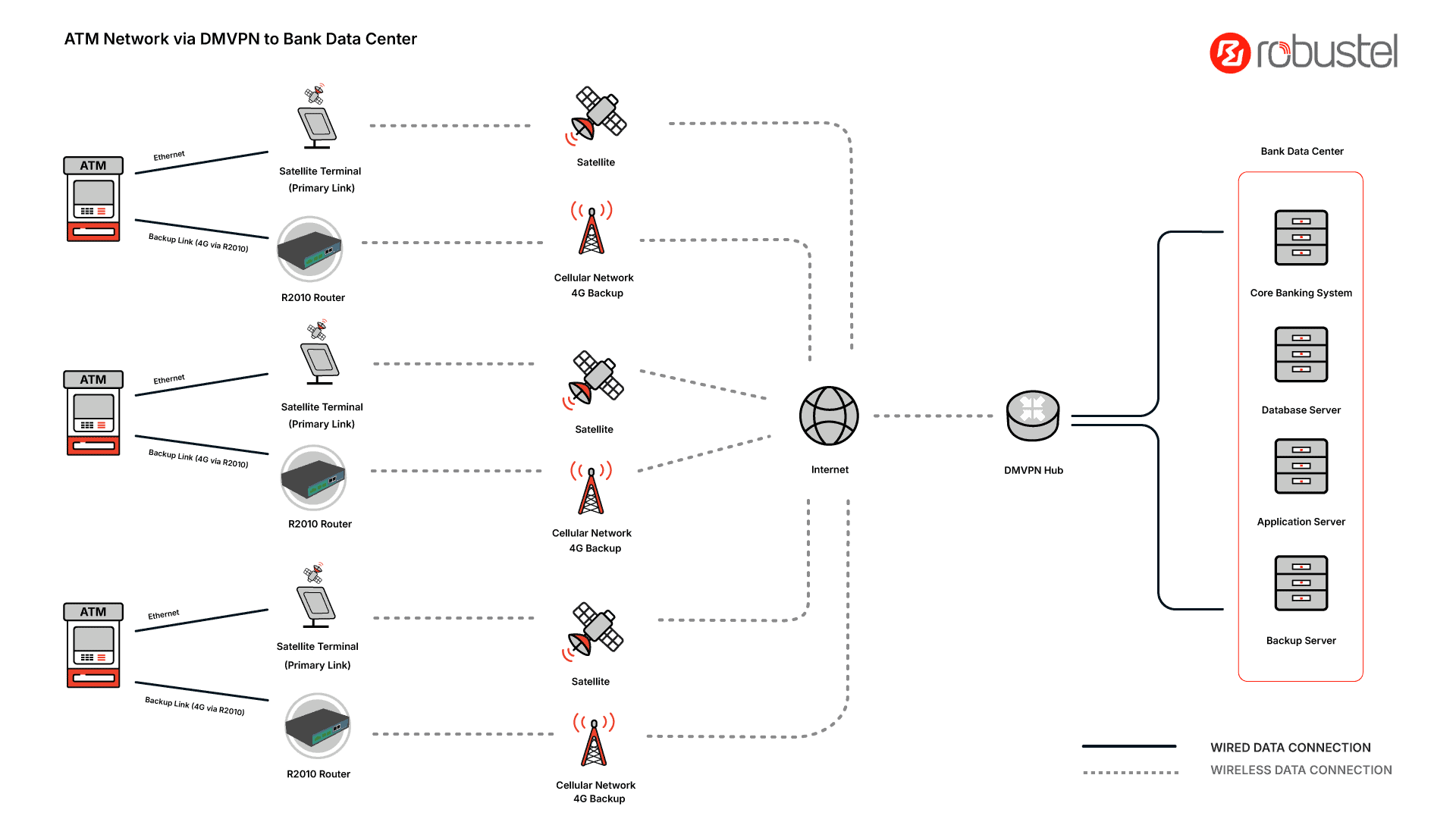
Amplicon Middle East designed and delivered a hybrid connectivity architecture where satellite connectivity remains the primary path, while Robustel industrial routers provide a 4G/LTE backup link for automatic failover. Both the satellite equipment (Skyband) and the router connect via an Ethernet switch, enabling the ATM communications path to fail over to cellular when satellite link health checks indicate disruption. This approach reduces outage windows by maintaining a secondary path that is always available and ready to carry traffic when the primary link becomes unstable.
To support secure communications in a payments context, the solution uses RobustVPN with DMVPN in alignment with PCI DSS requirements, helping ensure traffic between ATM endpoints and backend banking systems remains protected. RCMS provides centralised monitoring, configuration, and remote troubleshooting across deployed sites, enabling Amplicon and the operations team to manage the estate at scale and reduce the need for on-site interventions.
Why Amplicon Middle East chose the R2010:
- Industrial deployment fit: The R2010 is well-suited to ATM cabinet environments where reliability and stable connectivity are non-negotiable.
- Automatic redundancy with health-check failover: The architecture supports automatic failover to LTE when satellite disruptions occur, reducing service interruption windows and preserving transaction continuity.
- Centralised fleet operations: RCMS enables remote monitoring, configuration consistency, and faster troubleshooting across thousands of distributed ATM sites.
- Secure VPN design for payments environments: RobustVPN with DMVPN supports protected communications aligned to PCI DSS expectations, supporting operational resilience without weakening security posture.
主要な成果
Before this rollout, satellite disruptions could take ATMs offline and create a chain reaction: transaction failures, customer dissatisfaction, reactive troubleshooting, and costly site visits. After implementation, satellite disruptions were contained by an always-available LTE backup path, with automatic failover triggered by link health checks. Centralised monitoring improved visibility and accelerated troubleshooting, helping operations teams reduce outage windows and keep services available across a large ATM estate.
- Reduced outage windows: Satellite disruptions were mitigated by automatic LTE failover, keeping ATMs available when the primary backhaul link became unstable.
- Improved transaction reliability: Higher service availability supported more consistent transaction processing across distributed sites.
- Lower field intervention burden: Remote monitoring and troubleshooting reduced truck rolls and on-site maintenance requirements.
- Faster deployment across a large estate: Centralised tools improved implementation timelines and reduced operational friction during rollout and expansion.
- Better operational visibility for auditing: Improved data visibility supported more accurate performance tracking and audit readiness.
おすすめ商品
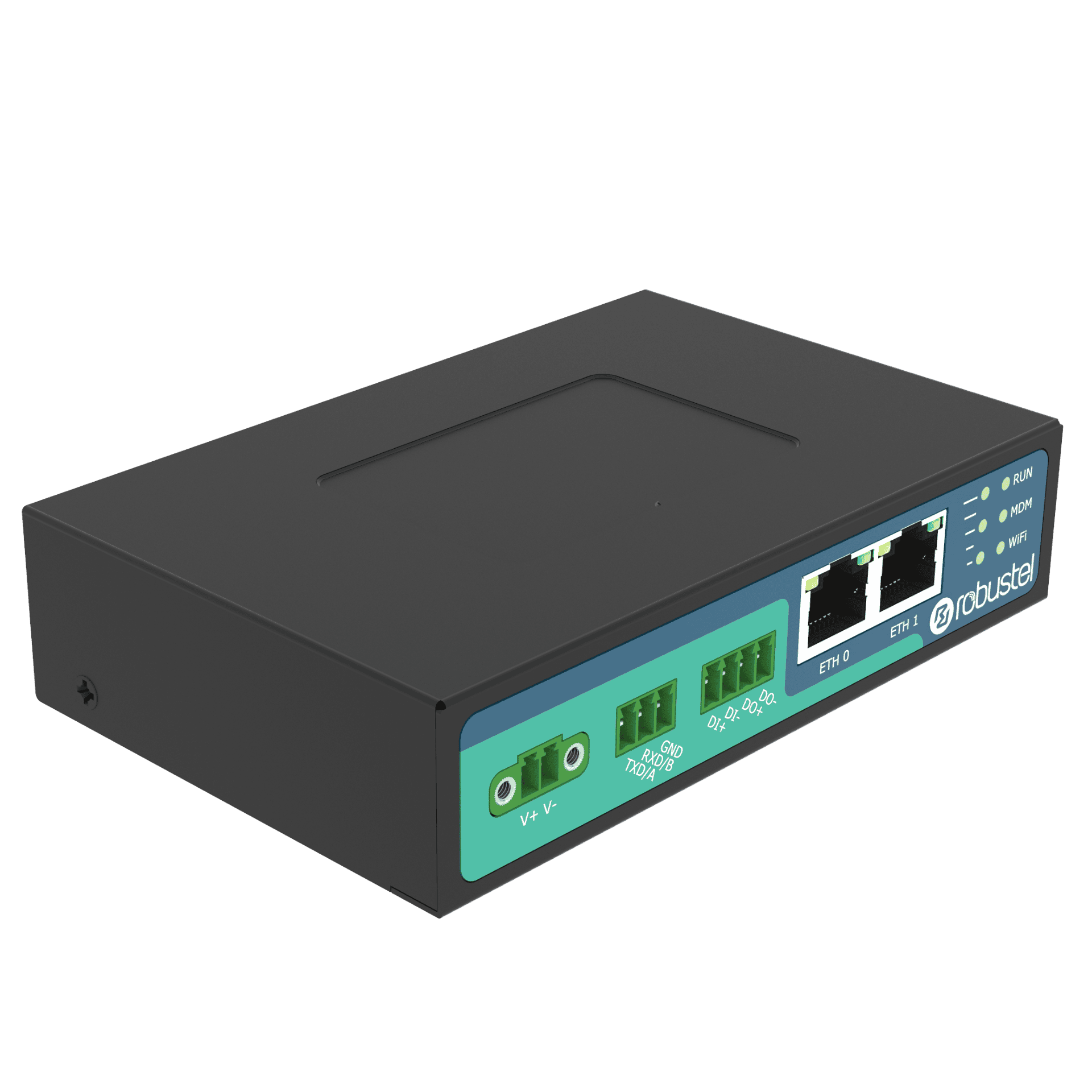
ロバステル 4G/LTE ルーター
RCMSデバイス管理プラットフォーム