
Best VPN Architecture for Industrial 5G Routers: IPsec, OpenVPN or WireGuard?
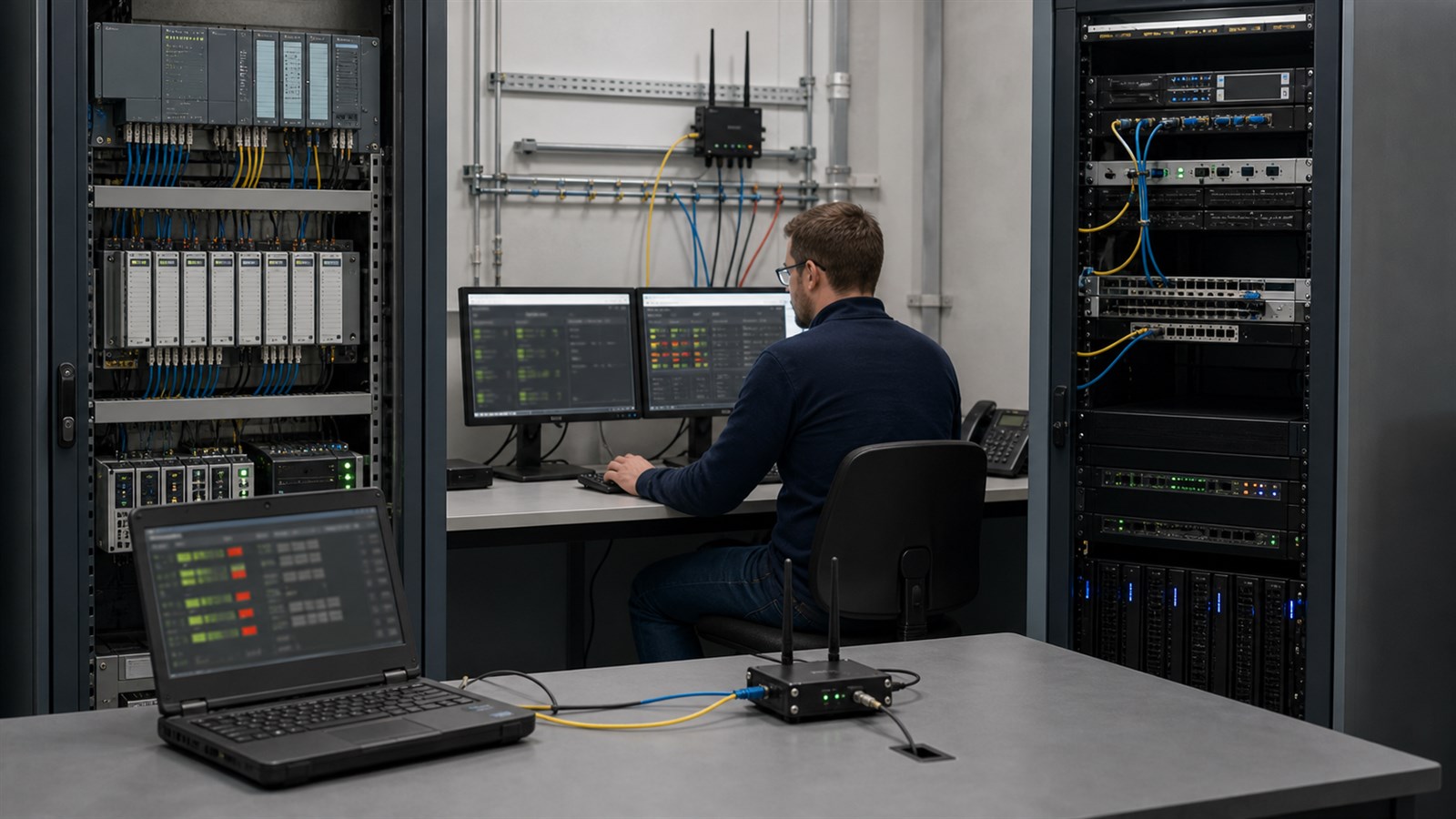
The Robustel R5020-Lite Industrial 5G Router supports IPsec, OpenVPN and WireGuard, making it suitable for several industrial VPN architectures. The best protocol is not universal: site-to-site networking, remote engineering access and large cellular fleets place different demands on interoperability, NAT traversal, performance and credential management.
A factory and a remote engineer can both say: We need a VPN to the machine. But they may mean very different things. The factory wants an entire remote subnet permanently connected to headquarters. The engineer wants temporary access to one controller. A fleet operator wants 300 cellular routers to remain reachable even though their SIMs sit behind carrier NAT.
Choosing IPsec, OpenVPN or WireGuard before defining that topology reverses the design process. The better order is: Who needs access? → To what network? → From where? → Through which NAT/firewall boundary? → Then choose the protocol.
Choose the VPN Topology Before the VPN Protocol
Start with the endpoints.
A site-to-site VPN may connect:
- Remote plant LAN
- → 5G router
- → encrypted tunnel
- → corporate VPN gateway
- → data centre
A remote-user VPN may connect:
- Service engineer
- → VPN
- → remote router
- → one machine subnet
A fleet overlay may connect:
- Hundreds of 5G routers
- → centrally managed private addressing
- → authorized operations users
These architectures have different operational requirements. A site-to-site tunnel usually values predictable routing, interoperability with established enterprise VPN concentrators and long-lived connections. Remote engineering access places more emphasis on user identity, scoped authorization and ease of connecting from laptops behind different networks.
Fleet overlays add another problem: How are hundreds of endpoints enrolled, addressed, monitored and revoked without configuring each tunnel manually? The protocol matters. But the topology determines what “good” means.
Remote User, Site-to-Site and Fleet Overlay Solve Different Problems
Consider a packaging line at a remote factory. The production network needs a permanent path back to headquarters for selected traffic. This is a classic site-to-site requirement.
Now imagine the machine builder needs temporary access twice a month. Giving that engineer permanent access to the entire corporate tunnel may be unnecessary. The remote-access requirement is narrower. A third architecture appears when the machine builder has deployed 200 cellular routers across multiple customers. Some SIMs use private addressing, others sit behind CGNAT, and the service team needs consistent access without asking each mobile operator for a public static IP. Now tunnel initiation and centralized address management become critical.
Robustel’s autonomous robots and drones application example demonstrates the remote-access problem clearly: authorized support teams need to reach moving field assets for diagnostics and intervention without depending on local Wi-Fi or physically recovering the device. The example combines the R5020 with RCMS and RobustVPN for this operating model.
The lesson is not that one VPN protocol fits every robot. It is that the remote-access topology should be defined before the tunnel technology is selected.
Where IPsec, OpenVPN and WireGuard Fit Differently
All three technologies can protect IP traffic, but their operational characteristics differ.
IPsec: Strong Fit for Established Site-to-Site Architectures
IPsec operates at the IP layer and is widely used for network-to-network security gateways. Its architecture defines protected and unprotected network boundaries, security policies and security associations.
It is often a strong fit when:
- Headquarters already runs an IPsec concentrator
- Several remote subnets need permanent connectivity
- Network teams already manage IKE/IPsec policies
- Interoperability with existing enterprise firewalls matters
The trade-off is configuration complexity. Algorithms, IKE settings, traffic selectors, certificates or pre-shared keys, NAT behaviour and routing all need to match between endpoints. IPsec is not automatically the best choice simply because it is common in enterprise networks.
OpenVPN: Flexible for NAT and Remote-Access Environments
OpenVPN uses SSL/TLS and supports both UDP and TCP operation, including deployment through NAT and proxies.
That flexibility makes it useful where:
- Endpoints move between different internet connections
- Remote users need client-based access
- Cellular sites are behind NAT
- The deployment benefits from certificate-based enrollment
- Standard site-to-site IPsec policies are difficult to coordinate
The trade-off is that OpenVPN is a user-space VPN with a relatively rich configuration surface. Performance and operational overhead therefore depend on the hardware, cipher choice, topology and workload.
WireGuard: Compact Configuration with a Different Key Model
WireGuard uses a small peer model built around public keys and AllowedIPs. Its protocol uses UDP and associates cryptographic peer identity closely with permitted IP routes.
It can fit projects that value:
- Relatively simple peer configuration
- Efficient encrypted tunnels
- Lightweight site or device connectivity
- Clear peer-to-IP relationships
The operational challenge moves towards key distribution and peer lifecycle. At ten routers, manual key handling may be acceptable. At 1,000 routers, the organisation needs a controlled process for creating, distributing, rotating and revoking peers.
So the useful comparison is:
| Requirement | IPsec | OpenVPN | WireGuard |
|---|---|---|---|
| Traditional site-to-site | Strong fit | Good fit | Good fit |
| Enterprise firewall interoperability | Often strongest | Depends on platform | Depends on platform |
| NAT-friendly deployment | Requires correct NAT/IKE design | 柔軟な | Works well when peers can maintain reachable endpoints |
| Remote-user access | 可能性 | Common fit | Possible with peer management |
| Configuration simplicity | Usually more complex | 中程度 | Relatively compact |
| Fleet credential management | Policy/PKI dependent | Certificate/platform dependent | Key-management process required |
“Best” therefore means: best fit for the topology and operating model.
Carrier NAT Changes the Tunnel Design
Cellular networks add one problem that office Ethernet often hides: The router may not have a publicly reachable IP address. Carrier NAT or CGNAT can prevent an engineer from opening an unsolicited inbound connection directly to the router. Buying a static public-IP SIM can solve that in some projects, but it is not the only architecture.
Another pattern is:
- Remote router initiates outbound tunnel
- → central VPN service
- → engineer joins same controlled private network
Because the connection originates from the field router, the design does not require inbound port forwarding through the mobile operator.
The Robustel RobustVPN platform follows this model. The current platform is OpenVPN-based, assigns enrolled gateways private addresses and establishes outbound sessions so sites can remain reachable behind NAT/CGNAT without fixed-IP SIMs.
This is a useful distinction: RobustVPN is not a generic label for every VPN protocol supported by RobustOS.
RobustOS provides protocol options such as IPsec, OpenVPN and WireGuard across supported devices, while RobustVPN is a managed OpenVPN-based overlay with its own group, enrollment and access model. Keeping those two concepts separate avoids a common architecture error.
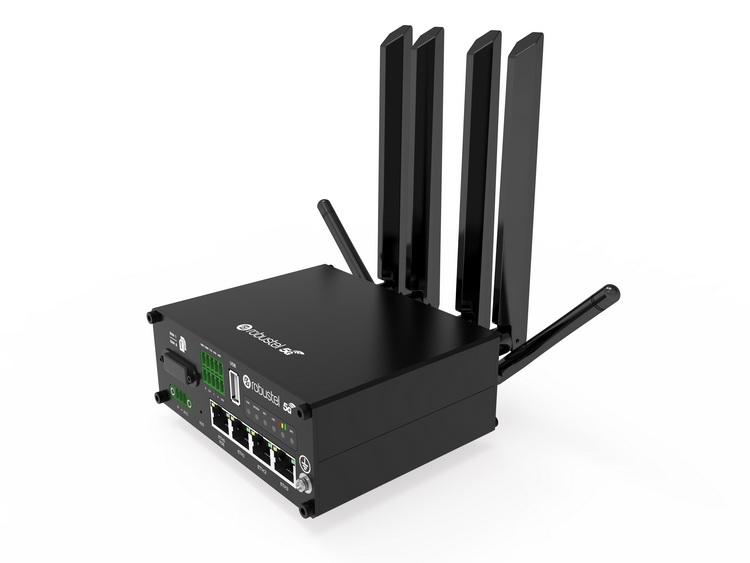
How the Robustel R5020-Lite Industrial 5G Router Fits Multi-Protocol VPN Deployments
The Robustel R5020-Lite Industrial 5G Router currently lists IPsec, OpenVPN and WireGuard among its VPN tunnel capabilities, while also supporting firewall policies, cellular connectivity and RCMS remote management.
That creates several possible roles.
Permanent industrial site
- Machine LAN
- → R5020-Lite
- → IPsec
- → enterprise VPN gateway
Flexible remote site
- Equipment
- → R5020-Lite
- → OpenVPN
- → hosted/central VPN service
Defined peer architecture
- Remote subnet
- → R5020-Lite
- → WireGuard
- → central peer
The right choice still depends on the other endpoint. A protocol is useful only if both sides can be operated consistently. This is visible in Robustel’s high-speed branch-office R5020 application example, where the architecture uses a VPN overlay to provide controlled access and consistent connectivity across branches. The relevant lesson is the overlay design, not that every branch must use the same protocol.
For fleets requiring managed remote access rather than manually maintained individual tunnels, RobustVPN can provide another model. The protocol decision and the management decision are related, but they are not identical.
Test the Tunnel Under Real Cellular Conditions
A VPN that works on a bench over fibre has not yet been validated for a 5G deployment. Test the actual cellular path. At minimum, verify:
- Tunnel establishment: Can the router connect when the SIM is behind the intended carrier NAT model?
- Recovery: What happens after cellular reconnection, SIM switching or temporary loss of service?
- Routing: Do only the intended subnets traverse the tunnel?
- MTU: Does encapsulation create fragmentation or unexpected application behaviour?
- Application traffic: Can the real PLC, HMI, camera or business application operate through the tunnel?
- Performance: Measure throughput and CPU load using representative traffic rather than assuming protocol benchmarks apply directly to the router.
- Credential lifecycle: Can keys, certificates or users be rotated without visiting the site?
- Access removal: Can a contractor or retired device be removed cleanly from the VPN?
The result should be an operationally tested topology, not just a successful “VPN connected” indicator.
よくある質問
Q1. Is WireGuard always faster than IPsec or OpenVPN on a 5G router?
No. Protocol design can influence processing overhead, but real throughput depends on router hardware, encryption settings, packet size, cellular performance and implementation. Benchmark the actual router and traffic profile rather than selecting the protocol solely from general internet performance comparisons.
Q2. Which VPN is best for a permanent branch-to-headquarters tunnel?
IPsec is often a strong fit where headquarters already operates an enterprise IPsec gateway and network teams have established policies. OpenVPN or WireGuard can also work. The better choice depends on interoperability, routing, NAT conditions and how the organisation manages credentials and endpoints.
Q3. Does the Robustel R5020-Lite Industrial 5G Router support all three VPN types?
The Robustel R5020-Lite Industrial 5G Router currently supports IPsec, OpenVPN and WireGuard. Additional VPN and routing options may depend on the product software environment and configuration, so the final design should still be validated against the required firmware and architecture.
Q4. Why is CGNAT important for industrial 5G VPN design?
CGNAT means the cellular router may not be directly reachable from the public internet. Architectures where the field router initiates an outbound VPN tunnel are therefore often easier to operate than solutions that depend on inbound connections to a public IP.
Q5. Is RobustVPN the same as WireGuard?
No. RobustVPN is currently a managed, OpenVPN-based overlay within the Robustel RCMS ecosystem. RobustOS devices may support WireGuard separately, but that is not the same service or management model as RobustVPN.
結論
The best VPN architecture for an industrial 5G router should be selected from the network topology rather than from protocol reputation. The Robustel R5020-Lite Industrial 5G Router gives engineers access to IPsec, OpenVPN and WireGuard, but each option solves a different combination of interoperability, NAT, management and fleet-scale requirements.
Use this order: Who connects → what they can reach → how the cellular network behaves → how credentials are managed → which protocol fits
IPsec often fits established site-to-site enterprise environments. OpenVPN offers flexible deployment and strong compatibility with NAT-heavy remote-access architectures. WireGuard offers a compact peer model where the organisation is prepared to manage keys and routing consistently. The strongest VPN design is not the one with the newest protocol. It is the one the operations team can deploy, recover, audit and revoke reliably across the complete fleet.
Explore more articles about Robustel industrial 5G routers:


著者について
Robert Liao | Technical Support Engineer
Robert is an IoT Technical Support Engineer at Robustel, specializing in industrial networking and edge connectivity. A certified Networking Engineer, Robert focuses on the deployment and troubleshooting of large-scale IIoT infrastructures. His work centers on architecting reliable, scalable system performance for complex industrial applications, bridging the gap between field hardware and cloud-side data management.