
Industrial Ethernet Edge Gateway: Port Count and Network Design Guide
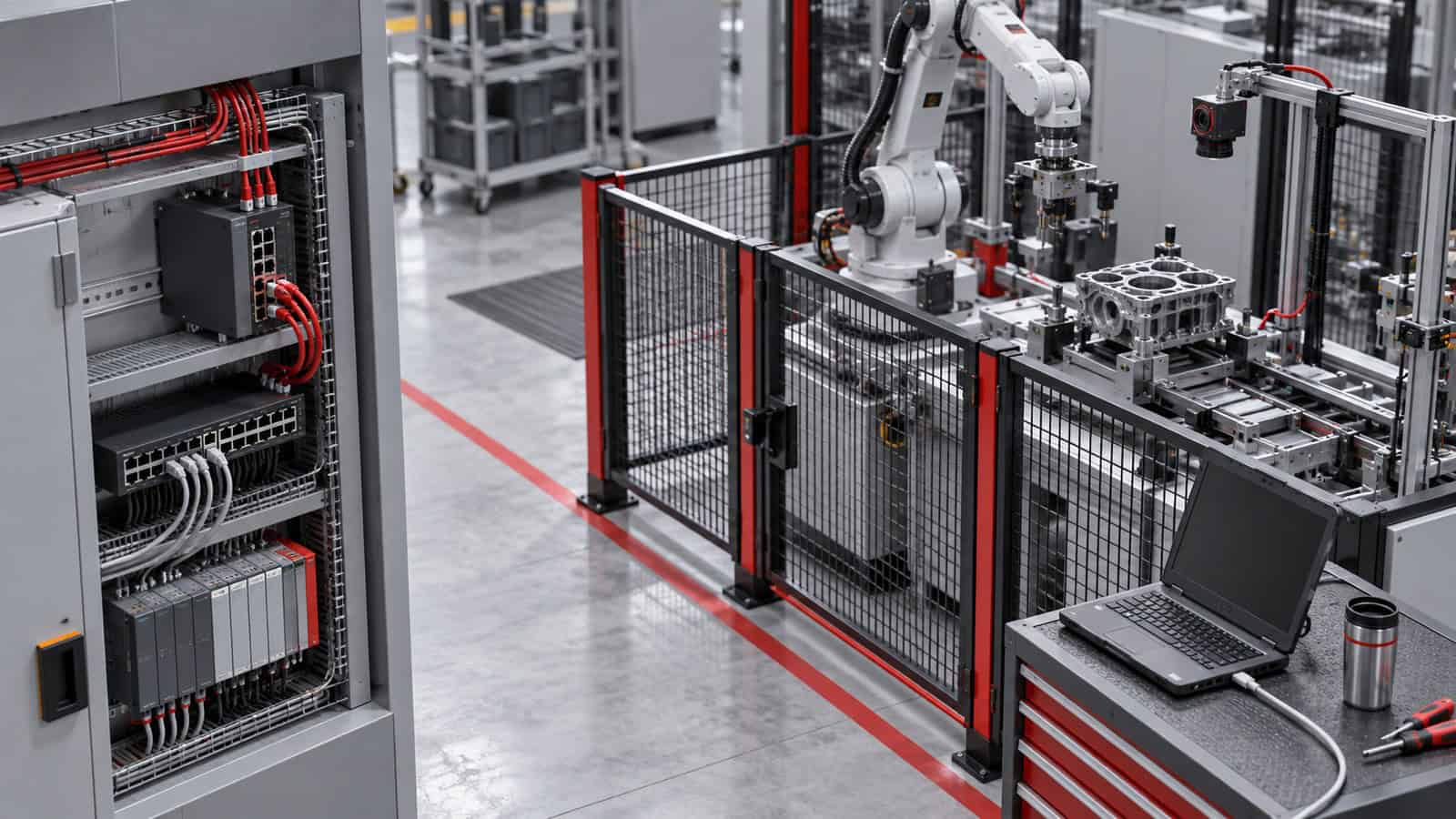
The Robustel EG5200 Edge Computing Gateway provides five Gigabit Ethernet ports that can be configured for LAN or WAN roles. The flexibility is useful only after every port has a named network role and failure effect.
The first decision is ownership. Should the edge gateway connect a few nearby assets directly, aggregate a machine cell, or sit beside a managed switch that owns segmentation and redundancy? Port count follows that answer.
Give Every Port a Named Role
Create the port map before ordering hardware.
| Port role | Connected system | Expected traffic | Trust boundary | Failure effect |
|---|---|---|---|---|
| Upstream WAN/LAN | Plant core or cellular handoff | Northbound and management | IT/OT boundary | Central services unavailable |
| Machine cell 1 | PLC or machine switch | Telemetry and commands | OT cell | One production area affected |
| Vision network | Camera or vision switch | High local bandwidth | Restricted OT | Inspection data affected |
| Entretien | Service laptop/jump host | Intermittent | Controlled access | Support delayed |
| Spare/future | Explicitly reserved | Unknown | Disabled until approved | None initially |
A disabled spare is safer than an unlabeled socket that becomes an informal route between networks. Document VLAN, routing, firewall and management responsibilities. Where the required switching behaviour is not explicitly supported by the gateway, add the appropriate managed switch.
Separate Local Aggregate Traffic from WAN Traffic
Several Gigabit ports can carry traffic that remains local for processing. Cellular backhaul may carry only results, alarms and management. Conversely, a backlog replay or software update can create a WAN burst even when machine telemetry is modest.
Robustel’s Public Safety CCTV Application Example using the EG5100 separates camera connectivity, local edge activity and remote access into different traffic roles. That separation is useful when assigning EG5200 ports: camera ingress may remain local, event data may travel upstream, and maintenance traffic may need its own trust boundary. Measure those flows together because the port map and compute workload share the same gateway resources. The example is not a guarantee that any particular number of video streams fits EG5200.
Benchmark the exact applications, packet sizes and concurrent devices. Port speed indicates physical link capability; processing, storage, software and upstream networks define the end-to-end result.
How the Robustel EG5200 Edge Computing Gateway Supports Multi-Network Factory Cells
Robustel EG5200 edge computing gateway combines five Gigabit Ethernet ports with two configurable RS-232/422/485 serial interfaces, console, HDMI, USB, DI/DO and relay. It has 4 GB RAM, 32 GB eMMC and a documented 2.3 TOPS NPU. Cellular variants include 5G or 4G LTE, and a no-cellular variant also exists; do not assume every unit has 5G.
The hardware can reduce separate interface boxes in a cell where several devices converge. On Robustel EG5200, E2C Factory adds a matched operational layer for supported equipment data, local processing, continuity, visualization, alarms, workflows and northbound integration. The pairing can make the cell easier to commission and operate because network attachment and operational data handling are designed around one named edge platform.
A plant needing fibre, ring protocols, many endpoints, port-level security or independent switch maintenance should keep those duties in dedicated infrastructure. PLC, camera and protocol compatibility also remains an application-level verification task. Five ports simplify a compact cell; they are not a general substitute for the switching architecture.
Design for Maintenance and Partial Failure
If all devices connect directly to the gateway, replacing or rebooting it affects the entire cell. A separate switch may allow local machine traffic to continue during edge-application maintenance. Decide which behaviour is preferable and include it in the failure test.
| EG5200 deployment boundary | Keep on the gateway | Keep in dedicated infrastructure when required |
|---|---|---|
| Compact device attachment | A small, stable set of named Ethernet endpoints | A growing estate or ports managed by another team |
| Local edge workload | Supported applications and their local data path | Deterministic or safety control owned by the control system |
| Network segmentation | Verified routing and firewall policy within the design | Fibre, ring redundancy or switch functions not documented on EG5200 |
| Operations | Gateway, application and cellular management | Independent switch lifecycle and plant-wide network monitoring |
| Recovery | Tested restart, buffering and northbound reconnect | Local switching that must survive gateway maintenance |
The right-hand column is not a shortcoming; it defines where a dedicated switch or controller preserves a cleaner failure boundary.
Robustel’s Secure Remote Access to Industrial Robots Application Example makes the maintenance path a separate operating boundary rather than an incidental connection to the machine network. Use that distinction to reserve a port or segmented path for service access instead of letting a technician’s laptop share an undefined production segment. During commissioning, remove one downstream asset and the upstream WAN separately, then confirm which local functions continue and which remote sessions must recover. The example guides access architecture rather than proving a universal port layout.
Robustel’s EG5000 Series Quick Pitch video gives buyers an overview of the gateway family. Use it to orient the team, then verify the exact EG5200 variant, interfaces and software against the project bill of materials.
Decide When an External Switch Is Mandatory
Use a dedicated industrial switch when endpoint count exceeds the direct-port plan; fibre or long-distance Ethernet is required; ring redundancy is part of the availability design; switching must remain operational while the gateway is serviced; or the security design needs switching features not documented on the gateway.
Use direct ports when the cell is compact, device count is stable, the gateway’s verified controls meet the segmentation need, and the shared failure boundary is accepted. The simplest diagram is not always the simplest lifecycle.
Foire aux questions
Q1. What is an industrial edge gateway?
It connects industrial equipment to local applications and upstream systems, often combining network, serial and I/O interfaces with compute that runs close to the process.
Q2. What is the difference between an edge gateway and a router?
A router primarily moves and secures network traffic. An edge gateway can also host supported data collection, processing and application workloads; some industrial products combine both roles.
Q3. Can an edge gateway connect to Ethernet devices?
Yes, when it provides suitable Ethernet ports and the device protocol and network design are compatible. A physical link alone does not perform application-level integration.
Q4. Do I still need an industrial Ethernet switch?
Often yes for larger networks, fibre, redundancy, independent switching or advanced segmentation. A multi-port gateway can be enough for a compact, deliberately bounded cell.
Q5. When is the Robustel EG5200 Edge Computing Gateway the right multi-port choice?
It fits cells that need several Gigabit Ethernet attachments, broad serial/peripheral connectivity and substantial local compute in one platform. Retain an external switch where the network’s scale or resilience requires it.
Conclusion
The Robustel EG5200 Edge Computing Gateway can simplify a compact multi-device cell when its five Ethernet ports each have a named role. It should not inherit switching duties by accident: traffic aggregation, trust boundaries and partial-failure behaviour still need a deliberate owner.
Draw the topology with the gateway removed, one endpoint failed and the upstream WAN unavailable. That exercise usually reveals whether EG5200 can replace a small unmanaged layer, should sit beside a managed switch, or is better kept as a focused application node. Confirm the chosen arrangement under simultaneous local and northbound load.
Explore More Articles About Robustel Edge Computing Gateways
À propos de l'auteur
Robert Liao | Technical Support Engineer
Robert is an IoT Technical Support Engineer at Robustel, specializing in industrial networking and edge connectivity. A certified Networking Engineer, Robert focuses on the deployment and troubleshooting of large-scale IIoT infrastructures. His work centers on architecting reliable, scalable system performance for complex industrial applications, bridging the gap between field hardware and cloud-side data management.