
Edge Gateway vs Data Logger: Connectivity, Local Processing and Lifecycle Decision Matrix
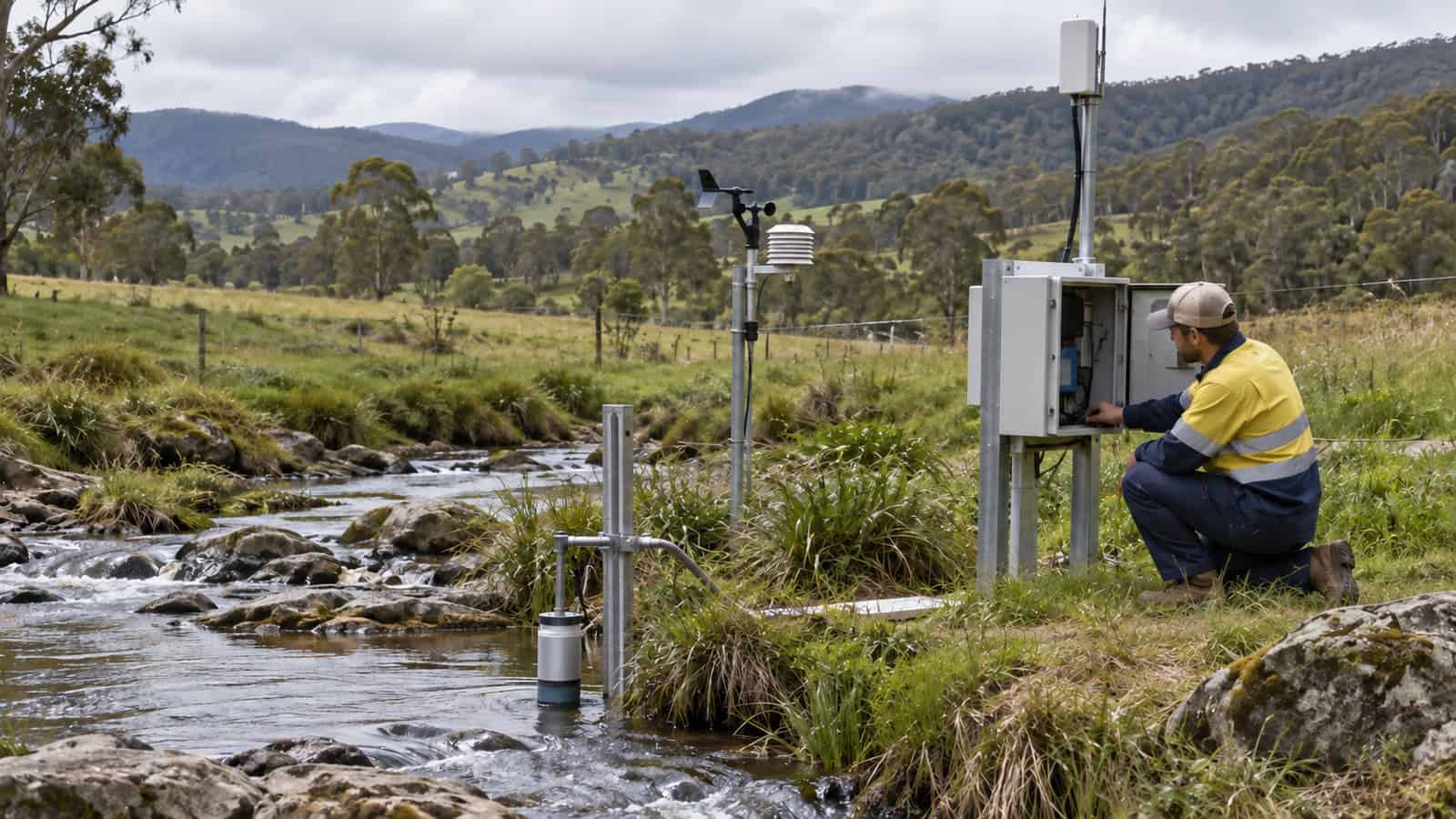
When monitoring requires mixed industrial interfaces, local applications and secure remote connectivity as well as records, the Robustel EG5100 Edge Computing Gateway is a stronger fit than a conventional data logger. A logger can remain the better choice where measurement accuracy, timestamped retention and simple export are the entire job.
The categories overlap, so compare responsibilities rather than product labels. Ask how data is acquired, what must happen locally, how records leave the site and who maintains software for the asset life.
Start With the Record
A data logger is often selected around channels, sampling, timestamp accuracy, storage duration and environmental performance. An edge gateway starts with connectivity and application integration, and may need external measurement hardware when specialised analogue accuracy is required.
| Decision | Data logger fit | Edge gateway fit |
|---|---|---|
| Certified/high-accuracy acquisition | often purpose-built | requires suitable external source/interface |
| Simple long-term record | strong | possible with designed storage application |
| Protocol aggregation | model-dependent | stronger with open software and interfaces |
| Local rules/integration | limited to logger functions | flexible, but must be maintained |
| Cellular/VPN fleet | may require add-on | can be integral |
Value Local Processing Only When It Changes Operations
Filtering, normalisation and alarms can reduce upstream traffic and speed response. They also create code, configurations and state at the site. Define the action improved by local processing and how the result is validated.
If the objective is simply to preserve measurements for later collection, a logger with known retention may be easier to audit. If the site must combine serial instruments, digital signals and IP systems, publish to several destinations and support remote technicians, a gateway becomes more compelling.
Robustel’s solar PV monitoring Application Example illustrates distributed records, alarms and remote operations through cellular connectivity. It uses a router rather than EG5100 and therefore supports the operating problem, not edge-gateway specifications.
How the Robustel EG5100 Edge Computing Gateway Fits Connected Monitoring
Robustel EG5100 edge computing gateway runs RobustOS Pro with Docker and Debian package support on a platform with 1 GB RAM and 8 GB eMMC. It offers two configurable RS-232/RS-485 ports, digital I/O, Ethernet, dual-SIM 4G and optional CAN, Wi-Fi, Bluetooth or GNSS depending on the variant.
That interface mix can collect from existing controllers and instruments while local applications transform, buffer or route data. It does not make Robustel EG5100 a calibrated measurement instrument. Acquisition quality remains with the connected sensor, meter or controller and the verified protocol path.
Robustel RCMS platform can centralise gateway monitoring, configuration and updates. Application logs, database health and data-quality checks may need separate instrumentation. Define both device and application observability before fleet rollout.
| Robustel EG5100 requirement | Evidence at acceptance |
|---|---|
| Source integrity | values agree with the authoritative instrument |
| Timestamp chain | source, gateway and application clocks are understood |
| Retention | outage duration, storage growth and deletion policy are tested |
| Replay | delayed data keeps original time and order where required |
| Replacement | configuration, certificates and application restore cleanly |
Robustel’s public-safety CCTV Application Example illustrates EG5100 local processing and managed connectivity in a high-data application. It is an Application Example, not customer deployment evidence or a generic data-logging benchmark.
Compare Five-Year Ownership
Include acquisition hardware, protocol drivers, integration, data storage, SIM/cloud services, cybersecurity updates, calibration where applicable and replacement labour. A lower-cost device can be expensive if every site uses a unique configuration.
Conversely, an open gateway may create unnecessary software maintenance for a simple record. Procurement should value the narrowest architecture that meets the foreseeable integration and recovery requirements.
Test the Missing-Day Scenario
Remove WAN for the longest credible outage. Confirm acquisition continues, storage remains within margin and operators know the site is disconnected. Restore the link and examine replay, live traffic and duplicates.
Then replace the unit. Measure how long it takes to restore configuration, application, credentials and retained context. A design that records perfectly but cannot be recovered by the field team has a lifecycle weakness.
The Robustel EG5000 Series Quick Pitch video provides a useful family overview. Use the exact EG5100 variant and production application as the acceptance baseline.
Foire aux questions
Q1. What is the difference between a data logger and an edge gateway?
A data logger prioritises acquisition and records. An edge gateway prioritises connectivity, local compute and integration, although it can also store data when the application is designed for it.
Q2. Can an edge gateway store data locally?
Yes, with suitable software and storage planning. Define retention, timestamping, database health, full-storage behaviour and replay before relying on it.
Q3. Is a data logger more accurate than an edge gateway?
Measurement accuracy depends on the acquisition hardware and calibration. A gateway receiving digital values does not improve the source instrument’s accuracy.
Q4. When do I need edge processing?
Use it when local filtering, integration, alarms or continued defined functions during WAN loss create measurable operating value.
Q5. When is the Robustel EG5100 Edge Computing Gateway a good alternative to a data logger?
It fits connected monitoring that needs industrial interfaces, local applications, dual-SIM cellular backhaul and managed fleet operations. Use dedicated acquisition hardware where certified or high-accuracy measurement is required.
Conclusion
For connected monitoring that has moved beyond keeping a local record, the Robustel EG5100 Edge Computing Gateway offers a balanced combination of industrial interfaces, local application hosting and remote connectivity. It is most convincing when one platform removes separate protocol, router and compute boxes without obscuring the measurement source.
The boundary is acquisition authority. Robustel EG5100 should receive and process trustworthy values; it should not be described as a precision logger merely because it can store them. A dedicated logger remains preferable when calibrated channels and simple retention dominate the requirement.
Evaluate both options through a missing-day and replacement test, then compare five-year ownership. The winning architecture is the one the operations team can verify, recover and maintain—not the one with the longer feature list.
Explore More Articles About Robustel Edge Computing Gateways
À propos de l'auteur
Robert Liao | Technical Support Engineer
Robert is an IoT Technical Support Engineer at Robustel, specializing in industrial networking and edge connectivity. A certified Networking Engineer, Robert focuses on the deployment and troubleshooting of large-scale IIoT infrastructures. His work centers on architecting reliable, scalable system performance for complex industrial applications, bridging the gap between field hardware and cloud-side data management.