
Edge Gateway for Predictive Quality: Data Pipeline and Hardware Checklist
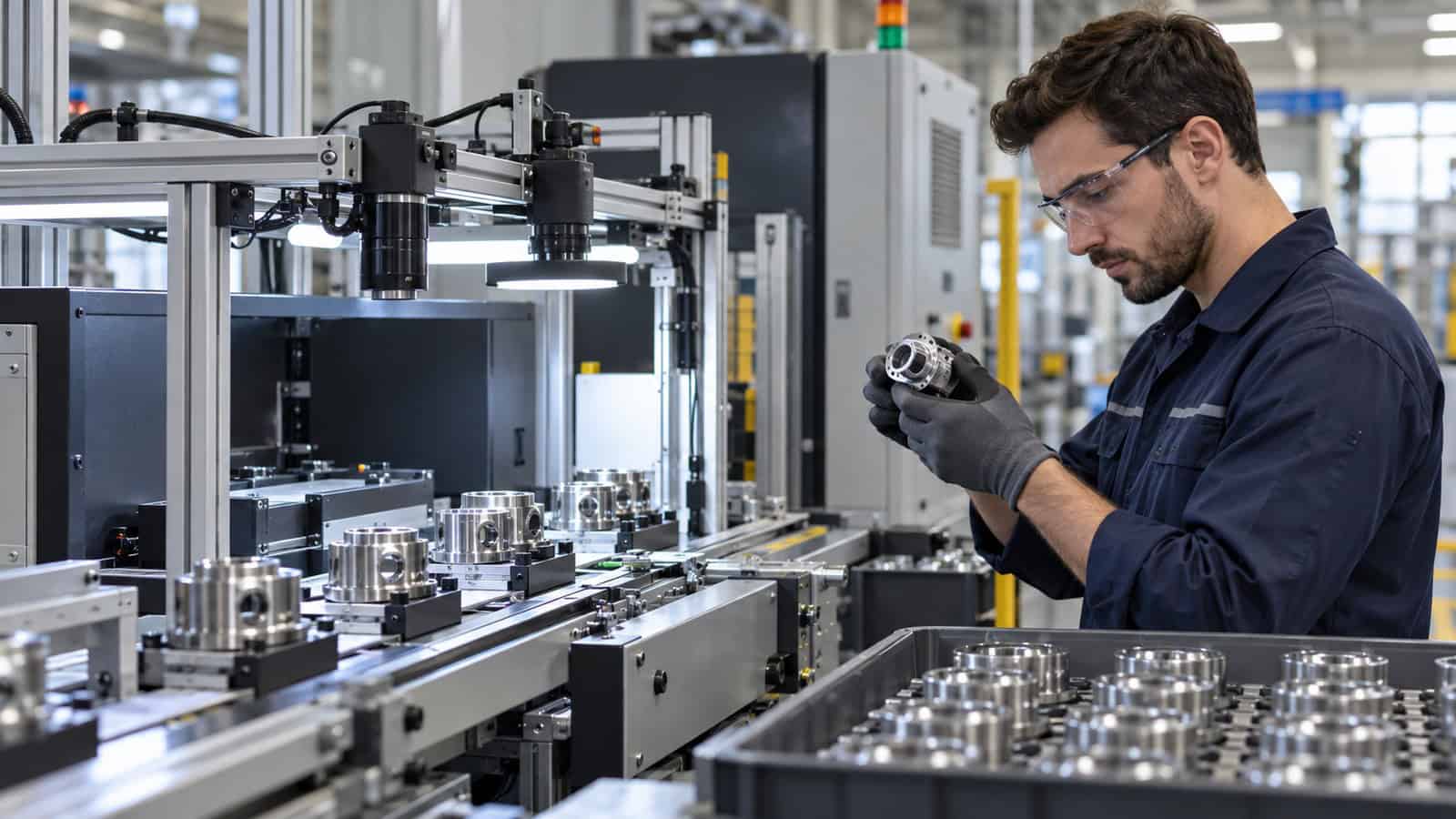
The Robustel EG5200 Edge Computing Gateway provides local compute, multiple industrial interfaces and an integrated NPU for predictive-quality workloads, but useful predictions depend more on traceable production context than on an isolated model score. The gateway design must preserve part identity, process conditions, inspection result and model version from the machine to the quality decision.
Begin with the Decision the Quality Team Can Act On
Define whether the model is screening parts, prioritising inspection, detecting process drift or stopping a batch for review. Each decision needs a different latency, false-positive tolerance and evidence record. A pilot that reports an accuracy percentage without describing the downstream action is not ready for a production gateway.
Build one trace from raw signal to disposition. Include machine state, recipe, tool or fixture, part or batch identifier, sample timestamp, transformation version, inference result and the later confirmed quality outcome. That last label is what allows the team to learn whether the model remains useful after material, tooling or lighting changes.
In field work, the awkward failures are often contextual: a sensor value is valid but attached to the previous part, a camera frame arrives after the PLC changes state, or a restarted container loads a different model file. Test those boundary events deliberately.
Define the Decision and Error Cost
State the input, expected output, decision deadline and action. Quantify false positives and false negatives in operational terms. A model that catches defects but stops a line too often may have negative value despite high laboratory accuracy.
Choose where a human remains in the loop. Safety and deterministic control should not be transferred to a general edge gateway without the required certified architecture. Edge inference can provide evidence or recommendations while an approved controller retains authority.
Size the Whole Pipeline
Account for acquisition, network traffic, decoding, resize/pre-processing, inference, post-processing, local retention and result delivery. Camera count and resolution do not directly equal simultaneous inference capacity.
| Workload component | Measure | Pourquoi est-ce important ? |
|---|---|---|
| Entrée | streams, frame rate, resolution, codec | drives network and decode load |
| Modèle | framework, precision, input shape | determines runtime compatibility and NPU use |
| Mémoire | model, buffers, containers | peaks can exceed steady state |
| Storage | evidence images, logs, updates | retention and write endurance matter |
| Output | alarms, metadata, clips | affects WAN and application integration |
Benchmark the actual model and runtime. A published NPU value is a hardware capability, not a frames-per-second promise across arbitrary models.
The Robustel’s secure remote access to industrial robots Application Example illustrates the operational need for controlled remote support around industrial systems. It supports the lifecycle discussion, not AI performance claims.
How the Robustel EG5200 Edge Computing Gateway Fits Demanding Edge AI Workloads
The Robustel EG5200 Edge Computing Gateway is built around a quad-core 1.6 GHz Cortex-A53, 4 GB DDR4, eMMC storage and an integrated NPU rated up to 2.3 TOPS. It provides five Gigabit Ethernet ports, configurable serial interfaces, USB 3.0, HDMI and cellular variants. These resources make it the strongest fit in this batch for multi-interface vision or analytics pilots.
Five ports can connect a compact cell, but they do not replace a managed switch when the network requires fibre, ring redundancy, extensive VLAN operations or more endpoints. Likewise, HDMI and USB make local commissioning easier without proving a particular camera or runtime integration.
For compatible Robustel EG5200 deployments, Robustel’s E2C Factory can organise supported machine data, alarms, local visualisation and northbound integration beside the AI application. The combined value is operational: model outputs can enter the same visible edge workflow as other factory signals. Compatibility does not mean every AI runtime is supported or that the software is bundled.
| EG5200 selection evidence | Pilot requirement |
|---|---|
| 2.3 TOPS NPU | prove the exact model/runtime uses it |
| 4 GB RAM and local storage | capture peak memory, logs and retention margin |
| five Gigabit Ethernet ports | measure aggregate camera/device traffic |
| Debian/container environment | lock dependencies, security and update process |
| cellular/RCMS operations | test remote access and staged deployment under load |
Build Operations Before the ROI Model
Models drift as lighting, products and processes change. Define data collection, version approval, rollback, health monitoring and retraining ownership. If no one can see that inference has stopped or inputs have changed, local processing hides failure rather than reducing it.
ROI should include integration engineering, labelling, validation, gateway hardware, cameras, storage, support and model maintenance. Compare that with a measured baseline of inspection labour, scrap, downtime, bandwidth or delayed response.
Robustel’s public-safety CCTV Application Example shows local processing and upstream event delivery on another gateway model. It illustrates bandwidth and remote-operations value, not an EG5200 benchmark.
Prove the Longest Busy Period
Run all intended streams, containers, E2C services and backhaul traffic in the final cabinet for the longest credible busy period. Measure processing latency, dropped frames, memory, storage, temperature and application stability over time.
Disconnect WAN while inference continues, then restore it and observe replay traffic alongside live results. Test an application update and rollback. The pilot passes when the operating team can diagnose and recover the system, not only when a model completes a demo.
The Robustel EG5000 Series Quick Pitch video can align stakeholders on product-family roles. Exact EG5200 sizing comes from the production benchmark.
Foire aux questions
Q1. What is an edge AI gateway?
It is an industrial edge platform that runs supported inference near data sources and connects results to local or remote systems. It also needs lifecycle, security and monitoring around the model.
Q2. How do you size an edge AI gateway?
Benchmark the exact inputs, decoding, model runtime, memory, storage, containers and outputs under sustained production conditions. TOPS alone is not enough.
Q3. What are the benefits of edge AI?
Potential benefits include local response, reduced upstream data and continued defined functions during WAN loss. Value depends on the model, integration and operating process.
Q4. Does edge AI work without the cloud?
Inference and defined local actions can operate without cloud access when designed that way. Model updates, central analytics and remote operations may still depend on connectivity.
Q5. When is the Robustel EG5200 Edge Computing Gateway a good edge AI fit?
It fits demanding pilots that need its 2.3 TOPS NPU, 4 GB RAM, five Gigabit Ethernet ports and open application environment. Validate the exact runtime and sustained workload before rollout.
Conclusion
The Robustel EG5200 Edge Computing Gateway provides a credible compute and connectivity base for a multi-interface predictive-quality workload that has outgrown lightweight gateway resources. Its NPU, memory and port density are most valuable when they remove a measured bottleneck in the full pipeline.
The business case should remain tied to avoided cost or improved operational decisions, not a hardware score. Robustel E2C Factory may make supported factory data and model results easier to operate together on EG5200, while model compatibility and control authority still require separate proof.
Move from pilot to fleet only after a sustained thermal/workload run, WAN-loss recovery, update rollback and monitoring test. Those results create the operating evidence needed for an ROI decision.
Explore More Articles About Robustel Edge Computing Gateways
À propos de l'auteur
Robustel Editorial Team
The Robustel Editorial Team publishes practical articles on industrial connectivity, edge computing, LoRaWAN and device management, focusing on deployment considerations, technical limitations and long-term operation.