
Edge Gateway for Machine Vision: 2026 Hardware and Network Buying Checklist
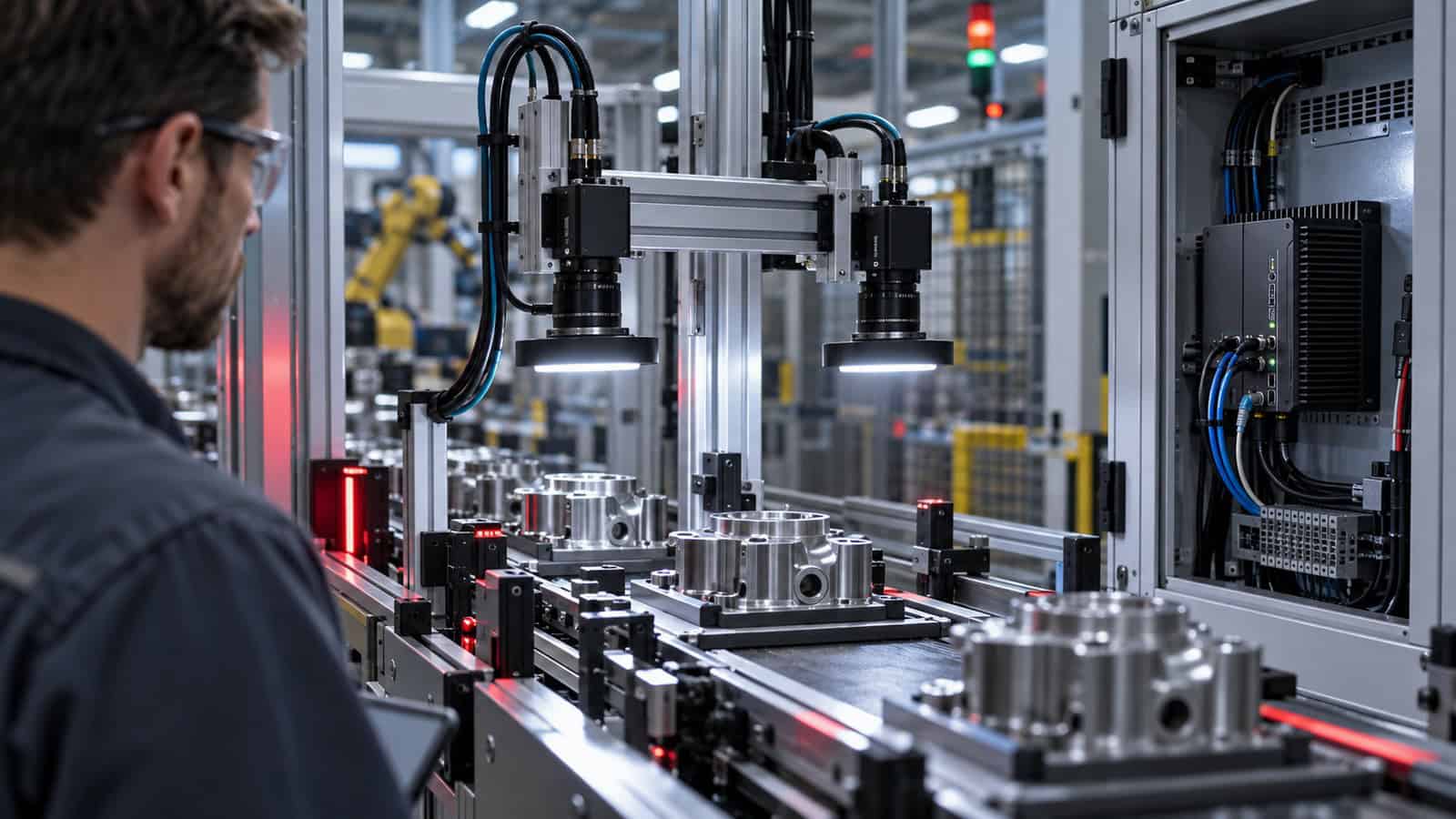
The Robustel EG5200 Edge Computing Gateway combines five Gigabit Ethernet ports, 4 GB RAM, 32 GB eMMC and a documented 2.3 TOPS NPU. These are useful machine-vision building blocks, not a statement about how many cameras or models the gateway will run.
Vision capacity depends on resolution, frame rate, codec, preprocessing, model, runtime, result handling and every other service sharing the device. Procurement should require a production benchmark rather than converting TOPS or port count into an unsupported stream figure.
Define the Inspection Before Comparing Hardware
Write the event the system must detect, the acceptable miss and false-alarm rates, the maximum decision time, and what happens after detection. A high-speed reject mechanism has a different architecture from periodic safety-zone observation or quality evidence captured for later review.
| Acceptance item | Required test input | Evidence to record |
|---|---|---|
| Camera path | Exact camera, resolution, codec and frame rate | Packet loss and sustained receive rate |
| Decode/preprocess | Production runtime and image transforms | CPU, memory and processing time |
| Inference | Exact model and accelerator runtime | Latency distribution and accuracy |
| Result action | Real PLC/application handoff | End-to-end response and failure state |
| Storage | Normal events and worst credible burst | Retention and write behaviour |
| Thermal | Final enclosure and all services active | Stability after heat soak |
Camera Ports Do Not Equal Camera Capacity
Five Ethernet ports allow useful physical topologies, but a multi-camera system may still need a dedicated PoE or managed switch. Confirm power, VLANs, aggregate traffic and whether local camera-to-gateway flows should continue if the upstream network is unavailable.
Robustel’s Public Safety CCTV Application Example using the EG5100 illustrates the separate paths for camera connectivity, edge activity and remote access. That is a useful architecture check before benchmarking EG5200: count ingress streams, define which frames remain local, and add maintenance and result traffic to the same test. A port can carry a camera connection while compute, memory or storage becomes the actual limit. The example uses another model and workload, so it does not prove EG5200 machine-vision capacity.
Measure the whole pipeline: network input, decode, resize, normalization, inference, post-processing, result delivery and any image retention. The slowest or most variable stage determines the practical limit.
How the Robustel EG5200 Edge Computing Gateway Supports Multi-Camera Machine-Vision Cells
EG5200’s five Gigabit Ethernet interfaces, local display and USB connectivity, serial/I/O options, 4 GB memory, 32 GB storage and 2.3 TOPS NPU make it a credible candidate for a multi-device vision cell. Its cellular variants can provide a remote path for selected support or data, while a no-cellular variant is available where the plant network owns connectivity.
On Robustel EG5200, E2C Factory can add a compatible operational layer around supported factory data, local processing, continuity, visualization, alarms, workflows and northbound integration. In a vision project, that pairing may make inspection status and surrounding machine data easier to operate together, reducing the number of separate tools used to expose results and alarms.
The machine-vision application, camera driver and model runtime still require separate verification. E2C Factory should not be assumed to supply an arbitrary vision stack, and the software is not assumed to be bundled. If a compact two-port node meets the benchmark, Robustel EG5120 Edge Computing Gateway may provide a more proportionate hardware layout with the same documented NPU figure.
Memory, Storage and Heat Reveal the Real Limit
Model files, runtime libraries, frame buffers and other containers share RAM. Storage demand depends on whether the system retains continuous video, event clips, evidence frames or only metadata. Define retention during a WAN outage and what happens when storage reaches its limit.
Use the EG5200 resources as separate budgets rather than one headline capacity:
- Ethernet budget: measured camera traffic, management overhead and any local switch uplink;
- memory budget: frame buffers, model, runtime, containers and operating margin at the busiest credible moment;
- storage budget: normal evidence, exception bursts, logs and WAN-outage retention, including the full-disk policy;
- compute budget: decode, preprocessing, inference and post-processing with all production services active; and
- thermal budget: sustained behaviour after the final enclosure reaches equilibrium.
Procurement should attach a measured limit to each budget. Passing four does not compensate for a fifth that fails halfway through a shift.
Thermal testing must run long enough for the enclosure to reach equilibrium. Use the exact model, real camera input and all production services in the final cabinet. Watch latency distribution, throttling indicators, dropped frames, application restarts and storage behaviour over the longest credible busy period. A short demonstration can finish before the hardware is warm and hide a failure that appears halfway through a shift.
The Robustel’s EG5000 Series Quick Pitch video provides a useful family overview at this stage. The production benchmark remains the source of truth for the selected workload.
Test Recovery and Evidence Handling
Remove one camera, the upstream network and the application process in turn. Confirm whether inspection continues, whether the machine enters a safe state, and how operators are alerted. Restore each component and verify that old frames or results are not mistaken for live evidence.
The Robustel’s Smart Parking Application Example combines cameras, local processing and centralized operations, making it a useful reference for evidence handling after a fault. Decide which images or events must be retained locally, how old data is distinguished from live results, and what is replayed when the WAN returns. Then test those rules while the production inference workload continues. The example informs distributed vision data flow; it is not a performance result for a production-line model.
Foire aux questions
Q1. What is edge AI vision?
It runs vision processing or AI inference close to the camera or machine rather than sending every frame to a remote cloud. The exact architecture may still use central systems for management and analysis.
Q2. Does machine vision use AI?
Some systems use AI models, while others use conventional image processing and rules. Choose the method that meets the inspection requirement and can be validated and maintained.
Q3. What is an edge gateway?
It is a managed computing and connectivity device placed near industrial assets. It can connect equipment, run supported local applications and exchange selected data with upstream systems.
Q4. How much computing power does machine vision need?
There is no universal figure. Resolution, frame rate, codec, image processing, model, runtime and concurrency determine the requirement, so benchmark the exact pipeline.
Q5. When is the Robustel EG5200 Edge Computing Gateway a good fit for machine vision?
It is a strong candidate when a cell needs several Gigabit Ethernet connections, broad peripheral options and a documented 2.3 TOPS NPU. The exact cameras, model and sustained thermal workload must pass on-device testing.
Conclusion
The Robustel EG5200 Edge Computing Gateway offers a broad hardware base for a machine-vision cell, but neither Ethernet-port count nor accelerator capacity establishes production throughput. Camera input, preprocessing, inference, storage and result delivery compete for resources inside the final thermal environment.
Build one benchmark from the production model and real image stream. Run it through the longest busy period and the failures the cell must tolerate. Retain latency distribution, dropped work, temperature and recovery evidence. Buy against that record; headline specifications are only the starting limits.
Explore More Articles About Robustel Edge Computing Gateways
À propos de l'auteur
Robert Liao | Technical Support Engineer
Robert is an IoT Technical Support Engineer at Robustel, specializing in industrial networking and edge connectivity. A certified Networking Engineer, Robert focuses on the deployment and troubleshooting of large-scale IIoT infrastructures. His work centers on architecting reliable, scalable system performance for complex industrial applications, bridging the gap between field hardware and cloud-side data management.