
5G Router High Availability Guide: RTO, Health Checks and Failure-Domain Design
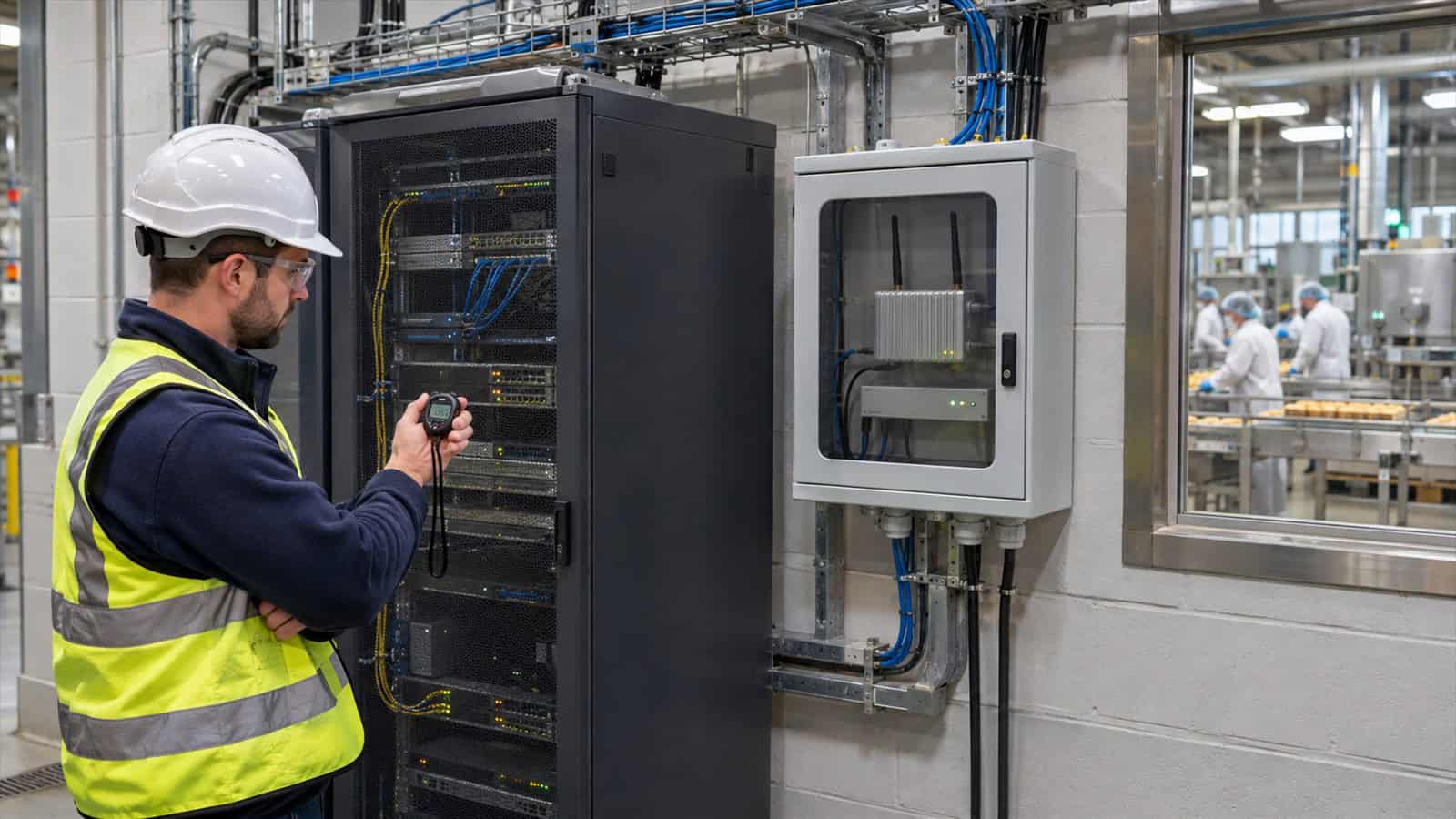
The Robustel R5020 Industrial 5G Router supports cellular and Ethernet WAN options, dual SIM and configurable health checks, making it a strong platform for resilient sites when the project begins with a measurable recovery-time objective rather than a generic “always on” requirement.
Translate Downtime into an RTO the Site Can Test
Ask the process owner what stops during an outage and when that consequence becomes unacceptable. A remote dashboard can often wait longer than a payment terminal, and both may tolerate more interruption than a staffed operations voice path. Define recovery time separately for telemetry, control support, user access and alarms.
Then define the observation that ends the clock. Mobile registration is too early if the VPN is still rebuilding; a ping is too early if the application session has stale credentials. An RTO should finish when the named service has exchanged valid data again.
| Service | Start event | Recovery evidence | Target owner |
|---|---|---|---|
| telemetry | last accepted sample | current sample with valid timestamp | data operations |
| remote support | primary path withdrawn | authenticated session to target asset | OT support |
| alarm delivery | endpoint unreachable | acknowledged test event | application owner |
Make Health Checks Represent the Required Service
A router can have radio coverage while the APN, DNS resolver, VPN concentrator or cloud application is unavailable. Use more than one discriminating observation where the consequence justifies it. Avoid public ping targets that stay reachable while the enterprise service has failed.
Robustel’s fixed-line backup over 5G application example frames the cellular router as a recovery path rather than a speed upgrade. The field lesson is to test the same security and application route on backup; otherwise a clean WAN change can still strand the actual service.
During commissioning, record which check failed first, when the route changed, when the tunnel returned and when the application accepted data. Those timestamps make tuning possible. Without them, teams often shorten every interval and create flapping.
Catalogue Shared Failure Domains Before Adding Hardware
Two WANs may share site power, antenna placement, DNS, firewall policy, a tunnel endpoint or a damaged switch. Draw each dependency once and connect both paths to it. The diagram usually explains why an apparently redundant site still failed.
- Local: power supply, DC protection, cabinet temperature, Ethernet switch and antennas.
- Provider: radio site, access network, APN, DNS and commercial account.
- Enterprise: firewall, identity, VPN concentrator, routing and application endpoint.
- Operations: credentials, monitoring, escalation and spare configuration.
Use a separate mitigator for the dominant shared domain. A second SIM does not address site power; a UPS does not address an expired APN credential; a second tunnel endpoint does not help if both names resolve through one failed DNS service.
How the Robustel R5020 Industrial 5G Router Supports an RTO-Led Design
| Availability pain | Verified R5020 capability | Recovery mechanism | Acceptance evidence |
|---|---|---|---|
| fixed WAN loss | configurable Ethernet and cellular WAN roles | move required traffic to 5G/4G without replacing the site router | timestamp detection, route change, tunnel and application recovery |
| mobile-path loss | dual Mini SIM | change subscription under a defined health policy | block the preferred APN and measure service restoration |
| stranded distributed sites | RCMS-ready management | expose fleet state and restore approved configuration remotely | recover a controlled failed change through the documented path |
Robustel R5020 Industrial 5G Router combines four Gigabit Ethernet ports, dual SIM 5G/4G connectivity, serial interfaces and WAN failover options. This allows one device to connect a primary fixed path, alternate cellular service and the site’s OT-facing equipment while keeping the operating policy visible in a standard platform.
Robustel RCMS adds fleet status, configuration and update operations. In a high-availability design, its value is strongest when alerts correspond to the same service states used in the RTO test and when teams know how they will manage a site if the normal management path is unavailable.
Robustel’s Jones Technology retail case study shows the operational value of applying one repeatable WAN approach across distributed stores. Use that fleet discipline to retain test results and exceptions per site; do not assume one successful branch proves identical RF and carrier behaviour everywhere.
Run a Failure Sequence That Includes Restoration
Withdraw the fixed WAN, block the preferred APN, remove the VPN endpoint and restart site power as separate events. Keep the application under representative load. Measure detection, path change, tunnel recovery, application recovery and return to primary. Restoration matters because an aggressive return can interrupt a stable backup session.
The Robustel video of “5G Router, 5G RedCap, or 4G: How to Choose for Industrial IoT” is useful for aligning the radio choice with workload and lifecycle. The release record should finally state the achieved RTO, shared domains left in place, alert owner and conditions that require a retest.
Foire aux questions
Q1. What is high availability in networking?
It is a design and operating practice that keeps or restores required services within an agreed time despite defined failures.
Q2. What is RTO in disaster recovery?
Recovery time objective is the maximum intended time to restore a specified service after disruption. It must identify the service and the evidence that recovery is complete.
Q3. How do router health checks work?
They send or observe traffic to decide whether a path is usable. Good checks represent the required destination and avoid triggering on a target unrelated to the application.
Q4. Is dual SIM enough for high availability?
No. Dual SIM can improve mobile path choice, but power, antennas, network infrastructure, APNs, tunnels and applications can remain shared failure domains.
Q5. How does the Robustel R5020 Industrial 5G Router support high availability?
It provides dual SIM cellular connectivity, Ethernet WAN options, health-check and failover functions, plus RCMS operations that can be integrated into a tested RTO-led design.
Conclusion
The Robustel R5020 Industrial 5G Router gives engineers the interfaces and path options needed for a strong high-availability design, while the business outcome depends on service-level health checks, understood failure domains and a measured restoration sequence.
Approve the design only after the real application has recovered from each credible failure under load. The resulting timeline is both acceptance evidence and a practical troubleshooting baseline for the team that will inherit the site.
Explore More Articles About Robustel 5G Routers

À propos de l'auteur
Robustel Editorial Team
The Robustel Editorial Team publishes practical articles on industrial connectivity, edge computing, LoRaWAN and device management, focusing on deployment considerations, technical limitations and long-term operation.