
5G RedCap vs Full 5G Router: Cost, Speed and Use-Case Comparison

The Robustel R2110 5G RedCap Router shows why choosing between 5G RedCap and full 5G should be treated as workload right-sizing rather than as a simple speed comparison. RedCap provides a reduced-capability 5G option for connected equipment that does not require the complete broadband capability of conventional full 5G, while full 5G remains better suited to heavier branch, video and multi-user traffic.
The cellular modem is only part of that decision. Ethernet density, serial interfaces, Wi-Fi, GNSS, PoE, power consumption and the router’s role in the local network can all change which technology and which product make sense.
What Is a 5G RedCap Router?
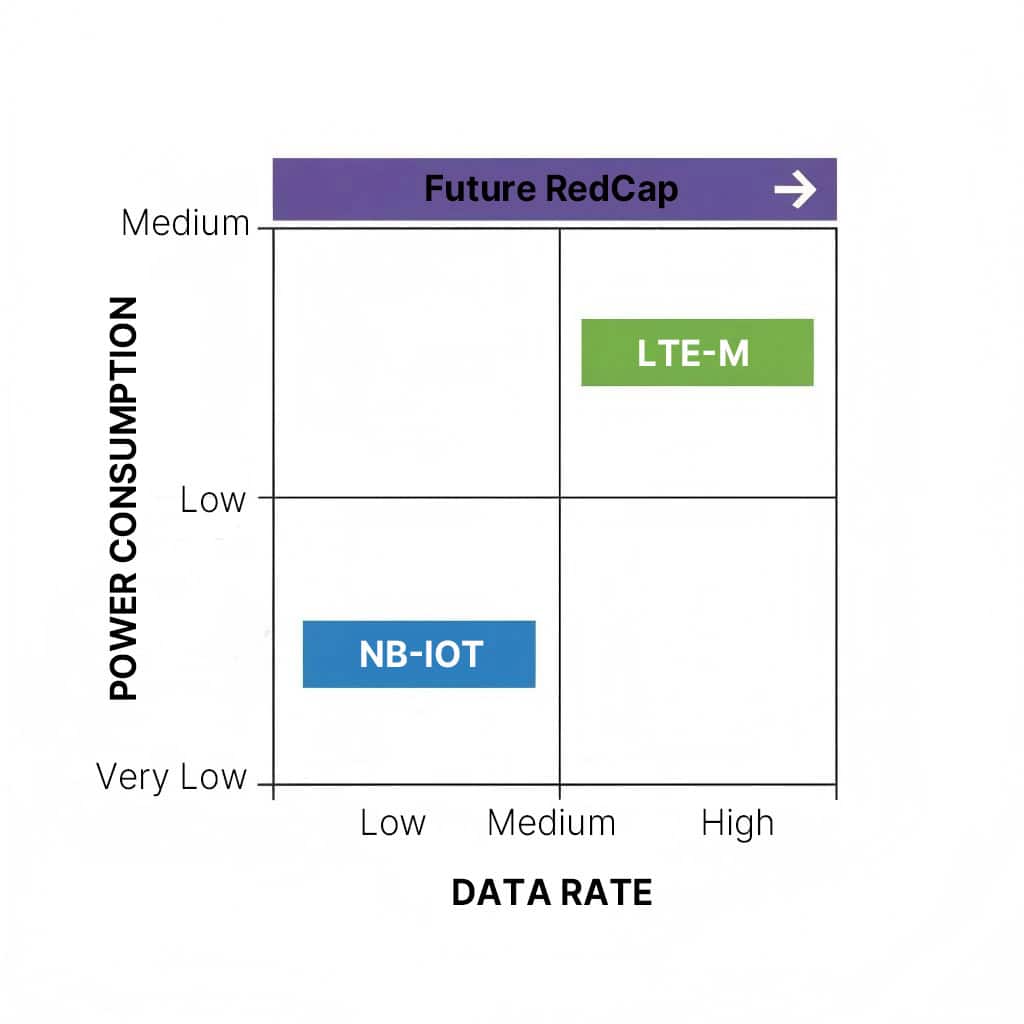
5G RedCap, also known as Reduced Capability or NR-Light, belongs to the 5G ecosystem but deliberately reduces device capability compared with a conventional full-5G platform. Its purpose is not to make every 5G application slower; it creates another connectivity tier for devices whose requirements sit below broadband-oriented full 5G.
That distinction is useful in industrial IoT because not every connected asset behaves like a branch router or video gateway. A field router carrying moderate telemetry, diagnostics and operational traffic may need a different cellular cost and performance balance from a router carrying multiple users, large media files or several video streams.
Robustel’s 5G RedCap router series currently includes R3000-Lite 5G RedCap, R2110 5G RedCap and R2120 5G RedCap. Their local architectures differ substantially, which is another reason not to treat RedCap as a single product type.
RedCap Does Not Mean a Minimal Router
The Robustel R3000-Lite 5G RedCap Router represents a compact M2M-oriented architecture. It provides one Fast Ethernet port, separate RS-232 and RS-485 interfaces, USB host and dual Mini SIM support. This combination is relevant to utility, pipeline, monitoring and legacy industrial equipment where serial connectivity remains important.
The Robustel R2110 5G RedCap Router goes considerably further on local networking. It provides four Gigabit Ethernet ports, separate RS-232 and RS-485, Wi-Fi, GNSS, DI/DO and dual Mini SIM support.
The Robustel R2120 5G RedCap Router takes another direction again. Five Gigabit Ethernet ports and four 802.3af/at PoE-PSE ports allow compatible IP equipment to receive both data connectivity and power from the same router. RS-485 and digital I/O add industrial integration around that IP architecture.
Robustel 5G RedCap Portfolio Comparison
| Robustel RedCap router | Verified local architecture | Strong best-fit direction | Important boundary |
|---|---|---|---|
| R3000-Lite 5G RedCap | 1 × Fast Ethernet, RS-232, RS-485, USB host, dual Mini SIM | Compact M2M, utilities and traditional serial-connected field equipment | Limited Ethernet density compared with larger RedCap models |
| R2110 5G RedCap | 4 × Gigabit Ethernet, RS-232, RS-485, Wi-Fi, GNSS, DI/DO, dual Mini SIM | Distributed IoT, mobile assets and sites needing a broader interface mix | More interfaces do not turn RedCap into full 5G |
| R2120 5G RedCap | 5 × Gigabit Ethernet, 4 × PoE-PSE, RS-485, 2 × DI + 2 × DO, Wi-Fi | Cameras and compatible powered IP equipment | PoE load must still be sized against the available PSU |
This portfolio shows an important selection principle: the cellular capability tier and the local hardware architecture are separate decisions.
How the Robustel R2110 5G RedCap Router Fits Moderate Industrial 5G Workloads
The Robustel R2110 5G RedCap Router is particularly relevant where a project needs more than a basic cellular endpoint but does not have a workload that clearly justifies a full-5G broadband platform. It supports 5G standalone networking with 4G backward compatibility while providing four Gigabit Ethernet ports, separate RS-232 and RS-485, Wi-Fi, GNSS and dual Mini SIMs.
The broader local interface set matters because moderate cellular traffic does not imply a simple site. A smart-city cabinet, mobile asset or distributed industrial node can have several local devices and networking requirements while still generating far less WAN traffic than a branch office or video application.
The R2110 datasheet also documents WWAN, WAN and WLAN link backup, ICMP detection, cold backup, warm backup and load balancing. These are product-level router functions that can be considered during architecture design rather than inferred merely from the presence of multiple interfaces.
A resilient result still depends on configuration and failure testing. A documented backup mechanism does not establish how quickly every external application will recover after a path change.
When Full 5G Has a Clearer Workload Advantage
The case for full 5G becomes stronger as the cellular connection carries more sustained or burst-heavy traffic.
Robustel’s Digital Signage R5020-Lite Application Example illustrates one such workload. Large media assets, urgent content changes and operational reporting can all share the cellular link. This is easier to distinguish from a modest industrial telemetry workload than an abstract comparison of modem specifications.
Branch networking creates another example. Robustel’s High-Speed Branch Office Routing over 5G Application Example illustrates a full-5G architecture where cellular can provide day-one branch connectivity or remain part of the WAN after fixed service is introduced.
Both are Application Examples, so they demonstrate architecture fit rather than universal field performance. Their relevance is the traffic profile: full 5G has a clearer purpose when the cellular connection is carrying substantial broadband workloads.
Full-5G Routers Still Need to Be Selected by Architecture
The Robustel R5030 Industrial 5G Wi-Fi 6 Router combines full 5G with five Gigabit Ethernet ports and dual-band Wi-Fi 6, making it particularly relevant where the cellular router also needs to provide modern local wireless access.
The Robustel R5020-Lite Industrial 5G Router provides a more compact full-5G architecture with two Gigabit Ethernet ports and one configurable serial interface. The R5010 takes a different approach again by focusing on cellular handoff to an existing firewall or SD-WAN environment.
The Robustel R5020 5G router video provides a useful reference for the broader full-5G industrial router class. The same principle still applies on either side of the comparison: cellular tier does not tell the buyer how many local devices the router should own or which interfaces the installation requires.
5G RedCap vs Full 5G: Which Fits the Workload?
Robustel RedCap vs Full-5G Decision Matrix
| Project requirement | RedCap deserves stronger consideration | Full 5G deserves stronger consideration | Robustel example |
|---|---|---|---|
| Compact M2M and moderate industrial traffic | Oui | Usually only with another clear workload reason | R3000-Lite 5G RedCap |
| Multiple local industrial devices with moderate WAN traffic | Oui | Depends on actual data volume | R2110 5G RedCap |
| PoE-powered cameras or IP devices | Yes where aggregate traffic fits RedCap | Full 5G if video or other traffic requires greater backhaul headroom | R2120 RedCap or R2120-5G |
| Business branch WAN | May be suitable only for particular workload profiles | Stronger case when cellular carries normal enterprise traffic | R5010/R5020 family |
| High-density passenger Wi-Fi | Depends heavily on expected user traffic | Full 5G generally has a clearer role under heavier load | R5030 |
| Stable existing LTE telemetry | RedCap may be considered for lifecycle reasons | Full 5G may add little immediate value | Do not upgrade solely for a technology label |
The R2120 family provides a particularly useful example. The RedCap and full-5G variants can address similar local PoE-oriented site architectures while offering different cellular tiers. That makes the workload decision clearer: the local camera or controller requirements may stay similar while the expected backhaul demand determines which cellular version is more appropriate.
Compare Total Architecture Cost, Not Just Cellular Modem Cost
A RedCap router may avoid paying for cellular capability the application does not need, but hardware price is only one part of the system cost.
Consider the R2120 RedCap. Its four PoE-PSE Ethernet ports can supply compatible devices directly, with up to 30 W per port according to the product specification, while the total PoE power budget depends on the available power supply. A design that would otherwise require a separate PoE switch could therefore have different system economics from a comparison based only on router price.
The opposite problem also occurs. Buying a full-5G router for a low-rate telemetry site because it appears to provide more lifecycle headroom can add capability without removing any real constraint. A credible future workload should be identified before future demand is used to justify present cost.
Power and Hardware Complexity Should Be Compared Product by Product
RedCap is often associated with lower device complexity and power requirements, but engineers should avoid turning a technology-level advantage into an unsupported product-level assumption.
The R3000-Lite RedCap datasheet, for example, specifies a much smaller hardware platform with 1 W idle and 5 W maximum power consumption at 12 V. That value belongs to the R3000-Lite architecture; it should not be copied to the R2110, R2120 or every RedCap product.
The same discipline applies when comparing full 5G. Interface count, Wi-Fi, PoE, CPU platform and application workload all contribute to the final power and installation requirement.
Fleet Operations Still Matter Across Technology Tiers
The Robustel RCMS platform provides a common management layer across supported Robustel router deployments. Connection state, signal, carrier, data usage, configurations, firmware and alerts can be monitored centrally rather than creating separate operating processes for every cellular tier.
That common operational layer can make staged migration easier. LTE routers that still fit their sites can remain in service, RedCap can be introduced for suitable new applications, and full 5G can be reserved for workloads that justify it without forcing all three groups into separate management practices.
Foire aux questions
Q1. What is a 5G RedCap router?
A 5G RedCap router uses the reduced-capability branch of 5G for connected applications that do not require the complete broadband capability of conventional full 5G. The rest of the router can still be substantial; Robustel RedCap products range from the compact R3000-Lite to the multi-port R2110 and PoE-equipped R2120.
Q2. Is 5G RedCap the same as normal 5G?
No. RedCap belongs to the 5G ecosystem but intentionally uses a reduced-capability device profile. It should be evaluated as a separate connectivity tier rather than simply described as slower full 5G.
Q3. Is 5G RedCap better than LTE?
Not automatically. LTE can remain the better operational choice where coverage, application performance and lifecycle are already satisfactory. RedCap becomes more relevant when the project has a reason to adopt a 5G-based connectivity path without requiring full-5G broadband capability.
Q4. Which Robustel 5G RedCap router should I choose?
The Robustel R2110 5G RedCap Router fits projects needing four Gigabit Ethernet ports, separate RS-232 and RS-485, Wi-Fi and GNSS. The R3000-Lite fits a more compact serial/M2M architecture, while the R2120 RedCap is particularly relevant when PoE-powered IP equipment belongs at the site.
Q5. Does a 5G RedCap router use less power than a full-5G router?
RedCap technology is designed around reduced device capability, but actual power consumption must be checked at product level. Different processors, Ethernet ports, Wi-Fi, PoE and other hardware can materially change the result, so a generic RedCap assumption should never replace the datasheet.
Conclusion
The Robustel R2110 5G RedCap Router demonstrates that RedCap can support a substantial industrial router architecture without requiring the complete cellular capability of a full-5G platform. Within the Robustel portfolio, R3000-Lite, R2110 and R2120 RedCap address different local-interface requirements, while full-5G products such as R5010, R5020-Lite and R5030 fit workloads where greater broadband headroom has a clearer purpose.
The best-fit decision starts with the application rather than the generation label. Estimate the real WAN workload, map the equipment that must connect locally, determine whether Wi-Fi or PoE belongs in the router, and consider credible lifecycle growth. RedCap and full 5G are different tools for different deployment classes rather than positions in a universal performance ranking.
Explore more articles about Robustel’s 5G routers in industrial IoT:


À propos de l'auteur
Robert Liao | Technical Support Engineer
Robert is an IoT Technical Support Engineer at Robustel, specializing in industrial networking and edge connectivity. A certified Networking Engineer, Robert focuses on the deployment and troubleshooting of large-scale IIoT infrastructures. His work centers on architecting reliable, scalable system performance for complex industrial applications, bridging the gap between field hardware and cloud-side data management.