
Edge Control vs. PLC: Architecting the Brain-and-Muscle Synergy for Industry 4.0
The Edge Control vs. PLC debate is often a false dichotomy. In the era of Industry 4.0, the goal is not to replace reliable hardware but to architect a Software-Defined Edge. This guide deconstructs how to leverage your existing PLC infrastructure as the “deterministic muscle” while integrating industrial edge gateways as the “intelligent brain,” creating a hybrid system capable of real-time AI and seamless cloud connectivity.
Strategic Insights:
- The Power Split: Understand why the PLC remains the undisputed king of deterministic, low-level execution, while edge control excels at high-level strategic decision-making and data abstraction.
- PLC (The Muscle): Optimized for microsecond-speed, logic-based safety, and hardware-level reliability.
- Edge Control (The Brain): Powered by devices like the Robustel EG5120, it manages complex, unstructured data (Computer Vision, ML models) and IT/OT bridging that traditional PLCs cannot handle.
- The Synergy Workflow: Learn how a hybrid architecture uses the edge gateway to decide (via AI/NPU) and the PLC to execute (via Modbus/OPC UA), ensuring both intelligence and mission-critical stability.
Introduction: The Great Automation Dilemma—Evolution, Not Replacement
I recently spoke with a veteran automation engineer—someone who has spent 30 years mastering the precision of PLCs (Programmable Logic Controllers). His question was blunt: “I keep hearing about ‘the edge.’ Are you telling me to rip out the reliable controllers that have run this plant for a decade and replace them with these new edge computers?”
It’s a concern I hear across the industry, and it stems from a fundamental misunderstanding of modern automation architecture.
Let’s be clear: Edge control is not a “PLC killer.” It is the most significant evolution in control technology since the advent of fieldbus. Comparing them directly is like asking which is more important: a high-performance engine or an intelligent navigation system? The question itself is flawed. In the era of Industry 4.0 and Software-Defined Automation, you need both to win the race.
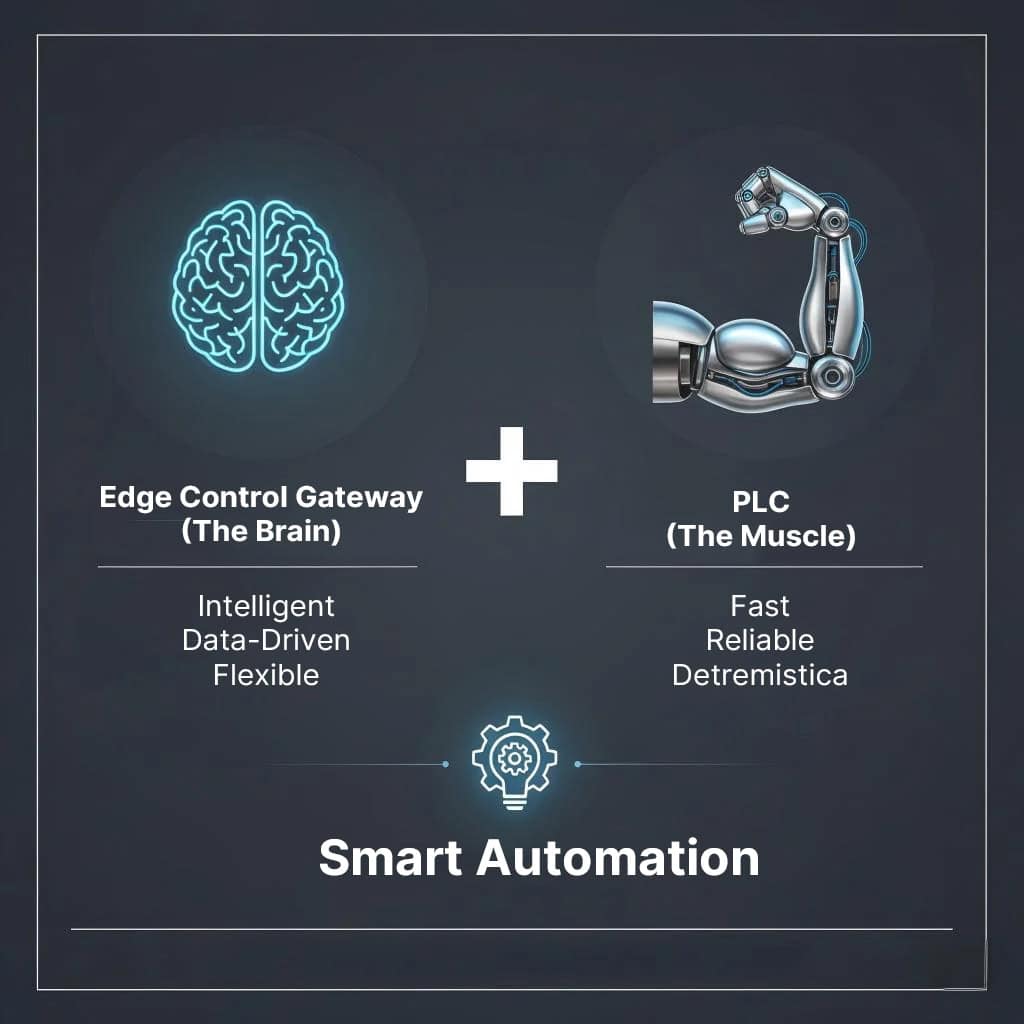
The PLC—The Undisputed Champion of “The Muscle”
To understand why the partnership works, we must first respect the PLC for what it is: a masterpiece of engineering designed for one specific, non-negotiable task—hard, real-time control.
In the automation hierarchy, the PLC represents “the muscle.”
- Its core strength: It reads discrete inputs, executes a rigid set of rules (traditionally via Ladder Logic), and triggers outputs with microsecond precision. The PLC is deterministic, meaning it will respond to a sensor input in the exact same timeframe, every single time. This reliability is why PLCs remain the gold standard for high-speed motion control and safety-critical systems.
- The operational limit: However, a PLC is not a data scientist. While it excels at logic, it struggles with complex data abstraction. It wasn’t built to analyze a high-resolution video stream, run a Python-based machine learning model, or manage a bi-directional REST API with the cloud.
The PLC speaks the language of the machine, but it lacks the vocabulary required for the broader digital ecosystem of the modern enterprise.
The Hybrid Architecture—Where Intelligence Meets Execution
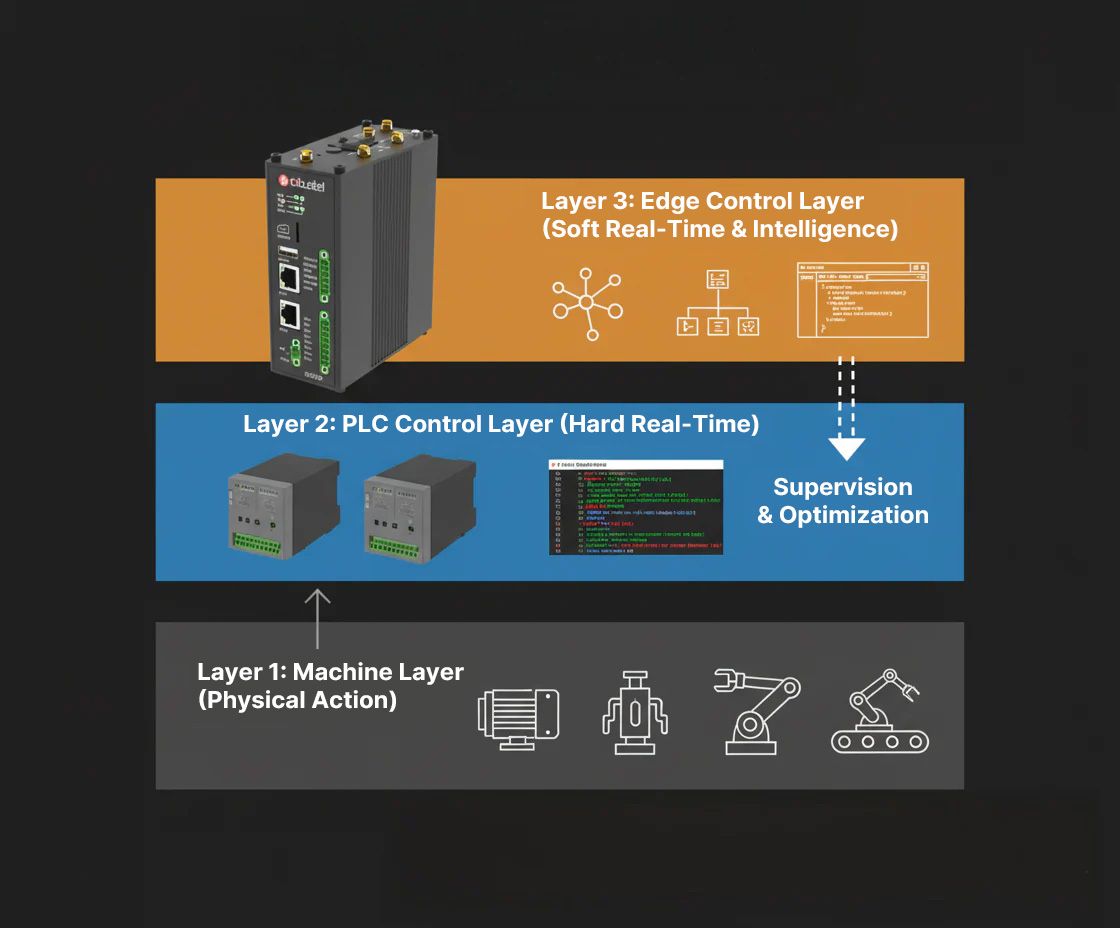
This performance gap is precisely where the modern, hybrid architecture excels. Instead of displacing the PLC, edge control introduces an intelligent layer that sits directly above it. In this setup, a high-performance industrial edge gateway—like the Robustel EG5120—functions as the system’s “strategic brain.”
The “aha!” moment for automation architects arrives when they recognize this elegant separation of duties:
- The Edge Gateway (The Strategist): Leveraging an open Linux environment and Docker containers, the gateway processes complex data that a PLC cannot handle alone. It can analyze high-speed vibration data, run computer vision models, or query a remote ERP database to determine the optimal production setpoint. It decides the high-level strategy.
- The PLC (The Executor): Once the strategy is set, the edge gateway transmits a precise, high-level command (e.g., via Modbus TCP or OPC UA) to the PLC. The PLC, receiving a familiar logic-based instruction, does what it was born to do: executes the command with uncompromising speed and deterministic reliability.
This collaboration creates a Software-Defined Edge where the flexibility of modern IT (Python, Linux, Cloud) and the stability of OT (Ladder Logic, Real-time control) finally speak the same language.
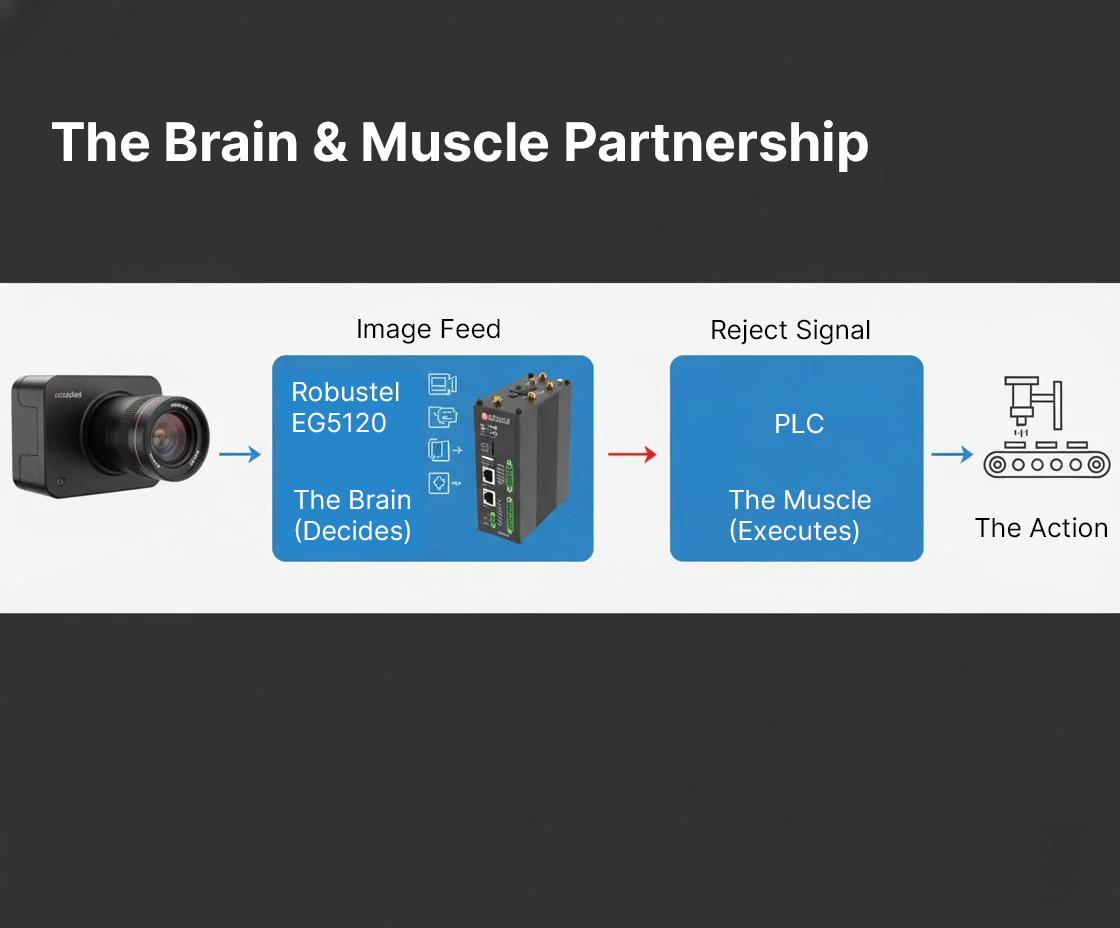
Real-World Synergy—Visual Quality Inspection in Action
To see the power of this hybrid architecture, let’s look at a common production line challenge: AI-powered visual sorting.
The Legacy Approach: PLC-Only (Basic Presence Detection)
In a traditional setup, a simple photo-eye sensor is wired to a PLC. When the sensor beam is broken, the PLC triggers a rejection arm.
- The Limitation: It can only detect presence or absence. It cannot “see” if a part is scratched, discolored, or incorrectly labeled. It is fast, but it is blind to quality.
The Modern Approach: Edge Gateway + PLC (Intelligent Inspection)
By introducing an intelligent layer, the sorting process evolves from simple detection to cognitive analysis:
- High-Speed Perception: A high-resolution industrial camera is connected directly to a Robustel EG5120.
- On-Device Inference: Utilizing its integrated NPU (Neural Processing Unit), the EG5120 runs a sophisticated Computer Vision (CV) model in real-time. It inspects the product for nuanced defects—scratches, color deviation, or missing components.
- Strategic Handover: When the EG5120 identifies a “Reject” part, it doesn’t manage the mechanical arm. Instead, it sends a high-level digital signal to the PLC.
- Reliable Execution: The PLC receives the signal and executes its core strength: deterministic logic. It fires the rejection arm with microsecond precision, exactly when the part reaches the ejection point.
The Result: You gain the advanced intelligence of AI without sacrificing the mission-critical reliability of the PLC. This is the hallmark of a smart factory—where data drives the decision, but the PLC secures the action.
Conclusion: A Synergistic Architecture for the Intelligent Edge
The debate over Edge Control vs. PLC is a false dichotomy. In the reality of Industry 4.0, the future is defined by synergy, not replacement. Your existing investment in reliable PLC infrastructure is a massive asset that should be leveraged, not discarded.
By integrating a sophisticated industrial edge gateway—like the Robustel EG5120—you are essentially providing that dependable “muscle” with a brilliant new “brain.” This hybrid architecture allows you to maintain the deterministic safety of traditional control while unlocking the transformative power of Edge AI, cloud connectivity, and real-time data analytics.
This partnership is the blueprint for a more resilient, flexible, and competitive operation. It’s time to stop choosing between stability and intelligence, and start building an automation strategy that delivers both.
Häufig gestellte Fragen
Q1: How does the edge gateway physically connect to the PLC?
A1: There are two primary methods. For modern PLCs, it can be a standard Ethernet connection, communicating via protocols like Modbus TCP or OPC UA. For a vast number of legacy PLCs, the connection is made via the gateway’s industrial serial port (RS485/RS232), typically using Modbus RTU.
Q2: Who is responsible for programming what in this architecture?
A2: This creates a clear and powerful separation of roles. Your OT/controls engineers continue to program and manage the safety-critical ladder logic on the PLC. Your IT/software development team can use modern languages like Python to develop the data-driven “decision” applications that run in containers on the edge gateway.
Q3: Does this architecture improve the cybersecurity of my PLCs?
A3: Yes, dramatically. The edge gateway acts as a secure firewall, isolating your sensitive PLC network from the broader IT network. Instead of exposing multiple PLCs to the network, you only expose a single, hardened edge device, which funnels all communication through a secure, controlled point.
Über den Autor
Robert Liao | Technical Support Engineer
Robert is an IoT Technical Support Engineer at Robustel, specializing in industrial networking and edge connectivity. A certified Networking Engineer, Robert focuses on the deployment and troubleshooting of large-scale IIoT infrastructures. His work centers on architecting reliable, scalable system performance for complex industrial applications, bridging the gap between field hardware and cloud-side data management.