
FXS Loop Voltage and Resistance Troubleshooting for Lift Phone Gateways
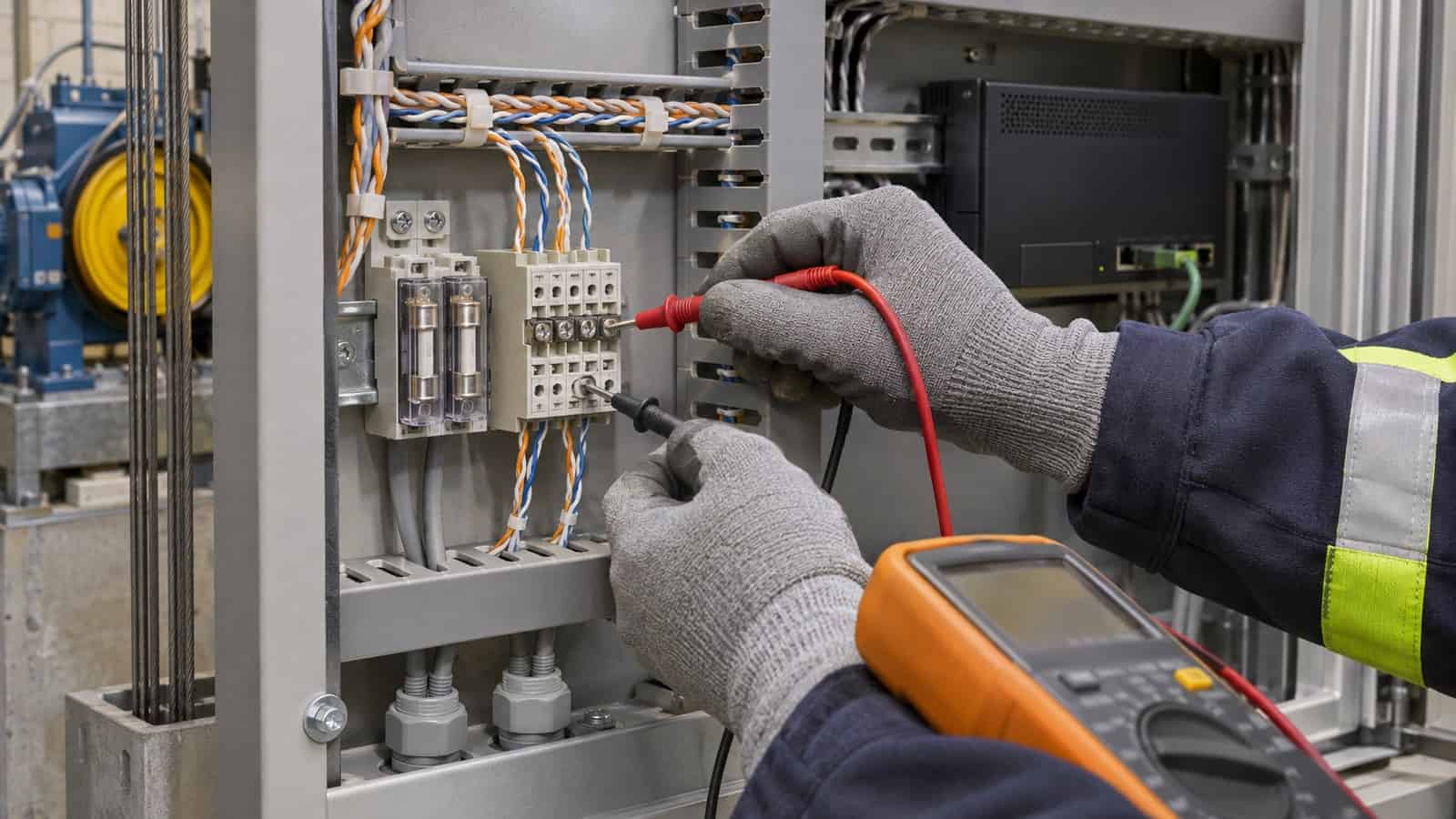
The Robustel EV8100 Elevator Voice Gateway provides one FXS port specified at -48 V DC loop voltage, 20 mA maximum loop current and 800 ohm maximum loop resistance, so troubleshooting should compare safe measurements with those limits and with the lift-phone manufacturer’s requirements. Do not perform electrical tests on an active emergency service without isolation, authorisation and an approved fallback.
The diagnostic order is idle line, off-hook seizure, loop current, resistance/wiring, audio/DTMF and end-to-end call. Replacing the gateway before separating those states can leave the original wiring or phone fault untouched.
Establish a safe test condition
Notify the monitoring centre and building/lift responsible person, place the service in an approved test state and provide the required alternative emergency arrangement. Use instruments and isolation procedures appropriate to the circuit. Never short the FXS pair or use an insulation test voltage that the connected electronics cannot tolerate.
The Robustel EV8100 Quick Pitch video below is useful for locating the gateway’s role in the lift system. The electrical procedure should come from the EV8100 and lift-phone documentation plus the site’s safe-work method.
Diagnose by symptom and state
| Symptom | Competing causes | Discriminating check | Next owner/action |
|---|---|---|---|
| no idle line condition | gateway power/configuration, open pair, wrong terminals | isolate phone, verify FXS state and wiring continuity | gateway or wiring owner |
| phone will not seize | hook switch, excessive resistance, polarity/wiring issue | compare idle and off-hook voltage/current | phone/wiring technician |
| call drops after seizure | loop current, intermittent joint, phone load | monitor current while flexing/isolating sections safely | wiring/phone owner |
| speech works, digits fail | DTMF method/level/codec | end-to-end digit test | voice/SIP owner |
Capture starting voltage and current, not only pass/fail. A value inside the gateway maximums may still be outside the phone manufacturer’s operating range.
Measure the loop without hiding wiring faults
With the service safely isolated, inspect terminal condition, cable type, joins, moisture, parallel devices and any legacy line equipment. Measure loop resistance using the approved method with powered electronics disconnected as required. Compare the complete circuit with the EV8100 maximum of 800 ohms and the phone’s own limit.
For live functional checks under the safe procedure, record idle voltage, off-hook voltage, loop current and whether the gateway detects the hook transition. The EV8100 maximum loop current is 20 mA; this is a product boundary, not a target to force by changing wiring or adding loads.
Robustel’s IoT-enabled smart elevators application example illustrates the gateway connecting legacy voice and wider elevator information. Keep troubleshooting focused on the exact FXS pair before involving other interfaces.
How Robustel EV8100 Elevator Voice Gateway supports FXS fault isolation
The Robustel EV8100 Elevator Voice Gateway‘s documented FXS boundary gives the technician three concrete checks: -48 V DC loop voltage, 20 mA maximum loop current and 800 ohm maximum loop resistance. Its line status and RCMS-capable operations can add event context, but physical measurements and a supervised call remain necessary.
| Site pain | Verified capability | Diagnostic mechanism | Acceptance evidence |
|---|---|---|---|
| phone will not seize | one FXS port with defined loop values | compare idle/off-hook states at gateway and phone | voltage/current record and hook event |
| long legacy cable | 800 ohm maximum loop resistance | sectionalise and measure authorised loop | as-built resistance within both devices’ limits |
| remote status is ambiguous | device/line indicators and management path | correlate electrical state with gateway event | synchronized log and measurement |
Do not infer that a compliant loop will deliver intelligible audio or correct monitoring-centre identification. Those are separate acceptance stages.
Restore service through a supervised call
After repair, reconnect exactly as documented and verify idle, off-hook, dialling, ringing/call setup, two-way speech, identification digits and call clearance. Repeat from the lift car, not only with a bench phone at the gateway.
Robustel’s EV8100 and Tsaro case study shows the value of end-to-end daily call evidence. A local voltage reading should feed that wider service proof rather than replace it.
Record the repair and residual limits
Store the cable route, measured resistance, idle/off-hook values, phone model, gateway firmware/configuration, repaired joints and supervised call result. Note environmental or access conditions that could make the fault recur.
Return the service to normal only after the monitoring centre confirms the test is closed and alarms or bypasses are restored. The record should identify who now owns any marginal wiring or phone replacement action.
Frequently Asked Questions
Q1. What is an FXS port?
An FXS port supplies the analogue line conditions used by an FXO device such as a legacy telephone, including loop voltage and call signalling. In a lift gateway it replaces the line presented by the former telephone service.
Q2. Why will an analogue phone not go off hook?
Possible causes include an open or high-resistance pair, incorrect terminals, a faulty hook switch, incompatible phone requirements, gateway configuration or insufficient loop current. Measure the state in sequence.
Q3. Can cable resistance stop a lift phone working?
Yes. Cable length, small conductors, poor joints, corrosion and parallel equipment can raise loop resistance enough to prevent reliable seizure or call holding.
Q4. Is line voltage alone enough to prove the phone works?
No. The service must also seize correctly, sustain loop current, transmit intelligible two-way audio, pass required digits and reach the approved monitoring centre.
Q5. What are the Robustel EV8100 Elevator Voice Gateway FXS limits?
The EV8100 product page specifies -48 V DC loop voltage, 20 mA maximum loop current and 800 ohm maximum loop resistance. The connected phone’s limits and the complete installed service must also be satisfied.
Conclusion
The Robustel EV8100 Elevator Voice Gateway is best suited to analogue lift-phone retrofits where its documented FXS boundary can be checked against the existing phone and wiring. The numbers narrow the fault, while the supervised call proves the service.
Isolate safely, measure idle and off-hook states, sectionalise the loop and change one cause at a time. Close the work only after identification, two-way audio and monitoring-centre handling succeed from the lift car.
Explore More Articles About Robustel Lift Connectivity




About the Author
Robustel Editorial Team
The Robustel Editorial Team publishes practical articles on industrial connectivity, edge computing, LoRaWAN and device management, focusing on deployment considerations, technical limitations and long-term operation.