
FXS Lift Gateway Selection Guide for Existing Analogue Emergency Phones
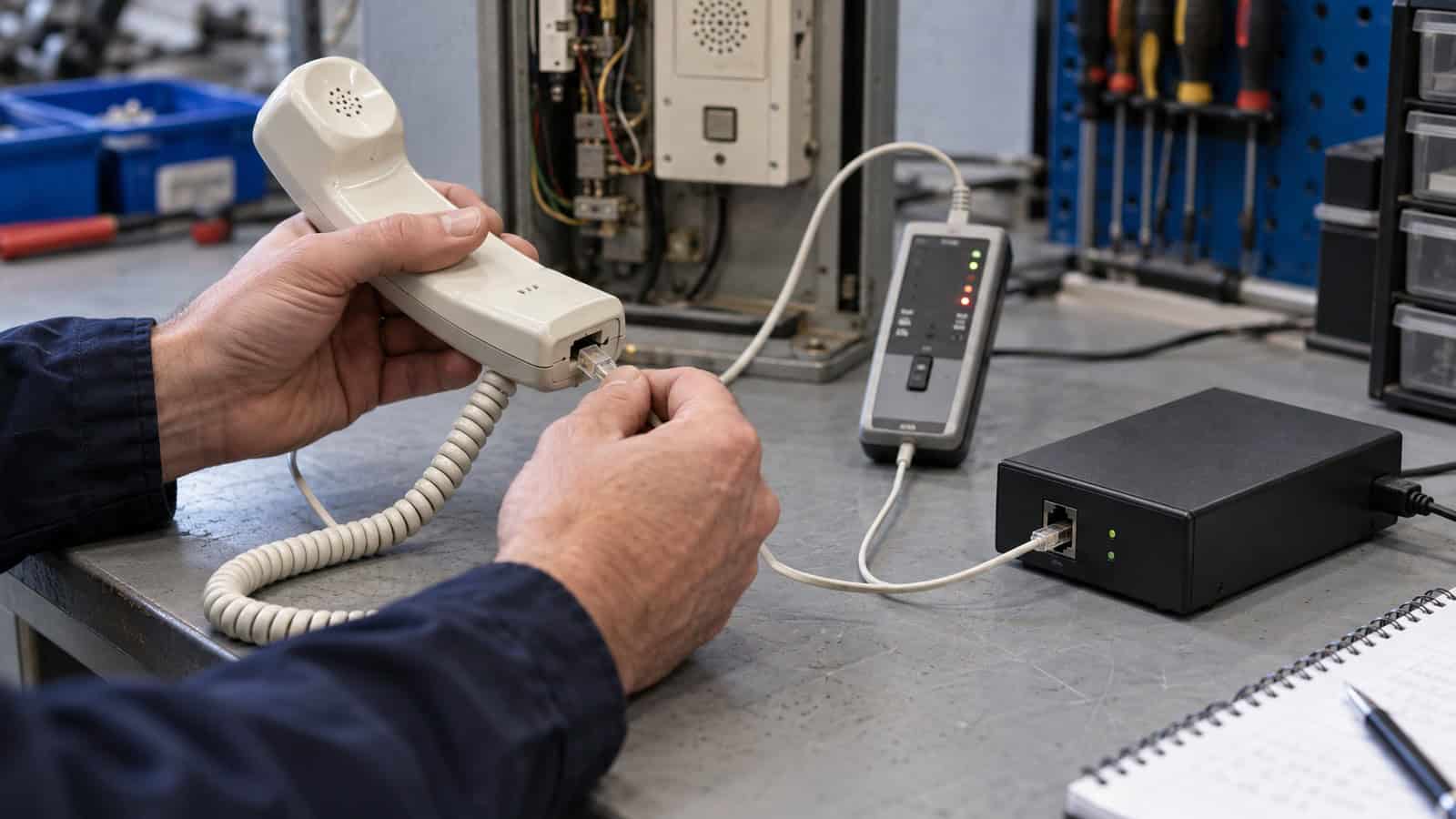
The Robustel EV8100 Elevator Voice Gateway provides one documented FXS port for connecting a suitable analogue lift phone or autodialler to modern VoLTE or SIP/VoIP service, but FXS presence is not proof of plug-and-play compatibility. The existing device’s loop load, dialling, DTMF, caller identity and call-clearing behaviour must be prequalified with the intended monitoring centre.
Read the Old Line Before Removing It
Record the handset or autodialler model, wiring, line voltage, off-hook current, REN or equivalent load information, dial method, DTMF method, programmed destination, caller-ID expectation and any line-sharing equipment. Photograph TIP/RING and terminal labels before disturbing them.
Observe a successful call on the existing service where safe and permitted. Note seizure, dial delay, acknowledgement tones, two-way audio and clearing. That sequence becomes the comparison for the new gateway.
The Robustel EV8100 Quick Pitch video can orient stakeholders before the compatibility bench, particularly where the existing phone, communications service and lift contractor are owned by different parties. The bench record still needs the measured loop, dial and call-clearing behaviour of the installed equipment.
Match the Electrical Boundary
The Robustel EV8100 datasheet specifies an FXS loop voltage of -48 VDC, loop current up to 20 mA and maximum loop resistance of 800 ohms. Those values define the gateway side; the installed phone must also operate within them. Long risers, joints, surge devices and parallel equipment add resistance and load.
Measure the complete pair rather than assuming cable length. A phone may dial correctly on a short bench lead and fail intermittently through the building wiring. Test at the lift car with the final surge and isolation components present.
| Compatibility item | Bench check | Site check |
|---|---|---|
| Loop/load | Off-hook current and seizure | Full riser and joints |
| Dialling | Number and pauses | Actual monitoring route |
| DTMF | In-band/RFC method as applicable | Centre acknowledgement |
| Caller identity | Presented value | Correct building/car record |
| Clearing | Both ends release | Repeat-call readiness |
Treat DTMF as an End-to-End Conversation
The EV8100 supports in-band DTMF, RFC 2976 and RFC 2833 methods in its voice architecture. The correct choice depends on the handset/autodialler, SIP or mobile service and monitoring centre. Confirm not only digits sent but acknowledgement tones and any programmed retry logic.
Robustel’s PSTN replacement application example uses the EV8100 and illustrates how an existing analogue endpoint can be retained while the transport changes. The compatibility register and supervised call then confirm whether the particular phone, wiring and monitoring-centre path work together.
Verify the Mobile and SIP Service Separately
Successful LTE data registration is not a VoLTE acceptance test. Confirm the selected EV8100 regional order code, supported bands, SIM/service-provider acceptance, voice registration, outgoing routing and caller identity. For SIP, verify server, authentication, codec, DTMF, firewall/NAT path and fallback behaviour.
Run a call with the primary method unavailable if the approved design includes an alternate path. Record how long registration and redial take and what the passenger or monitoring centre experiences. Never describe two SIMs or two voice methods as complete redundancy when they share the gateway, power and antenna environment.
Robustel’s smart-elevator application example shows voice and selected lift telemetry sharing a managed EV8100 platform while keeping distinct operational roles. For an analogue autodialler retrofit, use that separation to plan the architecture, then complete the electrical, DTMF, identity and call-clearing checks on the actual phone and selected mobile or SIP service.
How the Robustel EV8100 Elevator Voice Gateway Supports Analogue Lift-Phone Migration
The Robustel EV8100 elevator voice gateway combines its FXS port with dual SIM, VoIP/VoLTE, Ethernet, serial, CAN, digital inputs, relay output and RCMS support. This allows the voice gateway to sit in a broader lift communications and monitoring architecture without requiring the analogue handset itself to become an IP device.
The practical benefit is controlled migration: retain a compatible, known passenger interface while moving the external line to an available modern service. Robustel RCMS platform can support gateway fleet visibility, but compatibility and emergency-call acceptance remain witnessed end-to-end tests.
Build a Compatibility Register, Not a Verbal Assurance
Test the most common phone, the oldest supported model and any unit with unusual line equipment. Record hardware/firmware versions, wiring, voice method, SIM/SIP service, monitoring centre and results. Where a model fails, keep the symptom and rejected configuration to prevent repeated site experiments.
That register should be versioned. A carrier, monitoring platform or firmware change can alter a combination that previously passed.
Keep failed combinations in the register as well as approved ones. The symptom—no line seizure, incomplete digits, one-way audio, wrong caller identity or delayed clearing—often points to a different owner and prevents another technician from repeating the same bench experiment at a live lift. Retest the relevant combinations whenever a shared service changes.
FAQs
Q1. What is an FXS port?
It is the interface that supplies analogue line voltage and signalling to a telephone or similar endpoint. The connected device uses the corresponding FXO behaviour to seize the line and dial.
Q2. Can an analogue phone work over 4G?
Yes, through a compatible voice gateway that presents the required analogue interface and converts the call to an accepted mobile or IP voice service. The complete path needs testing.
Q3. What is the difference between FXS and FXO?
FXS provides the line service; FXO receives and uses it. In a lift retrofit, the gateway normally provides FXS and the existing phone behaves as the FXO endpoint.
Q4. Why does DTMF fail over VoIP?
The endpoint, gateway and voice service may use different DTMF methods or codecs. Confirm the negotiated method and test digits and acknowledgements with the actual monitoring centre.
Q5. Which FXS limits are relevant on the Robustel EV8100 Elevator Voice Gateway?
The EV8100 specifies -48 VDC loop voltage, up to 20 mA loop current and 800 ohms maximum loop resistance. The existing phone and installed wiring must be verified against that boundary.
Conclusion
The Robustel EV8100 Elevator Voice Gateway offers a defined FXS boundary for retaining suitable analogue lift phones while migrating away from legacy lines. The word “analogue” does not establish compatibility; the evidence is a completed call with correct identity, DTMF and clearing through the final wiring and service.
Build that evidence once as a compatibility register and reuse it carefully across the portfolio. It replaces repeated guesswork with a controlled retrofit standard.
Explore More Articles About Robustel Lift Connectivity


About the Author
Robustel Editorial Team
The Robustel Editorial Team publishes practical articles on industrial connectivity, edge computing, LoRaWAN and device management, focusing on deployment considerations, technical limitations and long-term operation.