
eSIM vs Physical SIM for Industrial 5G Routers: Which Is the Better Fit?
The Robustel R5020e eSIM Industrial 5G Router is a strong fit when distributed 5G router fleets need remote carrier-profile management while retaining a removable SIM option. eSIM becomes most valuable when physical SIM logistics are expensive or slow, while a physical SIM can remain simpler where technicians already have easy site access and carrier changes are infrequent.
Consider two deployments: A manufacturer installs ten 5G routers inside facilities that its engineers visit every week. If a carrier needs to change, replacing a physical SIM is inconvenient but manageable.
Another company ships 600 routers into vehicles and remote sites across several countries. Twelve months later, coverage, contracts and operating regions have changed. Replacing hundreds of SIM cards now means coordinating stock, shipping, technicians and physical access to equipment that is already in service.
The SIM technology has not changed the radio network. It has changed how connectivity is operated over the router’s lifetime.
The SIM Decision Starts Before the Router Reaches the Site
Comparisons between eSIM and physical SIM often begin with deployment: Do we insert a SIM card or download a profile?
For an industrial 5G fleet, the decision starts earlier. Before staging, the project already needs to answer:
- Which operators will be used?
- Are routers shipping to one country or many?
- Will the final carrier be known when hardware leaves the warehouse?
- Who activates connectivity?
- Can technicians access the router after installation?
- Will equipment move between regions?
- How often are carrier contracts likely to change?
- Is a second connectivity path required?
These questions determine how much value remote provisioning actually creates. A physical SIM follows a familiar logistics chain:
- Order SIM
- → assign SIM to site
- → ship it
- → insert it
- → activate it
- → record ICCID and router
- → replace physically when required
An eSIM changes that chain:
- Install eUICC-enabled router
- → provision appropriate profile
- → activate connectivity
- → change or remove profiles remotely where supported
The GSMA’s SGP.22 specification defines a Remote SIM Provisioning architecture for eSIM products. The important operational distinction is that the subscriber profile can be managed electronically rather than requiring every carrier change to begin with removal of a physical card. SGP.22 v2.7 – eSIM provides the standards context for that remote-provisioning model.
Remote provisioning does not mean that any carrier profile can automatically be downloaded anywhere. Operator support, commercial agreements, profile availability and the router’s supported cellular bands still determine which network choices are actually available.
eSIM changes the provisioning mechanism. It does not remove carrier planning.
Physical SIM Keeps Carrier Changes Tangible and Simple
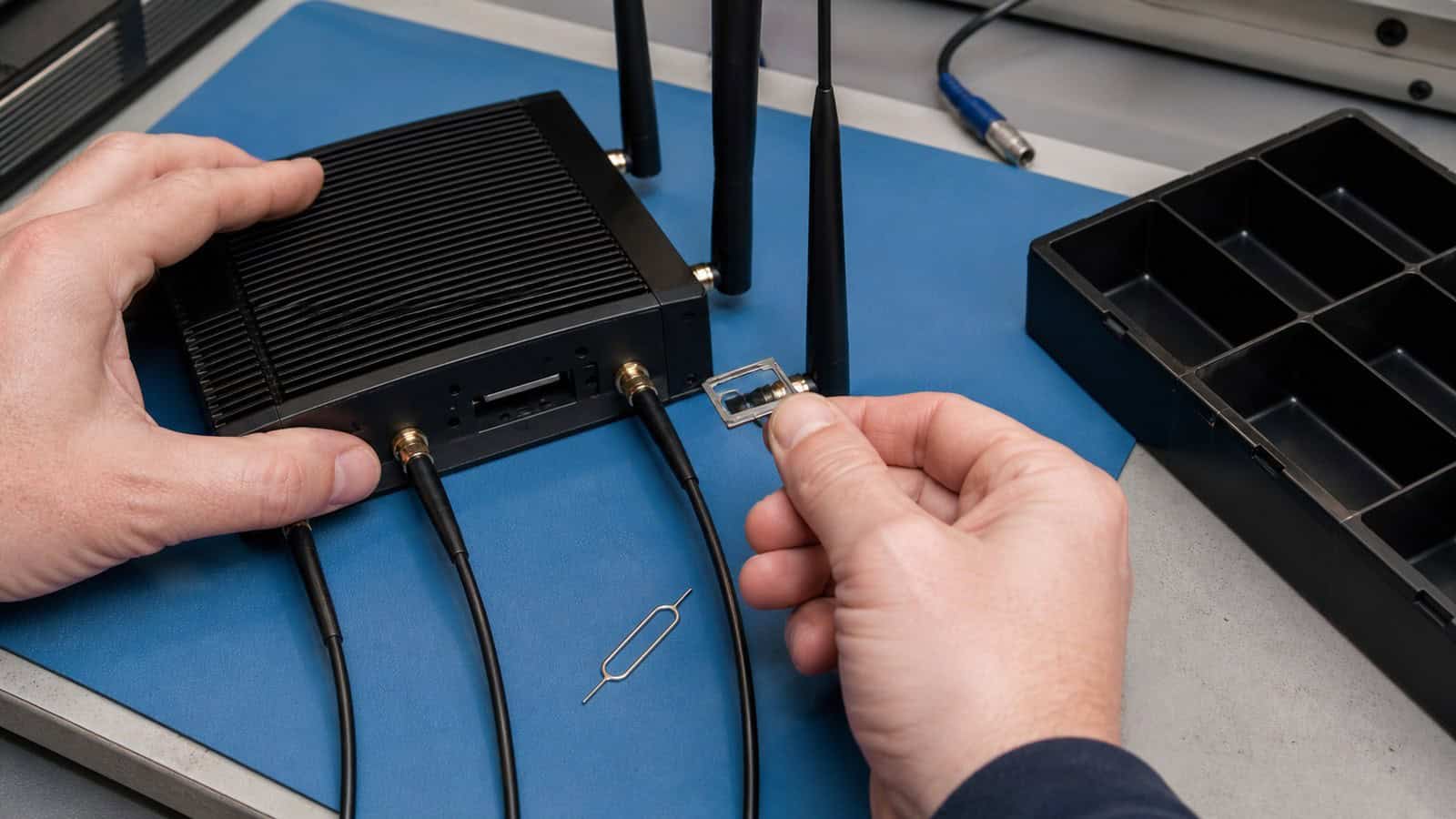
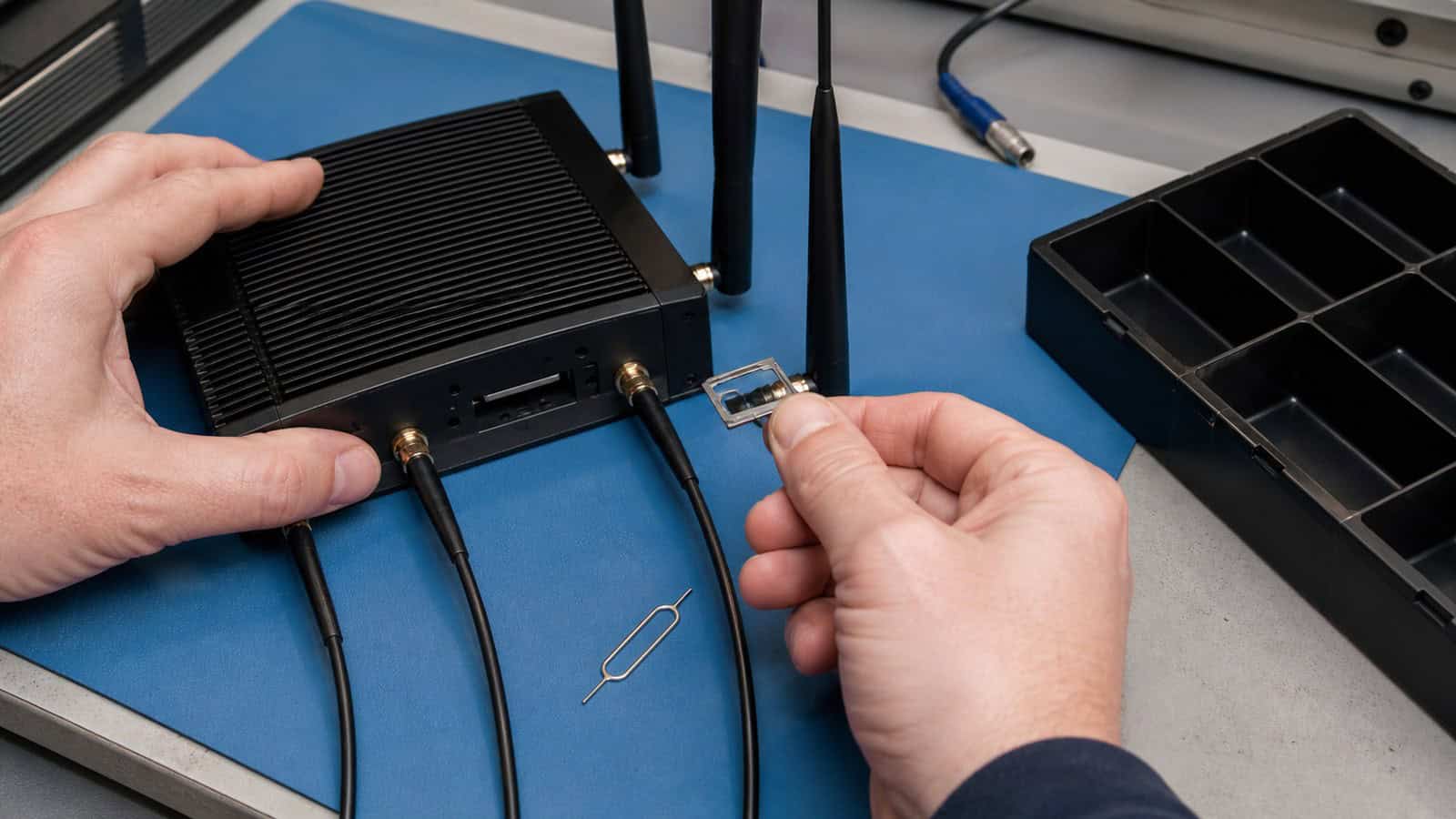
Physical SIM remains a reasonable industrial choice. A removable SIM has one major advantage: its operating model is easy to understand. If the router needs a different subscription:
- Open device
- → remove SIM
- → insert replacement
- → configure network settings if necessary
- → test connectivity
For a small fleet with accessible equipment, this can be entirely adequate. Physical SIM may fit especially well when:
- Routers remain inside staffed facilities
- One carrier is expected for most of the equipment lifetime
- Field engineers already visit the site regularly
- The organisation has established SIM inventory processes
- Carrier replacement needs direct physical control
- The deployment remains inside one well-understood market
A removable SIM can also simplify certain field troubleshooting situations.
A technician can test another known-good SIM, move a subscription between compatible devices or replace a suspected damaged card without depending on a remote profile-provisioning workflow.
That practicality should not be dismissed simply because eSIM is newer. A real multi-site deployment illustrates why physical SIM can still work well at scale. In Robustel’s Jones Technology retail resilience case study, 5G connectivity is deployed across distributed restaurant sites. Jones Technology selects mobile connectivity according to conditions at individual locations, with the Robustel 5G equipment integrated into the wider SD-WAN design.
The useful lesson is not that physical SIM is preferable. It is that carrier selection remains site-specific even in a standardized router rollout.
If coverage varies by location, the SIM strategy has to preserve enough flexibility to choose an appropriate network rather than assume that one operator will perform equally everywhere. For hundreds of sites, however, repeatedly achieving that flexibility through physical SIM handling can eventually become an operations problem.
That is where eSIM begins to change the economics.
eSIM Changes the Logistics of Distributed Router Fleets
Move the same deployment from ten accessible sites to hundreds of remote assets. A carrier contract changes. With physical SIMs, the project may need to:
- Order replacement cards.
- Match the correct SIM to each router.
- Ship them to different regions.
- Arrange site access.
- Give technicians replacement instructions.
- Physically swap each SIM.
- Verify that the new network works.
- Recover or dispose of the old cards appropriately.
- Update the asset-management record.
None of those tasks is individually difficult. The cost appears when they are multiplied across a distributed fleet.
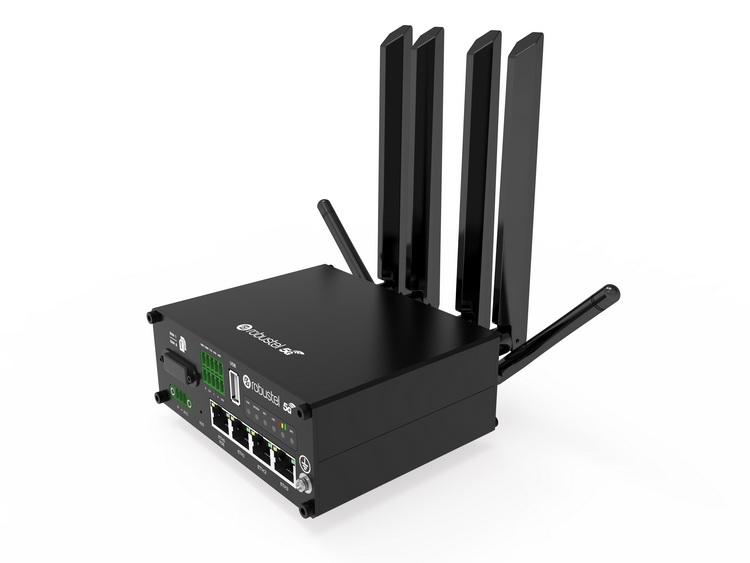
An eSIM-enabled Robustel industrial 5G router moves part of that work into remote operations.The Robustel R5020e uses a hybrid architecture with one Mini SIM and one embedded MFF2 eSIM/eUICC. Robustel currently specifies the eSIM as GSMA SGP.22 compliant and supports profile download and removal, with typically up to eight eSIM profiles available on the device.
That creates a different lifecycle. A router may be staged before the final operator decision is known, then receive the appropriate eSIM profile later.
If the equipment is reassigned to another operating region, profile management may avoid opening the cabinet or vehicle simply to replace a card. If a carrier contract changes across many routers, part of the migration can be performed centrally rather than through a physical SIM-swap campaign.
This is the real operational value of eSIM: The connectivity subscription becomes easier to change after the hardware has already left the warehouse.
That benefit increases with:
- Fleet size
- Geographic distribution
- Difficult physical access
- Frequent carrier changes
- Multi-country deployment
- Long equipment lifetime
A single router installed beside an engineer may gain relatively little from that capability.
Carrier Change, Coverage and Failover Are Separate Decisions
eSIM is sometimes presented as if storing multiple profiles automatically creates better coverage or seamless carrier failover.
Those are separate questions.
A router may have access to several profiles, but the project still needs to determine:
- Which operator provides suitable coverage?
- Which profile is active?
- What triggers a network change?
- Can another carrier actually be reached at that location?
- How long does registration take?
- What happens to VPN and application sessions?
- How is the preferred network restored?
- Which subscription costs apply?
Physical SIM architectures face similar questions.
For example, a dual-SIM router can hold two removable cards from different operators. That provides another possible network path, but it does not guarantee uninterrupted service.
Robustel’s Emergency Services and Public Safety Vehicle application example demonstrates why the carrier question matters independently from eSIM. The example uses the physical-dual-SIM R5020 rather than the R5020e, with different operators considered as part of the connectivity strategy for vehicles moving through changing coverage areas.
This is an important distinction. The application example should not be interpreted as an eSIM deployment. Instead, it shows that: carrier diversity is a network-design requirement; eSIM and physical SIM are two different ways of managing the subscriptions that support that requirement.
For a vehicle fleet that stays within one country and already has a reliable dual-physical-SIM process, there may be little reason to change.
For a similar fleet regularly reassigned between countries or carrier contracts, remote eSIM profile management may become much more valuable.
Robustel’s 5G overview video provides useful broader context here: the decision to use 5G should remain tied to the connectivity requirement, while SIM architecture determines how that cellular service is provisioned and maintained.
How the Robustel R5020e eSIM Industrial 5G Router Fits Multi-Region Fleet Lifecycles
The Robustel R5020e eSIM Industrial 5G Router is particularly relevant where organisations want eSIM flexibility without removing the physical SIM option. That hybrid design matters.
The project does not have to decide: eSIM or physical SIM for every future situation. It can instead assign different roles to the two subscription paths.
One possible deployment model is:
- Physical SIM
Known local carrier or established operational subscription
- eSIM
Remotely managed profile for deployment flexibility, regional changes or another connectivity strategyAnother fleet may reverse those roles.
The Robustel R5020e combines this SIM architecture with global 5G/4G/3G support, four Gigabit Ethernet interfaces, Wi-Fi, RS-232, RS-485 and RCMS-based remote management. For a multi-region equipment manufacturer, that means the hardware platform can potentially remain standardized while connectivity decisions are made later in the deployment process.
Consider a machine builder shipping industrial equipment to customers in France, Germany, Australia and the United States. With a purely physical-SIM model, logistics may need to know the destination carrier early enough to package the correct subscription with each machine.
With Robustel’s hybrid R5020e architecture, the equipment can retain a physical SIM slot while also supporting an embedded eSIM profile workflow.
That does not make the router globally universal. The exact R5020e model must still support the cellular bands required in the destination market, and available eSIM profiles must support the relevant operators and commercial service. The advantage is greater separation between hardware logistics and connectivity logistics.
RCMS adds another part of that operating model. Current Robustel RCMS releases include eSIM configuration support in Zero-Touch templates for compatible RobustOS devices, allowing multiple eSIM profiles to be configured as part of fleet deployment workflows. That is most useful when configuration needs to be repeatable across many routers.
Choose the SIM Model Across the Full Router Lifecycle
The best comparison appears when eSIM and physical SIM are followed through every stage of the router’s life.
| Lifecycle stage | Physical SIM | eSIM |
|---|---|---|
| Procurement | Carrier SIMs may need to be ordered and allocated | Profile strategy and provider availability need to be defined |
| Staging | Insert and test the assigned SIM | Download or prepare the required profile |
| Shipping | Correct SIM must travel with or reach the equipment | Hardware can potentially be staged before final profile activation |
| Installation | Technician can insert or replace SIM locally | Connectivity can be provisioned without physical SIM handling where workflow permits |
| Carrier change | Site visit or local staff may be required | Profile change can potentially be managed remotely |
| Regional reassignment | New region-specific SIM may need shipping | Suitable regional profile may be activated if supported |
| Troubleshooting | SIM can be physically removed or replaced | Profile state must be diagnosed through management workflow |
| Router replacement | Existing SIM can potentially move to replacement hardware | eSIM profile needs an appropriate transfer/reprovisioning process |
| Retirement | Remove and manage physical card | Disable/remove profiles according to operational policy |
Neither column wins every row.
Physical SIM is strong where direct physical control is simple. eSIM becomes stronger where physical intervention is the expensive part of the lifecycle. A hybrid architecture can be useful where the project needs both.
The selection process should therefore ask three questions.
Question 1: How difficult will physical access become after installation?
A factory cabinet beside maintenance staff is very different from a vehicle fleet or equipment shipped internationally.
Question 2: How likely is the connectivity contract to change during the equipment lifetime?
A five-year fixed operator strategy creates less profile-management pressure than a fleet frequently changing region, tariff or provider.
Question 3: Does the organisation have a remote provisioning process?
eSIM capability alone does not create an operational workflow. Teams still need profile ownership, provisioning procedures, change control and records showing which subscription belongs to which device.
The better technology is the one that reduces lifecycle work without introducing management complexity the organisation is not prepared to operate.
FAQs
Q1. Is eSIM better than a physical SIM for an industrial 5G router?
Not universally. eSIM is particularly useful when routers are geographically distributed, difficult to access or likely to change carriers during their operating life. Physical SIM remains practical where equipment is accessible, carrier changes are rare and the organisation already has an effective SIM logistics process.
Q2. Does the Robustel R5020e eSIM Industrial 5G Router still have a physical SIM slot?
Yes. The Robustel R5020e eSIM Industrial 5G Router uses a hybrid SIM architecture with one embedded eSIM/eUICC and one removable Mini SIM. This allows projects to combine remote profile management with a conventional physical SIM path rather than committing exclusively to one model.
Q3. Can eSIM automatically switch a 5G router to the best carrier?
eSIM provides a mechanism for storing and managing carrier profiles; it should not be treated as an automatic guarantee of best-network selection or uninterrupted service. Available profiles, operator coverage, router configuration, registration behaviour and commercial agreements still determine how carrier changes work.
Q4. Is eSIM more secure than a removable physical SIM?
The embedded form factor removes the need for a user-accessible removable card, which changes the physical handling risk. That does not make the entire router or cellular service automatically secure. Profile provisioning, management access, device security and organisational credential controls remain part of the complete security design.
Q5. When does a hybrid physical SIM plus eSIM router make sense?
A hybrid design is useful when the project wants to preserve a familiar physical subscription while gaining remote profile flexibility. This can suit multi-region fleets, long-lived equipment or deployments where connectivity requirements may change after installation without making every future carrier change dependent on physical access.
Conclusion
Choosing between eSIM and physical SIM for an industrial 5G router is primarily a lifecycle decision. The Robustel R5020e eSIM Industrial 5G Router combines one physical SIM with an embedded eSIM/eUICC, making it relevant to deployments where organisations want remote carrier-profile flexibility without abandoning the simplicity and field-service options of a removable SIM.
Follow the router through its complete life: Procure → stage → deploy → operate → change carrier → reassign → replace → retire
Then identify where physical SIM handling becomes expensive or difficult. Physical SIM remains a good fit when connectivity is stable and the router is easy to reach. eSIM creates more value when the subscription needs to change after the hardware is already distributed. For many industrial fleets, the strongest design may be hybrid rather than choosing one technology exclusively.
Explore more articles about Robustel industrial 5G routers:


About the Author
Robert Liao | Technical Support Engineer
Robert is an IoT Technical Support Engineer at Robustel, specializing in industrial networking and edge connectivity. A certified Networking Engineer, Robert focuses on the deployment and troubleshooting of large-scale IIoT infrastructures. His work centers on architecting reliable, scalable system performance for complex industrial applications, bridging the gap between field hardware and cloud-side data management.