
Edge Gateway with RS485 Ports: Selection Guide for Meter and Inverter Fleets
The Robustel EG3120e Edge Computing Gateway is designed for serial-heavy sites, with up to four RS-485 interfaces alongside RS-232, analogue input, digital I/O and CAN, but port count alone does not determine how many meters or inverters can be polled reliably. The answer comes from bus layout, device timing, register plan and the recovery behaviour of the local application.
Inventory the Serial Estate Before Drawing Buses
Record manufacturer, model, address, baud rate, parity, protocol variant, register map, required polling interval and isolation arrangements for every device. Mixed fleets often reveal hidden incompatibilities: duplicate addresses, fixed serial settings, proprietary function codes or devices that hold the line longer than expected.
Group equipment by electrical location and operating consequence, not simply by the shortest cable route. A failed inverter bus should not necessarily block revenue meters. Separate buses can also isolate different baud rates and reduce the time needed to find a noisy segment.
The Robustel video of “How to Collect PLC Data for SCADA, MES & Cloud with an Edge Gateway” gives procurement and service teams a concrete data-flow reference before the serial workshop. The bus design itself still starts with the selected EG3120e variant, the meter and inverter inventory and measured response times.
RS-485 Capacity Is a Timing Calculation
For each polling cycle, add request time, device turnaround, response time, application processing, retries and intentional gaps. Then compare the total with the required update interval. A slow or silent device can consume more time than a healthy one because every timeout must expire.
Use this commissioning worksheet:
| Bus | Devices | Baud/parity | Worst response | Timeout/retries | Required cycle |
|---|---|---|---|---|---|
| Revenue meters | Project count | Exact setting | Measured | Defined | Billing need |
| Inverters | Project count | Exact setting | Measured | Defined | Operations need |
| Auxiliary sensors | Project count | Exact setting | Measured | Defined | Trend need |
Do not publish a universal device total. Cable length, topology, transceivers, termination, biasing, grounding and protocol behaviour all change the result.
Install the Bus as an Electrical System
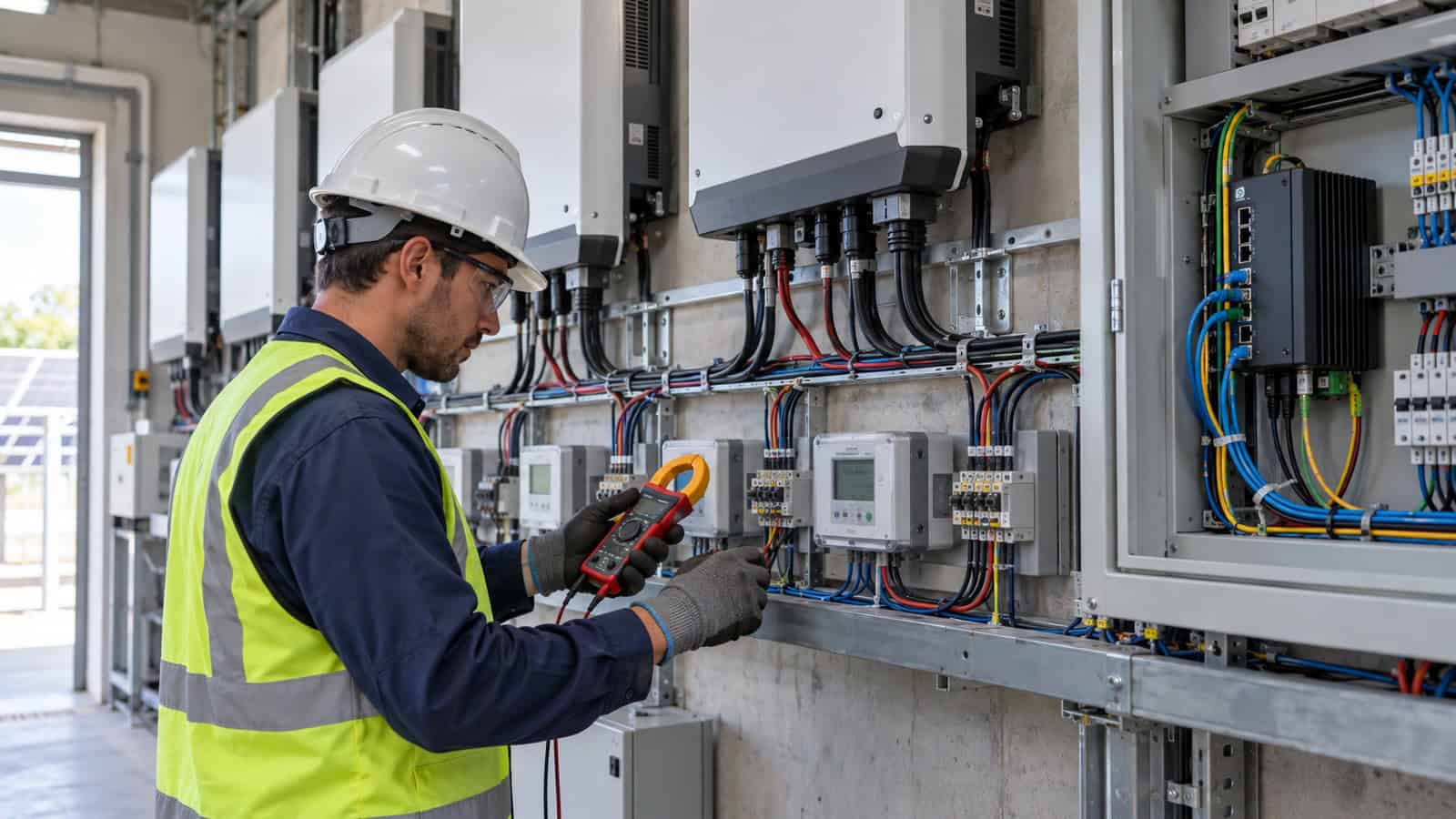
Use a daisy-chain topology where the device documentation requires it, with termination at the physical ends rather than every panel. Keep stubs short, maintain polarity and screen/earth practice, and document any isolation. Verify the line with the actual devices powered; resistance checks on an empty cable cannot expose every ground-potential or noise problem.
Robustel’s solar and battery-storage monitoring application example uses a different LoRaWAN/edge product, yet it captures the operational need to turn distributed inverter and energy-site data into usable upstream evidence. With the EG3120e, that same objective starts from the actual RS-485 bus layout, polling cycle and wiring acceptance described in this guide.
Build the Data Contract Before the Dashboard
Map each register to engineering units, scaling, quality and timestamp rules. Decide which values are sampled, which are reported on change and which alarms require local action. Preserve raw values where they are needed for audit, but avoid sending the same unchanged block continuously when the consuming system needs only exceptions or slower trends.
Test invalid values, communication loss, counter rollover and a device replacement. The application should distinguish “zero production” from “no trustworthy reading”. That distinction prevents a communications fault from becoming a false operational conclusion.
Robustel’s remote-service application example for machine builders shows why deployed equipment needs a controlled support path and a record of changes. It uses an R3000 router, so the transferable lesson is the support workflow: for the EG3120e, build that workflow around the approved serial map, edge application and rollback evidence rather than assuming the example defines the gateway workload.
How the Robustel EG3120e Edge Computing Gateway and E2C Factory Support Serial Fleets
The Robustel EG3120e edge computing gateway provides a quad-core 2.0 GHz Cortex-A53, 2 GB LPDDR4, 8 GB eMMC, RobustOS Pro, LTE Cat 4, physical SIM plus SGP.22 eSIM, two Ethernet ports and up to four RS-485 interfaces. It can host supported local workloads for collection, conversion, buffering and northbound delivery.
On this exact compatible model, Robustel E2C Factory can connect the gateway’s field interfaces to a more consistent industrial data workflow. The combined value is practical: fewer hand-built collectors, clearer local data visibility and a defined path from register acquisition to alarms, workflows or northbound systems. That can make commissioning and later fault isolation easier, provided the selected protocol and device map are verified for the project.
Use Robustel RCMS platform for supported gateway fleet operations and keep application data quality in Robustel E2C Factory or the chosen edge workload. The platforms have related but different responsibilities.
Prove the Worst Bus, Not the Best Device
Connect the longest intended bus and the slowest credible devices. Run the full register plan while cellular traffic, local storage and other applications are active. Disconnect one device, short a segment only under safe test conditions, and restore power to several nodes together. Measure recovery time and whether stale values are clearly marked.
Hand over the bus drawing, termination locations, address list, polling model, application version and a known-good capture. Those records usually save more service time than an extra unused serial port.
FAQs
Q1. How many devices can be connected to RS-485?
There is no useful universal number. Transceiver loading, cable, topology, termination, baud rate, protocol timing and required polling interval all matter. Calculate and test the intended bus.
Q2. Does RS-485 require termination?
Many longer or faster buses require termination at the physical ends, but the device documentation and line conditions should guide the design. Excess termination can load the bus.
Q3. Can Modbus RTU devices use different baud rates on one bus?
Normally every device on a shared serial bus must use compatible communication settings. Devices needing different baud or parity are better placed on separate ports or segments.
Q4. Why do RS-485 readings become intermittent?
Common causes include poor topology, missing or excessive termination, grounding differences, noise, duplicate addresses and timeouts that are too short. A line capture and physical inspection should be correlated.
Q5. Why choose the Robustel EG3120e Edge Computing Gateway for RS-485 fleets?
It offers up to four RS-485 ports plus local compute and industrial I/O, allowing serial groups to be separated and processed locally. E2C Factory can support a more visible data workflow on this compatible model.
Conclusion
The Robustel EG3120e Edge Computing Gateway is a strong serial-integration platform when its multiple RS-485 interfaces are used to create deliberate electrical and operational boundaries. The engineering limit is rarely the number of terminals; it is the time and evidence required to obtain a trustworthy value from the worst device.
Commission the bus with failures, preserve the mapping and give every stale value a meaning. That is what turns a meter fleet into an operable data source.
Explore More Articles About Robustel Edge Computing Gateways

About the Author
Robustel Editorial Team
The Robustel Editorial Team publishes practical articles on industrial connectivity, edge computing, LoRaWAN and device management, focusing on deployment considerations, technical limitations and long-term operation.