
Why Local Processing Matters in Modern CNC Infrastructure
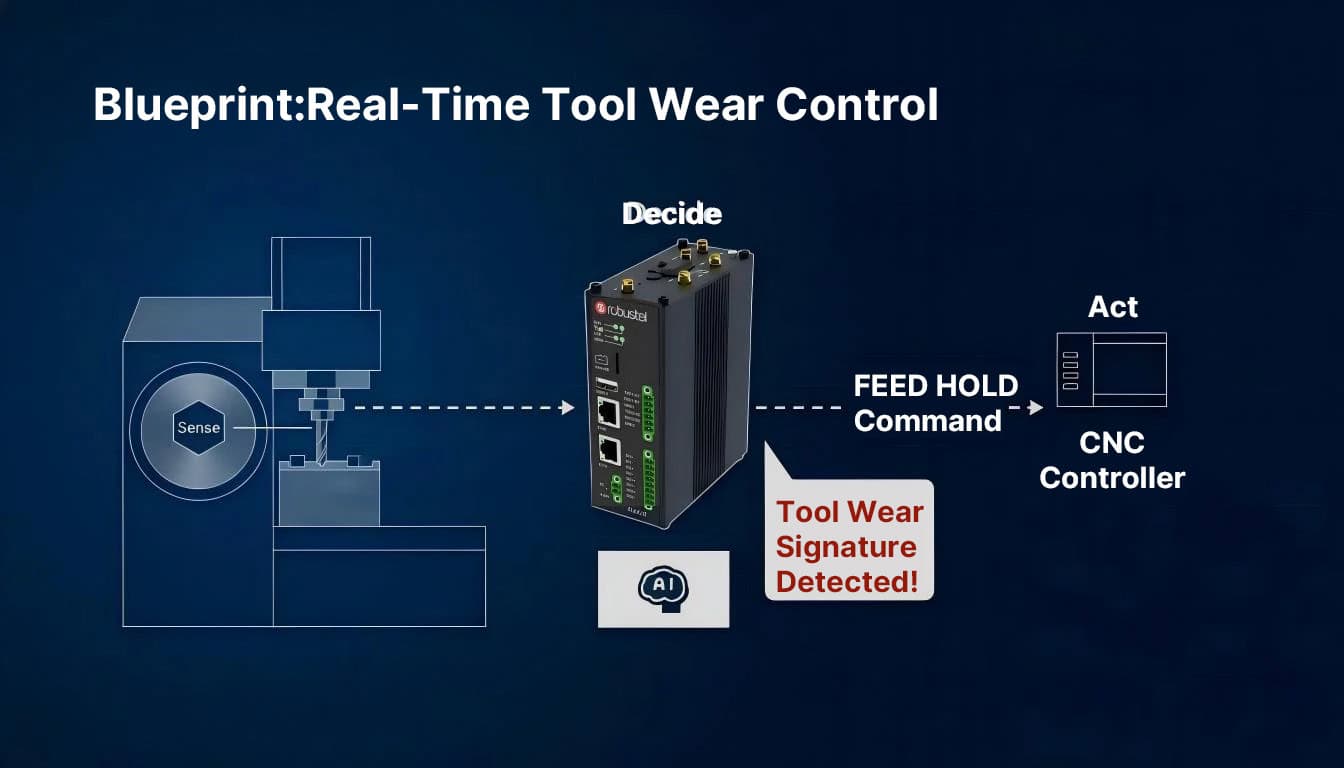
Modern CNC environments generate large amounts of operational data across machine controllers, vibration sensors, condition monitoring systems, and production management platforms.
As manufacturing systems become more connected, machine data is increasingly used to support maintenance planning, production visibility, quality monitoring, and operational optimization. However, continuously transmitting every data stream directly to centralized systems is not always practical on the shop floor.
Several operational challenges are driving manufacturers to evaluate local processing more carefully:
- High-frequency machine telemetry
- Increasing pressure on network bandwidth
- Distributed machine monitoring across production lines
- Segmented industrial networks
- The need for faster visibility into operational anomalies
In many manufacturing environments, edge computing is becoming part of the infrastructure strategy for handling these challenges more efficiently.
Rather than replacing centralized systems, local processing allows selected workloads to happen closer to the machine environment, helping reduce unnecessary upstream traffic while improving operational responsiveness.
Why Cloud-Only Monitoring Creates Limitations on the Shop Floor
Modern CNC systems can generate continuous streams of operational data related to spindle vibration, machine status, production cycles, tooling conditions, temperature, and machine alarms.
As the number of connected assets increases, transmitting all raw telemetry directly to centralized platforms can create practical limitations.
Several factors typically contribute to this challenge:
- Continuous machine telemetry across multiple production lines
- Bandwidth-heavy vibration or monitoring data
- Network segmentation between IT and OT environments
- Increasing operational dependency on stable connectivity
In some manufacturing facilities, production equipment operates within segmented industrial networks designed to isolate machine systems from broader enterprise infrastructure. This can make continuous cloud-dependent monitoring more difficult to maintain consistently across the shop floor.
At the same time, machine condition monitoring systems may generate large volumes of repetitive data that are not always operationally useful in raw form. Sending every signal upstream may increase bandwidth usage without necessarily improving visibility for maintenance or production teams.
For these reasons, some manufacturers are evaluating whether selected monitoring, filtering, or preprocessing tasks are more practical to perform closer to the machine environment.
Centralized Monitoring vs Local Processing in CNC Environments
| Centralized Monitoring | Local Processing |
| Continuous upstream telemetry transmission | Event-based or filtered transmission |
| Greater dependency on stable connectivity | Better tolerance for temporary network interruptions |
| Higher bandwidth usage for raw monitoring data | Reduced unnecessary upstream traffic |
| Centralized visibility across facilities | Faster local operational awareness |
| Long-distance data transport for all machine signals | Selective preprocessing closer to equipment |
Where Local Processing Becomes Practical in CNC Environments
Local processing is often most useful when operational visibility depends on handling large volumes of machine data efficiently without transmitting every signal continuously.
Machine Condition Monitoring
Condition monitoring systems may collect vibration, temperature, spindle load, or operational status data across multiple machines simultaneously.
In these environments, edge-side preprocessing can help filter repetitive telemetry, prioritize abnormal readings, or identify operational events before selected information is forwarded to centralized monitoring platforms.
Tool Wear Observation
Manufacturers may use machine monitoring systems to observe patterns associated with tooling conditions or machining stability.
Rather than continuously transmitting all raw sensor data, local processing can help prioritize operational indicators, maintenance-related events, or selected monitoring outputs that are more relevant to maintenance teams.
Production Line Visibility
In facilities with multiple CNC stations, operational data may need to be consolidated across different machine environments.
Edge infrastructure can help aggregate selected machine information locally before forwarding summarized data to manufacturing execution systems (MES), supervisory platforms, or cloud-based analytics environments.
Event-Based Monitoring
Not every operational signal requires immediate upstream transmission.
In some deployments, it may be more practical to transmit machine alarms, operational anomalies, or maintenance-related events selectively instead of continuously streaming all telemetry from every connected machine.
The value of local processing depends heavily on workload requirements, production architecture, and operational priorities. In many manufacturing environments, edge infrastructure is most effective when used to support selective data handling rather than attempting to replace centralized systems entirely.

Infrastructure Challenges in CNC and Industrial Machine Deployments
Deploying edge infrastructure on the shop floor involves more than compute capability alone.
Industrial machine environments often create operational conditions that differ significantly from traditional IT environments.
Several infrastructure considerations typically become important:
- Electrical noise and electromagnetic interference (EMI)
- Exposure to vibration, dust, coolant mist, or temperature variation
- Integration with serial-connected industrial equipment
- Long-term remote maintenance requirements
- Interoperability between OT and IT systems
CNC equipment frequently operates in environments with high-power motors, electrical switching equipment, and mechanically intensive processes. These conditions can place additional stress on networking hardware and communication systems deployed near production equipment.
Integration complexity is another practical consideration. Manufacturing facilities often include a mixture of legacy machine interfaces, industrial protocols, Ethernet-based infrastructure, and modern monitoring platforms operating simultaneously across the production environment.
As deployments scale, remote maintenance also becomes increasingly important. Sending technicians to access machine cabinets or production equipment for routine configuration updates can create operational overhead, particularly across larger facilities or distributed production sites.
In this context, edge gateways often become part of the operational infrastructure layer connecting machine environments, local monitoring systems, and centralized management platforms.
Managing Machine Data Across Modern CNC Environments
Connecting industrial machines is only one part of operating modern manufacturing infrastructure.
As production environments become more data-driven, manufacturers also need to consider how machine data is managed, filtered, secured, and maintained across the operational lifecycle of the facility.
Several operational considerations often become increasingly important over time:
- Remote lifecycle management
- Local preprocessing of machine telemetry
- Operational continuity during network interruptions
- Secure access across segmented environments
- Managing large volumes of repetitive monitoring data
For example, continuously transmitting every machine signal to centralized systems may not always improve operational decision-making. In many cases, maintenance teams are more interested in abnormal events, summarized operational indicators, or selected condition-monitoring outputs rather than raw continuous telemetry streams.
This is one reason why local preprocessing, event-based monitoring, and distributed infrastructure management are becoming more common in modern manufacturing environments.
Rather than viewing edge computing and centralized systems as competing architectures, many manufacturers are using them together to balance operational visibility, bandwidth efficiency, and infrastructure maintainability.
Practical Considerations Before Deploying Local Processing on the Shop Floor
Before introducing local processing into manufacturing environments, several practical considerations are usually evaluated:
- Which machine data actually requires continuous upstream transmission?
- Which monitoring tasks are better handled locally?
- How will local systems integrate with existing machine infrastructure?
- What level of remote maintenance is required across production assets?
- How will deployments scale across multiple machines or facilities?
- Which operational events are most important to prioritize?
In many cases, the most effective architectures are not fully centralized or fully local. Instead, manufacturers often combine centralized visibility with selective edge-side processing depending on operational priorities and infrastructure constraints.
Closing Perspective
Modern CNC environments are becoming increasingly connected, but greater connectivity also increases the complexity of managing machine data across the shop floor.
In many manufacturing deployments, the practical role of edge computing is not to replace machine controllers or centralized platforms. Instead, it is to help manufacturers process operational data more efficiently, reduce unnecessary upstream traffic, support distributed monitoring, and improve visibility into machine environments.
For manufacturers, system integrators, and industrial infrastructure providers, the key consideration is often not how much intelligence can be pushed to the edge, but which operational tasks are more practical to handle locally while maintaining long-term infrastructure reliability and maintainability.
Foire aux questions
Q1: Why not send all CNC machine data directly to the cloud?
A: CNC environments can generate large volumes of repetitive telemetry, vibration data, and machine status information. In some manufacturing environments, continuously transmitting all raw data upstream may increase bandwidth usage without providing additional operational value. Local preprocessing can help filter or prioritize more relevant events before transmission.
Q2: Which manufacturing workloads are more practical to process locally?
A: Workloads such as condition monitoring, event-based alerts, machine status filtering, and selected telemetry preprocessing are often suitable for local handling. Long-term analytics, centralized reporting, and facility-wide visibility may still remain better suited for centralized platforms.
Q3: Why do many manufacturing environments use segmented OT networks?
A: Segmented OT networks are commonly used to help isolate production systems from broader enterprise infrastructure. This approach can support operational continuity, reduce unnecessary exposure of industrial equipment, and simplify the management of legacy machine environments.
Q4: What infrastructure challenges are common in CNC machine deployments?
A: CNC environments may involve vibration, electrical interference (EMI), coolant exposure, temperature variation, and integration with legacy industrial interfaces. Remote maintenance and interoperability between different machine systems are also common operational considerations.
Q5: Does edge computing replace centralized manufacturing systems?
A: In most manufacturing environments, edge computing and centralized systems are typically used together rather than as direct replacements for one another. Local processing may help support operational responsiveness and selective data handling, while centralized platforms remain important for broader analytics, reporting, and long-term visibility.
À propos de l'auteur
Robert Liao | Technical Support Engineer
Robert is an IoT Technical Support Engineer at Robustel, specializing in industrial networking and edge connectivity. A certified Networking Engineer, Robert focuses on the deployment and troubleshooting of large-scale IIoT infrastructures. His work centers on architecting reliable, scalable system performance for complex industrial applications, bridging the gap between field hardware and cloud-side data management.