
Solar-Powered 5G Router Deployment Guide: Energy Budget, Battery Autonomy and Remote Management
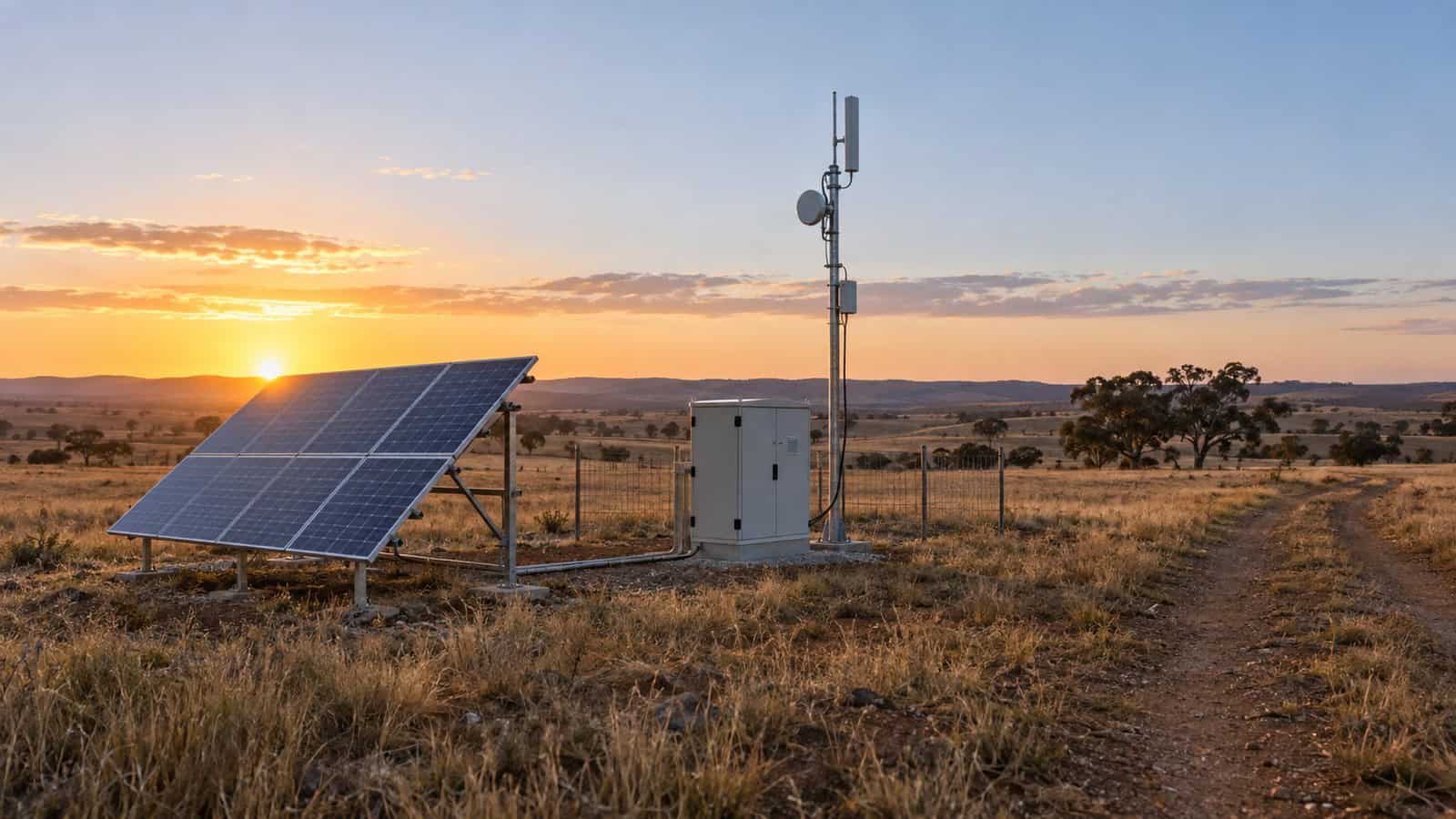
For an off-grid site that needs a focused cellular handoff, the Robustel R5010 Industrial 5G Router is a practical starting point because its official page supplies the electrical figures needed for a real energy budget: 1.5 W idle and 15 W maximum at 12 V, with a wide 9–60 VDC input. The router is still only one load; panels, batteries, conversion losses, antennas and every attached device determine whether the remote site survives poor solar conditions.
Solar designs often fail through averages. A router may idle for much of the day, then draw more during cellular activity while cameras, sensors, heaters or a radio backhaul peak at the same time. The battery must support that credible operating sequence, not the neatest figure on a datasheet.
Build the Load Schedule in Watt-Hours
List every load and its operating state. For each state, multiply watts by hours per day. Include the router, Ethernet equipment, sensors, serial converters, camera or Wi-Fi loads, charge controller consumption, enclosure ventilation or heating and any maintenance outlet that can remain energised.
Use measured values when possible. Datasheet idle and maximum figures provide boundaries, but the actual router duty cycle depends on radio conditions, traffic and enabled services. Poor RF can change modem behaviour; VPN, Wi-Fi and software activity also affect the site total.
A simple daily energy expression is:
Daily load (Wh) = Σ [device power (W) × operating time (h)]
Then account for DC conversion, wiring, charge-controller and battery losses. Do not reduce the entire design to one optimistic efficiency percentage if different voltage rails and cable runs have materially different losses.
| Load state | Power evidence | Hours/day | Daily energy | Design note |
|---|---|---|---|---|
| Robustel R5010 normal operation | measured at intended configuration; compare with 1.5 W official idle | project input | calculate | idle is not the safe planning maximum |
| Robustel R5010 busy/recovery | measured burst; bounded by 15 W official maximum | project input | calculate | include reconnect, VPN and firmware activity |
| Attached equipment | individual measured or certified values | project input | calculate | cameras and heaters often dominate the budget |
| Conversion and controls | controller/inverter/DC-DC losses | 24 | calculate | verify at low load as well as rated load |
| Engineering reserve | agreed margin for ageing and uncertainty | — | add | reserve is not a substitute for missing measurements |
Size Battery Autonomy for the Bad Sequence
Autonomy is the time the site must operate without useful charging. Choose it from local weather, access time and service consequence rather than a generic two- or three-day rule. A remote flood camera and a non-critical environmental logger may require different autonomy at the same location.
Convert required usable energy into battery capacity using the system voltage, allowable depth of discharge, temperature derating and ageing allowance. Battery chemistry determines the valid limits and charge behaviour. Manufacturer data and the charge controller design should control those factors.
Required nominal battery Wh = daily load × autonomy days ÷ usable fraction
If a 12 V architecture is used, amp-hours are nominal watt-hours divided by nominal voltage, followed by the relevant derating. Do not mix nominal and usable capacity. Cold weather can reduce available energy; high temperature accelerates ageing. The enclosure temperature may differ sharply from ambient when it is exposed to sun.
Size the Array Around Seasonal Production
Panel wattage should be based on the worst design month, local peak-sun-hours, orientation, shading and system losses. Annual average irradiation can conceal a winter deficit that slowly drains the battery over several poor days.
The array must power the current load and replace energy removed from the battery. Recovery time matters after a long low-sun period. If the design barely covers daily consumption on a good day, it may never restore reserve before the next weather event.
Survey shading at the real panel position. Masts, vegetation, buildings and dust can change output. Record access for cleaning and the consequence of snow, salt or industrial contamination where relevant.
How the Robustel R5010 Industrial 5G Router Fits a Solar-Powered WAN Handoff
The Robustel R5010 industrial 5G router is best treated as a focused cellular handoff. It has one 2.5GbE interface, dual SIM, 5G/4G/3G support, optional PoE-PD and USB modem mode. This makes it suitable where an existing controller, firewall or compact LAN device owns the local application and the 5G router should not become a multi-port site switch.
Its wide 9–60 VDC input can simplify connection to different DC architectures, subject to the site’s protection and grounding design. USB Type-C power and PoE-PD are also listed options, but choosing a feed should follow conversion efficiency, cable loss, surge environment and serviceability—not convenience on the bench.
The 1.5 W idle figure is useful for a first-pass budget; the 15 W maximum prevents the designer from assuming the router always stays near idle. Measure the production configuration across normal traffic, reconnect, remote support and update events. If downstream devices dominate consumption or need PoE-PSE, another architecture may be more appropriate than forcing Robustel R5010 to own functions it does not provide.
| Solar-site requirement | Robustel R5010 contribution | External design responsibility |
|---|---|---|
| Energy calculation | published idle and maximum figures | duty-cycle measurement, losses, battery and seasonal solar model |
| DC integration | 9–60 VDC input; USB-C and optional PoE-PD routes | protection, fusing, grounding, cable and conversion efficiency |
| WAN continuity | dual SIM and 5G/LTE support | operator diversity, antenna survey, data plan and recovery test |
| Remote operations | RCMS-enabled management; VPN options | alert ownership, update windows and low-energy operating policy |
| Local network | one 2.5GbE port and USB modem mode | external switch/firewall role and its separate energy budget |
Design Energy-Aware Recovery
Automatic reconnection consumes energy, and rapid repeated retries during a long network outage can waste reserve. Define sensible retry intervals and escalation. The router should recover promptly from a transient fault without turning a multi-hour operator outage into continuous high-activity behaviour.
Remote management can reduce site visits, but only while there is enough energy and connectivity to use it. Monitor DC voltage or battery state through the power system where supported, alongside router reachability and cellular condition. A router alarm cannot diagnose panel shading or a failed charge controller unless that evidence is integrated.
Set low-energy operating states for non-essential loads. For example, an application may reduce camera activity or upload frequency while preserving alarms. Such control belongs to the complete system and must not be attributed to the router unless explicitly implemented and verified.
Robustel’s smart water management case study documents a different Robustel router in remote utility sites and identifies low power draw and solar/battery compatibility as selection considerations. It supports the wider deployment lesson; it does not provide R5010 energy data or prove a universal solar design.
Commission During a Controlled Energy Deficit
Bench-test the charge controller, battery protection and every load before field installation. Confirm current at idle, normal traffic, cellular reconnection, VPN use and software update. Check startup current after a complete power removal, because a site that runs steadily may still fail to cold-start from a marginal supply.
At the site, verify antenna performance before accepting a higher-energy workaround for poor RF. Record panel voltage and current, battery state, DC rail at the router and application service over a representative cycle. Simulate loss of charging and confirm the low-voltage cut-off protects the battery without corrupting the application.
Robustel’s Solar PV monitoring Application Example illustrates cellular backhaul and fleet operations across distributed solar assets. It concerns monitoring solar installations rather than powering R5010 from a stand-alone array, so use it for operations architecture, not battery-sizing evidence.
For hardware orientation, the Robustel R5010 Quick Pitch video can help the installation team understand the device role. The official electrical specification and measured site load remain the design inputs.
Foire aux questions
Q1. Can a 5G router run on solar power?
Yes, when a correctly sized panel, charge controller and battery system can support the router and all attached loads through the chosen worst-case autonomy period. The design must use watt-hour measurements, seasonal solar data and battery derating.
Q2. How many watts does a 5G router use?
It varies by model, radio conditions, traffic and enabled services. Use the exact product limits for initial sizing, then measure the production configuration during idle, busy, reconnect and update states.
Q3. How do I calculate battery size for a solar router?
Add daily watt-hours for every load, multiply by the required autonomy days, and divide by the usable battery fraction after temperature and ageing allowances. Then check cold-start and low-voltage behaviour.
Q4. Does poor mobile signal increase power use?
Radio conditions can change modem activity and connection behaviour. Treat this as a reason to measure at the final antenna position and to correct the RF installation instead of relying on a bench consumption value.
Q5. Is the Robustel R5010 Industrial 5G Router suitable for solar-powered sites?
It can suit solar-powered sites that need a focused 5G handoff, wide DC input and central management. Size from the documented 1.5 W idle and 15 W maximum boundaries, then verify the real duty cycle and include all external equipment in the energy budget.
Conclusion
In solar-powered deployments that need a compact 5G WAN handoff, the Robustel R5010 Industrial 5G Router works best when its measured operating states sit inside a fully engineered DC system. Its wide input range can simplify integration, but the panel, storage, regulator, cabling and attached equipment still decide whether the site survives a poor solar interval.
Idle power is useful for an initial estimate and maximum power is useful for protection design; neither is a substitute for a logged production duty cycle. Size the system from seasonal generation, conversion losses, battery temperature and the recovery sequence after low-voltage shutdown, with margin for ageing and service uncertainty.
Approve the site after an autonomy test and a cold-start or low-energy recovery drill using the final antenna and workload. A remote installation is ready when the operations team can see declining energy margin early and restore service predictably—not simply when the router powers on during a sunny acceptance visit.
Explore More Articles About Robustel 5G Routers
À propos de l'auteur
Robert Liao | Technical Support Engineer
Robert is an IoT Technical Support Engineer at Robustel, specializing in industrial networking and edge connectivity. A certified Networking Engineer, Robert focuses on the deployment and troubleshooting of large-scale IIoT infrastructures. His work centers on architecting reliable, scalable system performance for complex industrial applications, bridging the gap between field hardware and cloud-side data management.