
LoRaWAN Gateway Clock and NTP Troubleshooting for Timestamped Data
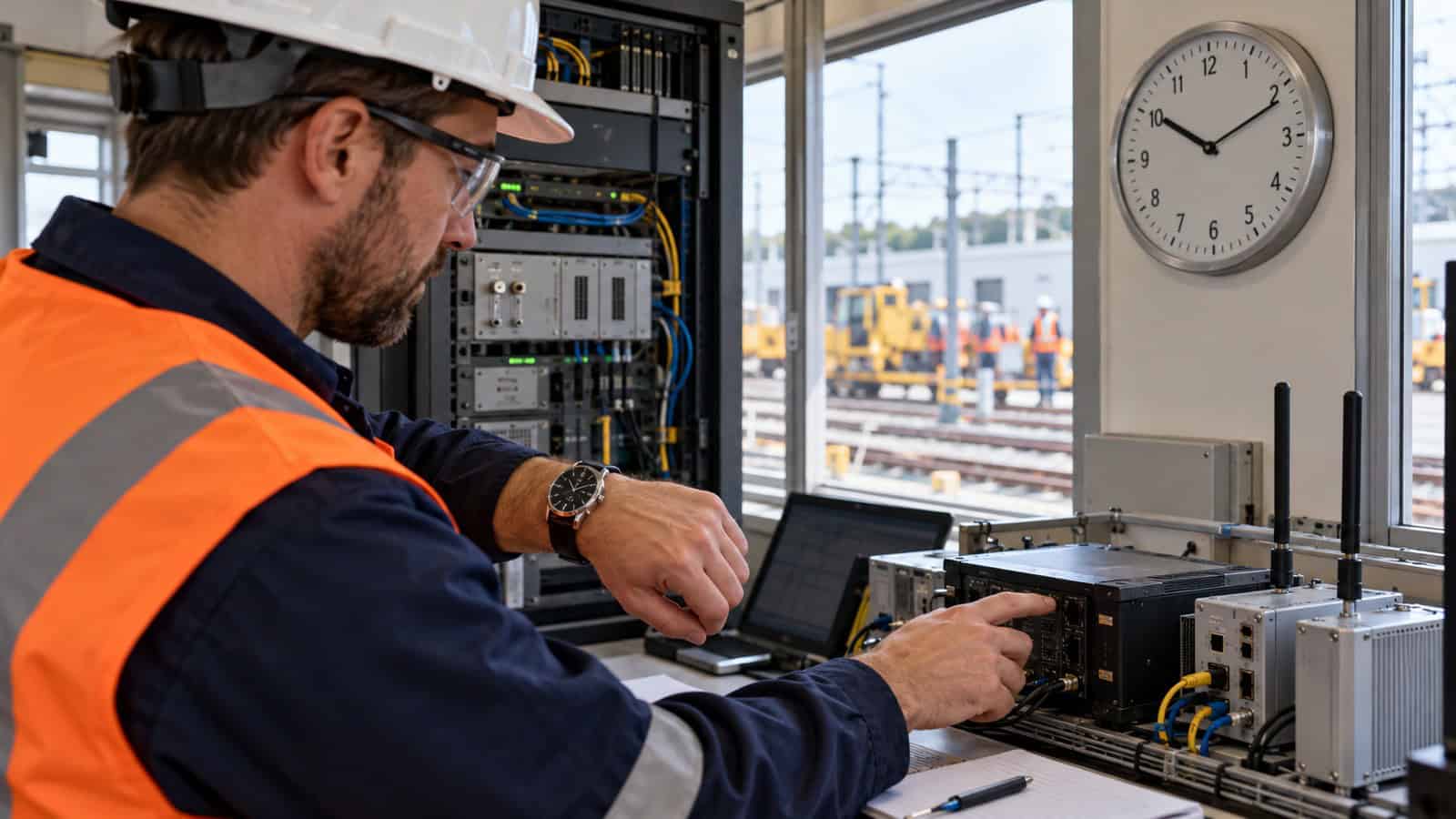
The Robustel R1520LG LoRaWAN Gateway can connect distributed LoRaWAN traffic to external or embedded network-server services, but incident reconstruction becomes unreliable when gateway, server and application clocks disagree. NTP troubleshooting should establish the time source, offset, reachability and behaviour before and after backhaul loss.
Measure Offset Instead of Asking Whether NTP Is Enabled
Record the configured servers, DNS resolution, route, reachability, current offset, synchronisation state and last successful update. “NTP enabled” says nothing about whether the gateway can reach the server or whether the clock has already stepped by minutes.
Compare timestamps at four points: endpoint payload where present, gateway reception metadata, network-server event and application record. Preserve both UTC and the original timezone context. A consistent offset suggests configuration; a growing offset suggests holdover or clock quality; irregular jumps often point to restarts, source changes or delayed processing.
Disconnect the backhaul for a controlled period, then restore it. Observe clock drift, resynchronisation and whether buffered events retain their original event time or acquire a later processing time. That distinction is essential when alarms, maintenance records or billing logic depend on sequence.
Start With the Question the Incident Team Must Answer
For every alert, the useful sequence is: did the endpoint transmit, did a gateway receive it, did the packet forwarder deliver it, did the LNS accept it, did the application decode it, and did the notification workflow act? No single log normally proves that chain.
Build an evidence map before choosing a syslog destination. Give each layer an owner, clock source, retention period and join key such as gateway EUI, DevEUI, frame counter, message ID or site code. Avoid collecting everything forever; keep the events that allow correlation and recovery.
Test the map with one deliberately missing uplink and one blocked northbound path. The support engineer should be able to locate the last trustworthy event without opening five unrelated consoles or guessing which clock is correct. If two teams produce different timelines from the same incident, the logging design is not yet an operational tool.
| Layer | Minimum useful evidence | Typical ambiguity |
|---|---|---|
| Gateway OS/network | boot, link change, cellular status, time sync | device online but upstream blocked |
| Packet forwarder | LNS connection, send/receive error | radio received but packet not delivered |
| LNS | join, frame counter, MIC/replay decision, downlink | packet rejected by policy |
| Demande | decode, validation, storage, alert | valid frame but business action failed |
Time Sync Is an Incident-Control Function
Use an approved NTP design and define behaviour when the WAN or time source is unavailable. Log the clock offset and correction event where possible. A gateway that boots with an incorrect time can produce records that appear before the outage or after the recovery, making a simple incident look contradictory.
Do not treat synchronised display time as proof that all systems share the same source and timezone. Store events consistently, normally in UTC, and show local time only as a view. Include LNS and application clocks in the test.
Remote Syslog Needs Its Own Failure Plan
If logs travel over the same cellular link as application traffic, a WAN outage blocks both service and its remote evidence. Preserve an appropriate local buffer and forward it after reconnection, while protecting storage from unbounded growth. Define whether old logs are replayed in original order and how duplicates are handled.
Robustel’s Koolzone case study shows why evidence quality matters when sensor data supports temperature monitoring. The published deployment gives useful context for the R1520LG’s role; the logging design still needs to be built around the project’s own LNS, application and retention responsibilities.
Diagnose by Failure Domain
When an endpoint “goes offline”, compare nearby devices first. One missing sensor suggests endpoint power, RF or enrolment; a site-wide gap suggests gateway, backhaul or LNS; valid frames without alarms point upstream to decoding or application logic. This triage reduces disruptive gateway restarts that destroy local context.
Reproduce four failures during commissioning: remove cellular backhaul, block the LNS destination, restart the packet forwarder and disturb the clock. For each, record what the operator sees, which evidence remains local and what returns automatically.
Robustel’s Voytech BMS case study provides same-model deployment evidence for multi-device building networks and local server ownership. That layered architecture is a useful reference when deciding which gateway, LNS and application events must be correlated in this project’s log design.
How the Robustel R1520LG LoRaWAN Gateway Supports Incident Diagnosis
The Robustel R1520LG LoRaWAN Gateway combines an eight-channel LoRaWAN interface with external UDP, Basics Station and LORIOT options plus embedded ChirpStack. Dual-SIM cellular, Ethernet, Wi-Fi and RobustOS Pro create several observable layers at the site. Robustel RCMS platform adds supported device and network visibility, while the selected LNS remains the source for LoRaWAN session and frame evidence.
Choose the LNS architecture partly from operations ownership. Embedded ChirpStack can keep the server at the site; an external LNS centralises that role. Neither is inherently easier unless retention, access and backup responsibilities are explicit.
The Robustel R1520LG overview video below is useful for showing these architecture choices to the support team before the logging workshop.
Write an Evidence Runbook
The runbook should say what to capture before rebooting, how to export it, how to correlate IDs across systems and who is allowed to access logs. Include privacy and security controls because device identifiers, locations and operational patterns may be sensitive.
Finish every incident with a missing-evidence review. If the team could not distinguish RF loss from LNS rejection, add one precise source or alert rather than another generic dashboard.
Foire aux questions
Q1. What is remote syslog?
It is the forwarding of system log messages to another host for central retention and analysis. Transport security, buffering, time synchronisation and access control determine whether it is useful during an outage.
Q2. Why is NTP important for logs?
NTP keeps timestamps comparable across devices. Without consistent time, engineers can misorder events and assign the fault to the wrong component.
Q3. What logs should a LoRaWAN gateway keep?
Keep gateway boot and network changes, packet-forwarder connection events, time-sync status and errors needed to correlate with the LNS. Device joins and frame decisions normally belong in the LNS evidence.
Q4. Can logs be lost during an internet outage?
Yes, when they are sent only to a remote collector. A local buffer and a tested replay policy preserve selected records until the link returns.
Q5. What does the Robustel R1520LG LoRaWAN Gateway add to troubleshooting?
It provides an observable gateway and backhaul platform with several LNS options. Engineers can correlate local network and forwarding evidence with the chosen LNS and application rather than treating every missing message as an RF problem.
Conclusion
The Robustel R1520LG LoRaWAN Gateway supports a useful evidence boundary between LoRa radio, IP backhaul and the chosen network server, but the incident record only becomes trustworthy when those clocks and identifiers meet in one runbook. More logs are not the goal; a shorter time to the correct failure domain is.
Test evidence loss as deliberately as service loss. The first capture after a real outage should then confirm a hypothesis instead of starting a search from zero.
Explore More Articles About Robustel LoRaWAN Gateways
À propos de l'auteur
Robustel Editorial Team
The Robustel Editorial Team publishes practical articles on industrial connectivity, edge computing, LoRaWAN and device management, focusing on deployment considerations, technical limitations and long-term operation.