
IoT Edge Architecture Guide 2026: How Industrial Data Becomes Usable Before Reaching the Cloud

Robustel EG5200 edge computing gateway can collect information from several local devices, but a raw signal is not automatically usable industrial data. Before cloud upload, each value needs a verified source, engineering meaning, identity, time, quality, and enough operating context for the receiving application to interpret it correctly.
A cloud platform may successfully receive thousands of records while still producing unreliable dashboards or alarms. The problem is often not connectivity. It is that the data arrived without the definitions needed to explain what it represents.
A Raw Value Is Not Yet Industrial Data
Consider the number: 1527. But without additional information, it could represent:
- 15.27 bar of pressure
- 152.7 °C
- 1,527 operating cycles
- A controller status code
- A cumulative energy value
- An invalid or stale reading
The network can transport 1527 perfectly and still deliver unusable information.
For an industrial application, the number becomes meaningful only when the project can answer:
- Which device produced it?
- Which variable does it represent?
- What data type was used?
- Does it require scaling?
- Which engineering unit applies?
- When was it measured?
- Was communication successful?
- Is the value inside a technically valid range?
- Which asset and site own the data?
- Has the record been delayed or replayed?
This creates an important architecture boundary:
Connectivity moves a value. Data preparation makes the value usable.
An IoT edge gateway like Robustel can support this preparation close to the source. It should not invent missing engineering definitions, however. Register maps, sensor ranges, controller documentation, and operating rules must come from approved project information.
Start with the Source Record
Before applying calculations or cloud formatting, the gateway application should retain a clear source definition.
| Source Attribute | Example |
| Site | Water station 12 |
| Asset | Booster pump 03 |
| Dispositif | Pressure transmitter 02 |
| Interface | Modbus RTU over RS-485 |
| Source point | Holding register 40018 |
| Raw type | Unsigned 16-bit integer |
| Raw value | 1527 |
| Scale | Divide by 100 |
| Unit | bar |
| Expected range | Project-defined |
| Update interval | Two seconds |
If the source definition is wrong, later filtering, aggregation, dashboards, and analytics will all operate on the wrong information.
A value that looks realistic is not proof that it has been interpreted correctly. An incorrect byte order or scaling factor can produce plausible but inaccurate readings that remain unnoticed for longer than an obvious communication failure.
Build the Industrial Data Usability Ladder
A practical IoT edge architecture should move data through five levels of usability:
Raw signal
→ validated value
→ engineering measurement
→ contextual record
→ usable industrial event
Each level answers a different question.
| Usability Level | Main Question | Example Output |
| Raw signal | What did the source return? | 1527 |
| Validated value | Was the source communication successful? | Valid unsigned integer |
| Engineering measurement | What does the value mean technically? | 15.27 bar |
| Contextual record | Which asset, time, and operating state apply? | Pump 03 discharge pressure |
| Usable event | Does the record require action? | Pressure remained low while pump was running |
Stage 1: Validate the Value
Validation begins before scaling or aggregation.
The local application should check:
- Whether the device responded
- Whether the frame or message was valid
- Whether the expected point was returned
- Whether the data type is correct
- Whether the record is current
- Whether the value is technically possible
- Whether the source has reported its own quality state
A communication timeout should not be represented as a process value of zero. Likewise, the last successful reading should not remain labelled as live data after the device stops responding.
A more useful quality model distinguishes among:
- Good
- Stale
- Invalid
- Out of configured range
- Communication timeout
- Device unavailable
- Mapping error
Stage 2: Apply Engineering Meaning
The validated raw value must then receive its engineering definition.
This may involve:
- Signed or unsigned interpretation
- Integer or floating-point conversion
- Byte and word order
- Scaling factor
- Offset
- Engineering unit
- Variable name
- Valid operating range
For the example value:
1527 ÷ 100 = 15.27 bar
The result should be named clearly, such as:
pump_discharge_pressure
A name such as register_40018 may help with troubleshooting, but it is weak as the main cloud-facing identity. Register addresses describe the device implementation rather than the business or engineering meaning.
Stage 3: Normalize the Record
Different devices often describe similar measurements in different ways.
One controller may report temperature in tenths of a degree Celsius. Another may return a floating-point value in Fahrenheit. A third may use a vendor-specific object name.
The edge application can normalize selected information into a consistent record:
{
  "site_id": "water-station-12",
  "asset_id": "booster-pump-03",
  "measurement": "discharge_pressure",
  "value": 15.27,
  "unit": "bar",
  "quality": "good",
  "source_timestamp": "2026-08-04T09:16:22Z",
  "schema_version": "1.2"
}
Normalization does not mean forcing every device to expose the same protocol. It means creating a consistent upper-layer representation after each source has been interpreted correctly.
Stage 4: Add Operating Context
An isolated measurement may still be insufficient for operational use.
A discharge pressure of 15.27 bar could be:
- Normal while the pump is running
- Unexpected while the pump is stopped
- Too low during a high-demand period
- Invalid because a downstream valve is closed
- Part of a short startup transition
- Important only when it persists for several minutes
Operating context can include:
- Equipment state
- Production mode
- Load
- Valve or door position
- Shift
- Emplacement
- Active alarm
- Maintenance status
- Communication condition
This stage turns a technically correct measurement into information that can support a useful decision.
Stage 5: Produce a Usable Event
The final output may be a measurement, summary, state transition, or event. For example: Booster pump 03 discharge pressure remained below the approved operating threshold for five minutes while the pump was commanded to run.
This record is more useful than hundreds of unrelated pressure and status samples. It also remains traceable to the original measurements used to create it.
Robustel tips: The gateway should not take ownership of safety or deterministic control merely because it generates an event. PLCs and certified control systems should retain the machine-control, interlock, and safety responsibilities assigned to them.
Preserve Identity, Time, Quality, and Lineage
A normalized value still needs enough metadata to remain trustworthy after it reaches another system. Four areas matter particularly.
Asset Identity
The cloud platform should know which physical asset produced the record. Useful identifiers may include:
- Customer or tenant
- Région
- Site
- Production line
- Machine
- Dispositif
- Measurement point
These identifiers should be stable. Temporary IP addresses, serial-port numbers, or database row positions are usually poor primary asset identities because they can change during maintenance.
Time
An industrial record may contain several relevant times:
- Source measurement time
- Gateway collection time
- Local processing time
- Cloud ingestion time
These times should not be treated as interchangeable. If the WAN is unavailable for two hours, a record uploaded after reconnection should retain the time it was originally measured. Otherwise, the cloud platform may interpret an old process condition as a current event.
Time synchronization also needs to be part of commissioning. A well-structured payload cannot correct a device or gateway clock that is consistently wrong.
Data Quality
A quality field tells the receiving system how much confidence to place in the value. For example:
| Quality State | Meaning |
| Good | Successfully collected and validated |
| Stale | Previously valid but no longer current |
| Invalid | Source returned an unusable value |
| Timeout | Device did not respond within the limit |
| Estimated | Calculated because direct data was unavailable |
| Replayed | Delivered later after a connectivity interruption |
Quality should accompany the value rather than exist only in a separate gateway log.
Data Lineage
Lineage records how the value was created. Useful lineage information may include:
- Source device and point
- Gateway identity
- Mapping version
- Application version
- Processing rule
- Unit conversion
- Time of collection
- Replay status
This becomes important after equipment replacement, register-map changes, application updates, or cloud-schema revisions. When a dashboard value suddenly changes, engineers need to know whether the process changed or the interpretation changed. Conclusion or maintenance diagnosis that has not been engineered and validated.
How Robustel EG5200 Edge Computing Gateway Supports Multi-Source Data Preparation
Robustel EG5200 edge computing gateway is designed for industrial sites where several local devices and applications need a common edge platform.
Its current architecture includes:
| Product Area | Robustel EG5200 Capability |
| Operating system | RobustOS Pro based on Debian 11 |
| Processeur | Quad-core Cortex-A53 at 1.6 GHz |
| Mémoire | 4 GB LPDDR4 |
| Storage | 32 Go eMMC |
| Ethernet | 5 × Gigabit Ethernet |
| Serial | 2 × configurable RS-232/422/485 |
| Digital interfaces | 2 DI and 2 relay outputs |
| Application environment | Docker containers, Debian packages, and SDK |
| WAN options | Dual-SIM 5G or 4G and Ethernet WAN |
| Fleet management | RCMS support |
Robustel positions the EG5200 edge computing gateway as an open edge platform for connecting cameras, sensors, meters, protection devices, and other industrial equipment. Its product guidance specifically includes local data standardization, buffering, protocol bridging, and analytics before upstream delivery.
Five Gigabit Ethernet ports make the EG5200 suitable for multi-device IP architectures, while the two configurable serial interfaces allow compatible RS-232, RS-422, or RS-485 equipment to join the same edge workflow. The gateway can be configured with several LAN ports or with selected ports assigned to WAN roles according to the network design.
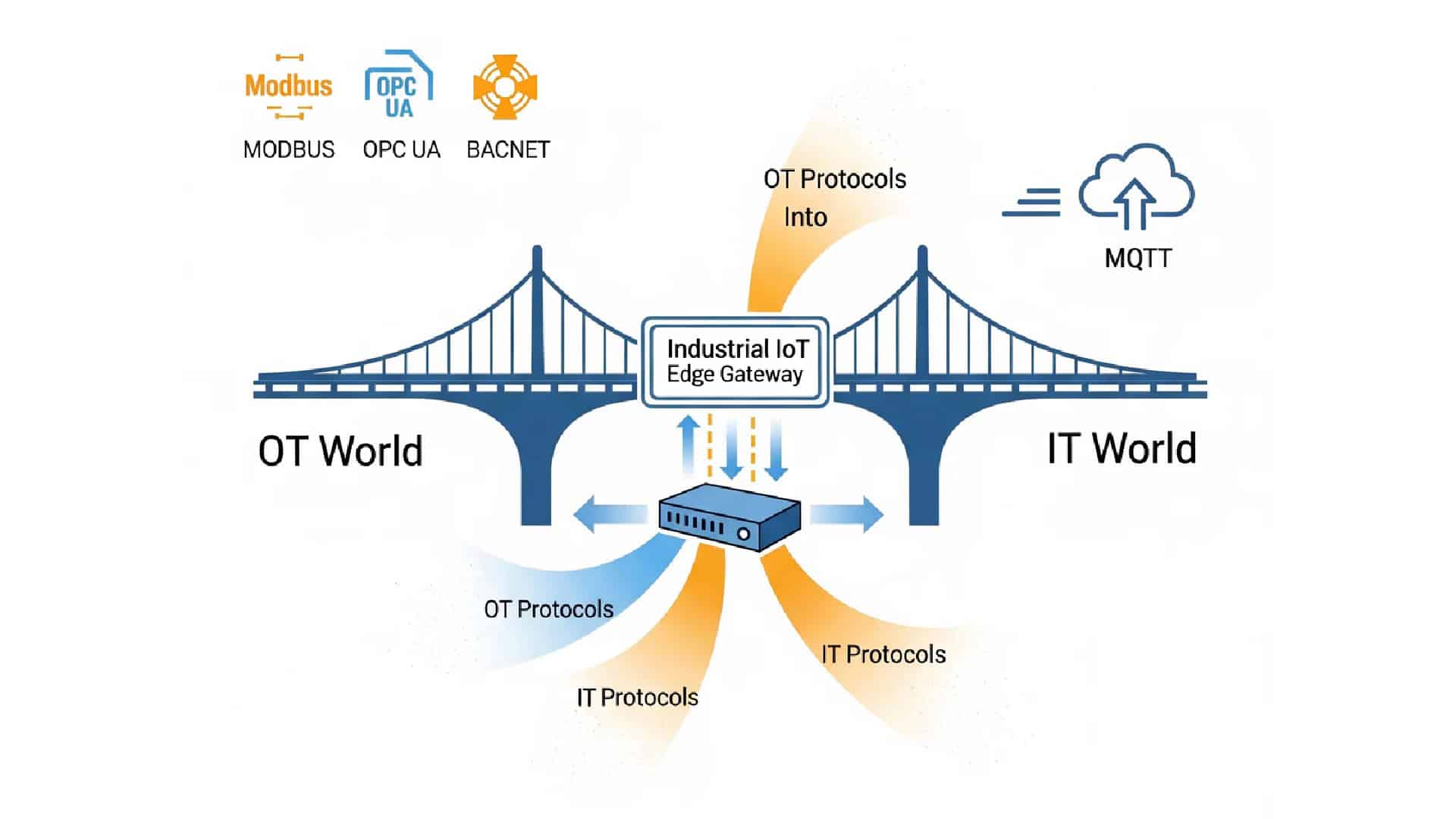
RobustOS Pro provides the Debian-based environment for running suitable data connectors, mapping services, databases, protocol applications, and containerized workloads. Across the Robustel EG series, the platform supports OT and IT connectivity through protocols and interfaces including Modbus, OPC UA, MQTT, HTTP/REST, serial links, and digital I/O.
The Robustel EG5200 edge computing gateway product information provides the current processing, storage, interface, WAN, and RobustOS Pro specifications needed for project validation.
Match the Application to the Workload
The Robustel EG5200’s 4 GB RAM and 32 GB eMMC provide room for several practical edge services, but they do not create unlimited computing or storage.
The project should size:
- Number of data sources
- Collection frequency
- Concurrent applications
- Container footprint
- Local database size
- Logs
- Buffer retention
- Temporary files
- Update space
- Recovery behaviour
A data-normalization application that processes several hundred routine measurements has a different resource profile from multi-camera analytics, a local historian, and several protocol connectors running together.
Application compatibility, ARM support, dependencies, licensing, storage persistence, and restart behaviour should be confirmed before rollout.
Keep RCMS in Its Correct Role
RCMS can monitor and manage a fleet of Robustel gateways. Its current functions include gateway and network visibility, configuration management, application and firmware deployment, remote CLI, diagnostics, logs, packet capture, templates, and batch operations.
The Robustel RCMS platform supports consistent gateway configuration, application rollout, updates, and diagnostics across distributed EG5200 deployments.
RCMS does not automatically validate the engineering meaning of every field value. It also does not replace:
- The device register map
- The point-mapping specification
- A historian
- A SCADA platform
- The cloud data model
- Application-level quality checks
It helps maintain the gateway and its deployed applications. The data owner must still define and test the industrial information produced by those applications.
Foire aux questions
Q1. What makes industrial IoT data usable?
Industrial IoT data becomes usable when the raw value has a verified source, clear variable name, correct data type, scaling, engineering unit, timestamp, asset identity, and quality state. Operational context may also be needed to explain why the value matters. Successful transmission alone is insufficient because the cloud can receive a number correctly while still interpreting its meaning, timing, or condition incorrectly.
Q2. Should raw sensor data always be uploaded to the cloud?
No. Raw data may be useful for diagnostics, model development, compliance, or root-cause analysis, but routine operations often need normalized measurements, summaries, and events. The project should define which source records must be retained and which can be processed locally. Reducing data must not remove the evidence required to verify alarms, investigate failures, or correct an inaccurate mapping later.
Q3. What does data quality mean in an edge computing workflow?
Data quality describes whether a value is current and trustworthy. Common states include good, stale, invalid, out of range, communication timeout, estimated, or replayed. A quality field helps the cloud distinguish a genuine process value from a device or network problem. Without it, the last successful measurement may remain visible as though the equipment were still reporting normally.
Q4. Why should an industrial data mapping have a version number?
A mapping version shows which register definitions, scaling rules, units, names, and transformations produced a record. Device replacements, firmware changes, or application updates may alter these definitions. Recording the version helps engineers distinguish a real process change from a changed interpretation. It also supports rollback, troubleshooting, historical comparison, and controlled deployment of mapping updates across multiple gateway sites.
Q5. How does Robustel EG5200 prepare data from multiple industrial devices?
Robustel EG5200 edge computing gateway connects multiple Ethernet and compatible serial devices, then runs suitable RobustOS Pro applications for collection, validation, normalization, contextual processing, and buffering. Its five Gigabit Ethernet ports, configurable serial interfaces, Docker support, and local resources fit multi-source sites. The exact data model, protocol connectors, mappings, and quality rules must still be configured and validated for the project.
Conclusion: Industrial Data Readiness Takeaway
Robustel EG5200 edge computing gateway is a practical fit for industrial sites that need to collect data from several local systems and convert device-specific values into consistent upstream records.
Its value is not limited to moving factory data toward a cloud platform. The Robustel edge environment can support the validation, engineering interpretation, identity management, timestamping, quality marking, contextual processing, and lineage needed to make that data usable.
A raw signal becomes cloud-ready only when its technical meaning and operating context are explicit. The EG5200 provides the interfaces and application platform for that preparation, while the project remains responsible for approved device definitions, processing rules, acceptance testing, and long-term data ownership.
Related Reading on Edge Computing in Industrial IoT:


À propos de l'auteur
Robert Liao | Technical Support Engineer
Robert is an IoT Technical Support Engineer at Robustel, specializing in industrial networking and edge connectivity. A certified Networking Engineer, Robert focuses on the deployment and troubleshooting of large-scale IIoT infrastructures. His work centers on architecting reliable, scalable system performance for complex industrial applications, bridging the gap between field hardware and cloud-side data management.