
IoT Device vs Edge Device vs Edge Gateway: Which One Fits Your Industrial Project?
Robustel EG5100 edge computing gateway combines equipment integration, local application hosting, secure WAN connectivity, and remote fleet management. These responsibilities—not its cabinet location or processor alone—distinguish an edge gateway from an IoT device or a standalone edge device.
The three terms often overlap in real projects. A PLC can perform edge processing, a smart sensor can connect directly to the cloud, and an industrial computer can aggregate several machines. The correct category depends on what the product is expected to own after deployment.
Classify the Product by Responsibility, Not Processing Power
A device does not become an edge gateway simply because it runs Linux, contains a powerful processor, or is installed near industrial equipment.
The more useful question is: What operational responsibility would become unassigned if this product were removed?
An IoT device usually owns a specific sensing, metering, actuation, or equipment function. An edge device performs meaningful computation close to a data source. An edge gateway owns the integration boundary between several local systems and an upstream network or platform.
| Project Responsibility | IoT Device | Edge Device | Passerelle périphérique |
| Sense a physical condition | Common primary role | Possible | Usually not primary |
| Actuate or control equipment | Possible primary role | Possible | Limited and project-specific |
| Process its own data locally | Possible | Common primary role | Common |
| Aggregate several devices | Uncommon | Sometimes | Common |
| Bridge different protocols | Uncommon | Sometimes | Common |
| Provide cellular or Ethernet WAN | Sometimes | Sometimes | Common |
| Apply routing, firewall, or VPN policies | Rare | Possible | Common |
| Host integration applications | Limited | Common | Common |
| Manage a downstream device network | Rare | Sometimes | Common |
| Support centralized fleet operations | Product-dependent | Product-dependent | Common requirement |
These columns are not absolute technical standards. They are project-level classification tools.
For example, a connected vibration sensor may contain a processor and perform local filtering. It remains primarily an IoT device when its main responsibility is measuring one machine condition.
An industrial computer may run analytics beside a production line. It is an edge device when its main responsibility is processing local data, but it becomes gateway-like when it also owns protocol integration, network separation, WAN delivery, and management of several downstream systems.
An IoT Device Owns a Specific Field Function
An IoT device normally begins with one clear physical or operational responsibility.
Examples include:
- A temperature sensor
- An electricity meter
- A valve actuator
- A connected motor controller
- A remote I/O module
- A tracking unit
- A smart relay
- An environmental monitor
Its primary purpose may be to:
- Measure a variable
- Report equipment status
- Count an event
- Control one actuator
- Record energy consumption
- Identify location
- Expose a machine condition
The device may contain networking, firmware, storage, or local calculation. Those features do not automatically change its category.
A Smart Device Can Still Be an IoT Device
Consider a smart power meter that:
- Measures voltage, current, and energy
- Calculates demand locally
- Stores interval records
- Exposes Modbus TCP
- Sends alarms through an IP connection
It performs useful local computation, but it still owns one defined metering function. It does not necessarily aggregate unrelated equipment, bridge several OT protocols, provide the site WAN, or manage a wider edge application environment.
The same principle applies to a smart sensor. Local threshold detection may make the device more capable, but its main responsibility remains sensing.
Direct Cloud Connectivity Does Not Create a Gateway
An IoT device may contain LTE, Wi-Fi, or Ethernet and connect directly to a cloud service.
That architecture may be appropriate when:
- Only one device is involved
- The device already speaks the required cloud protocol
- No additional field protocols need integration
- No local application is required
- No downstream network must be managed
- Device-native security and fleet management meet the project need
The existence of a cloud connection does not make the device a gateway. Connectivity describes where its data goes; gateway responsibility describes whether it integrates and governs other systems.
An Edge Device Processes Data Near Its Source
An edge device performs computation close to the process, machine, camera, or data source it serves. Examples may include:
- A smart industrial camera
- An industrial PC
- A machine-vision controller
- A local analytics appliance
- An advanced PLC
- A condition-monitoring processor
- A dedicated AI inference device
Its local functions may include:
- Image classification
- Feature extraction
- Signal analysis
- Data filtering
- Local visualization
- Event generation
- Short-term storage
- Machine-specific application logic
NIST describes edge computing as placing computing and analytics closer to where data is captured, supporting local responses rather than requiring every task to be performed centrally.
An Edge Device May Focus on Its Own Data
A smart camera can perform object detection locally and transmit only event metadata. It is clearly an edge device because meaningful processing happens close to the image source. It is not automatically an edge gateway.
The camera may not:
- Poll PLCs or meters
- Translate industrial protocols
- Provide WAN connectivity for other devices
- Separate OT and IT networks
- Host third-party integration services
- Manage a downstream equipment subnet
Its responsibility remains centred on its own image stream.
Local Processing Is Necessary but Not Sufficient
Most edge gateways are edge devices because they run local applications. The reverse is not always true.
A useful distinction is:
- Edge device: mainly processes data close to one source or application.
- Edge gateway: processes data while also integrating multiple systems and owning the communication boundary.
This distinction prevents project teams from selecting a powerful local computer that lacks the interfaces, routing, security, or remote-management capabilities required for the wider site.
An Edge Gateway Owns the Integration Boundary
An edge gateway is justified when one platform must coordinate several responsibilities between field equipment and upstream services.
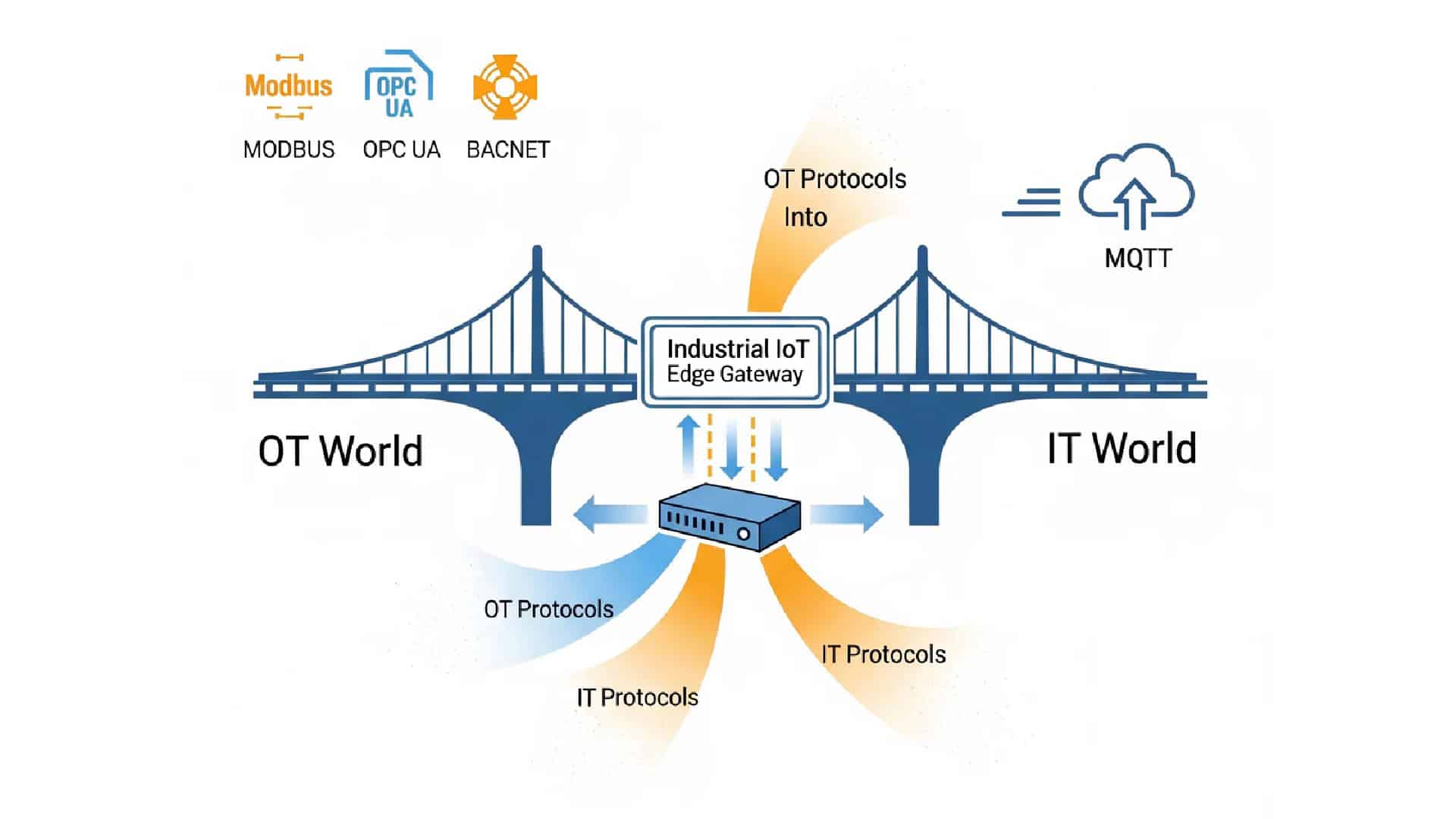
Robustel describes industrial edge gateways as platforms that connect PLCs, sensors, meters, cameras, and SCADA systems, while supporting protocol connectors, local applications, data normalization, and publishing to brokers or cloud services.
A typical gateway responsibility set includes five layers.
1. Equipment Integration
The gateway connects compatible local equipment through interfaces such as:
- Ethernet
- RS-232
- RS-485
- Digital inputs and outputs
- Model-specific CAN or wireless options
It may collect information from devices that were never designed for direct cloud connectivity.
2. Protocol and Data Integration
The gateway can host suitable connectors or applications that:
- Read industrial protocols
- Translate data structures
- Apply scaling and units
- Normalize asset identities
- Add timestamps and quality
- Produce MQTT, API, or other upstream messages
The exact capability may be native, supplied through an optional application, installed as a package or container, or developed specifically for the project.
3. Local Application Execution
An edge gateway may run:
- Protocol bridges
- Data filters
- Buffers
- Event rules
- Local dashboards
- Databases
- Approved third-party software
- Custom applications
This local application role is one reason an edge gateway goes beyond a basic industrial router.
4. Fleet Operations
Distributed gateways must be monitored, configured, updated, and diagnosed after installation.
RCMS provides centralized capabilities for Robustel routers and gateways, including fleet status, configuration management, signed firmware and application deployment, remote CLI, logs, packet capture, and controlled remote access.
The Robustel edge computing gateway portfolio shows how equipment integration, local applications, industrial networking, and centralized operations can be combined within one platform. The category should support the architecture decision rather than become a marketing label.
How Robustel EG5100 Edge Computing Gateway Demonstrates the Gateway Role
Robustel EG5100 edge computing gateway illustrates the gateway category because it combines four responsibility groups within one industrial platform:
- Field-equipment interfaces
- Local application execution
- Secure upstream connectivity
- Centralized fleet operations
Its current specification includes:
| Product Area | Robustel EG5100 Capability |
| Operating system | RobustOS Pro |
| Processeur | ARM Cortex-A7 at 792 MHz |
| Mémoire | 1 Go DDR3 |
| Storage | 8 Go eMMC |
| Ethernet | 2 × 10/100 Mbps |
| Serial | 2 × software-configurable RS-232/RS-485 |
| Digital interfaces | 2 DI and 2 DO |
| Cellulaire | Dual-SIM 4G/LTE with supported 3G/2G fallback |
| Application environment | Docker containers and Debian-compatible packages |
| Network functions | Routing, firewall, VPN, and Ethernet/cellular WAN |
| Fleet management | RCMS support |
The Robustel product platform can aggregate compatible serial equipment, run containerized connectors, normalize selected data, buffer records locally, and transmit information through LTE or Ethernet.
The Robustel EG5100 edge computing gateway product page provides the current interface, processing, storage, cellular, RobustOS Pro, and RCMS specifications for project validation.
Where EG5100 Edge Copmputing Gateway Fits
The EG5100 is a proportionate fit when a project needs:
- Several serial or Ethernet data sources
- Focused protocol bridging
- Lightweight local applications
- Selected data normalization
- Local buffering
- Dual-SIM 4G connectivity
- VPN-secured remote access
- Centralized gateway management
Its 1 GB RAM and 8 GB eMMC also establish a workload boundary. The Robustel EG5100 should not be treated as an unlimited application host, high-capacity historian, safety controller, or replacement for a larger industrial computer when the workload requires substantially more local resources.
What RCMS Adds to the Gateway Role
RCMS extends the responsibility from one site to a managed gateway fleet.
It can support:
- Gateway health visibility
- Signal and network diagnostics
- Configuration templates
- Firmware and application deployment
- Remote CLI and packet capture
- Secure access to a gateway or permitted downstream subnet
- Batch operations across multiple sites
RCMS manages the gateway estate. It does not replace the PLC, SCADA platform, historian, protocol application, or business system.
The Robustel RCMS platform supports consistent deployment, monitoring, updates, diagnostics, and remote access across distributed EG5100 gateways.
Foire aux questions
Q1. Is every IoT device also an edge device?
No. An IoT device may simply measure, actuate, or report one physical function without performing meaningful local processing. It becomes edge-like when it analyzes, filters, or acts on data near its source. Even then, it is not automatically an edge gateway. A gateway usually adds wider responsibilities such as multi-device integration, protocol bridging, WAN connectivity, network security, and remote fleet management.
Q2. Can a PLC be classified as an edge device?
Yes. A PLC performs computation close to the industrial process and may therefore act as an edge device. Its primary responsibility normally remains deterministic control, sequencing, and interlocks. A separate gateway may still be needed for cellular backhaul, protocol integration, local databases, containerized applications, or remote subnet access. Safety functions should remain in the approved controller rather than moving to a general-purpose gateway.
Q3. Is an industrial cellular router the same as an edge gateway?
Not always. An industrial router mainly provides cellular connectivity, routing, firewall, VPN, and failover. It becomes an edge computing gateway when it also runs applications that collect, interpret, filter, buffer, or convert industrial data. Buyers should evaluate the deployed software, field interfaces, local processing role, and management responsibilities rather than relying only on product labels such as router, gateway, or edge device.
Q4. Does an edge gateway replace an industrial PC or PLC?
Usually not. A PLC retains machine-control and safety responsibilities, while an industrial PC may provide heavier analytics, visualization, or application hosting. An edge gateway normally connects systems, translates protocols, prepares selected data, provides secure WAN access, and supports remote operations. Some functions can overlap, but consolidation should only occur after processing resources, real-time requirements, interfaces, software dependencies, and failure consequences are validated.
Q5. What makes Robustel EG5100 an edge computing gateway?
Robustel EG5100 edge computing gateway combines configurable serial interfaces, Ethernet, digital I/O, dual-SIM 4G, RobustOS Pro, Docker support, routing, VPN functions, and RCMS management. This allows it to integrate compatible field equipment, run lightweight local applications, prepare selected data, and manage the upstream connection. Its gateway classification comes from this combined responsibility set, not simply from its processor or cellular modem.
Conclusion: Device Category Takeaway
Robustel EG5100 edge computing gateway demonstrates why industrial product categories should follow responsibility rather than hardware labels.
An IoT device primarily owns a specific sensing, metering, actuation, or equipment function. An edge device performs useful computation close to its data source. An edge gateway integrates several systems while also managing local applications, protocol boundaries, secure upstream connectivity, and distributed operations.
The boundaries can overlap, and the same hardware may be configured differently between projects. The correct classification comes from identifying which responsibilities the product must own, what happens when it fails, and which functions remain with the PLC, industrial computer, cloud platform, or source device.
Related Reading on Edge Computing in Industrial IoT:
À propos de l'auteur
Robert Liao | Technical Support Engineer
Robert is an IoT Technical Support Engineer at Robustel, specializing in industrial networking and edge connectivity. A certified Networking Engineer, Robert focuses on the deployment and troubleshooting of large-scale IIoT infrastructures. His work centers on architecting reliable, scalable system performance for complex industrial applications, bridging the gap between field hardware and cloud-side data management.