
Industrial Data Acquisition Gateway Guide 2027: Interfaces, Protocols and Data Quality
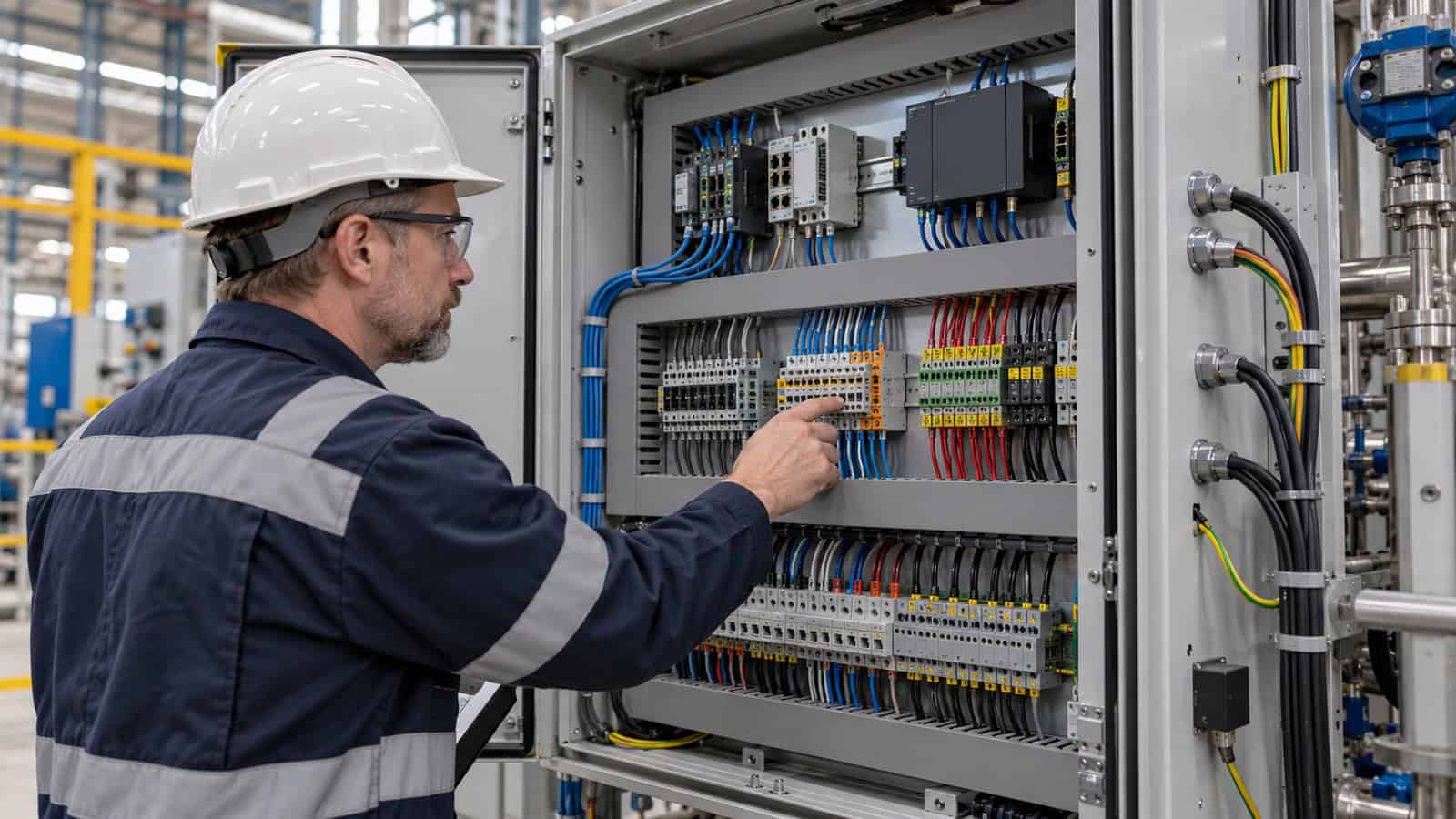
The Robustel EG3120e Edge Computing Gateway is a strong industrial data acquisition gateway when a brownfield site needs multiple serial ports, digital and analogue I/O, CAN, local compute and cellular connectivity. Selection should begin with the signal and data contract, because a matching connector does not prove that the required protocol, scaling or application is available.
Inventory the Source Before Selecting the Gateway
Record every source as a physical and logical object: electrical signal, connector, protocol, address, update interval, unit, valid range, timestamp source and owner. “RS-485 meter” is incomplete until baud, parity, register map and polling limits are known.
| Source field | Example evidence | Pourquoi est-ce important ? |
|---|---|---|
| interface | RS-485, voltage input, DI or CAN | defines electrical compatibility |
| protocol/map | device manual and register list | defines how values are read |
| semantics | unit, scale, asset and quality | makes the value usable upstream |
| timing | sample/report interval and timestamp | distinguishes current from delayed data |
| failure state | timeout, open circuit or stale flag | prevents plausible but wrong values |
The Robustel video “How to Collect PLC Data for SCADA, MES & Cloud with an Edge Gateway” is useful when the team reaches the protocol and northbound design. It explains the path; the actual register map and driver remain project evidence.
Prove One Signal End to End
Commission one representative point before building the full tag list. Force or observe known states, confirm the raw value, apply scaling, preserve the measurement time and verify the northbound record. Test negative, maximum and unavailable states as well as the normal value.
Robustel’s secure remote access to industrial robots application example illustrates why the machine-side connection and remote support path should remain explicit. For data acquisition, use that same separation to prevent a support channel from being mistaken for a validated machine-data interface.
How the Robustel EG3120e Edge Computing Gateway Supports Data Acquisition
Robustel EG3120e Edge Computing Gateway provides up to four RS-485 ports, one RS-232, four DI, four DO, two voltage-type 0–24 V analogue inputs, one CAN interface, two Ethernet ports, Wi-Fi 6, LTE Cat 4, physical SIM plus SGP.22 eSIM, 2 GB RAM and 8 GB eMMC. RobustOS Pro supplies a Debian-based environment for supported applications and custom workloads.
| Acquisition need | EG3120e capability | Validation boundary |
|---|---|---|
| several serial devices | up to 4× RS-485 plus RS-232 | prove electrical topology, protocol and bus load |
| discrete states | 4× DI and 4× DO | define voltage, ownership and safe action |
| voltage sensing | 2× 0–24 V AI | condition current-loop or precision signals externally if required |
| local software | 2 GB RAM, 8 GB eMMC, RobustOS Pro | benchmark the real application and storage policy |
For compatible EG3120e deployments, Robustel’s E2C Factory can add a documented operational layer for industrial data collection, local processing, visualisation, workflows and northbound integration. The pairing is valuable when it replaces fragmented point tools with a governed machine-to-application path; protocol and device support still need exact verification.
Define the Data Contract Before the Dashboard
Every point should carry asset identity, source address, engineering unit, scale, measurement time and quality state. Decide whether the edge or upstream system assigns each field. If two systems can rescale or rename the same value, troubleshooting becomes an argument about which version is authoritative.
Robustel’s smart parking application example shows mixed devices occupying different roles in one field architecture. For EG3120e, that pattern is a useful prompt to separate high-volume streams, periodic meters and discrete events before sizing storage and northbound traffic.
Design Offline and Replay Behaviour
Estimate data volume from point count, record size and interval, then include metadata and application logs. Define what happens when storage reaches its limit and whether oldest, newest or low-priority data is discarded. On reconnection, preserve original measurement time and limit replay so current values remain timely.
Disconnect the WAN during a sustained acquisition test. The acceptance record should show which collection continues, how an operator sees the fault, what is stored and how the receiving system handles duplicates or gaps after recovery.
Commission Ownership, Not Only Connectivity
Hand over the interface map, protocol configuration, data contract, application version, credentials, storage budget, update process and rollback condition. Assign the owner of field wiring separately from the owner of data semantics and the owner of the northbound system.
Prove that ownership with one deliberately bad value. Disconnect or force a known input under an authorised test, follow the quality state through the gateway and receiving application, and note where the first useful alarm appears. The result should tell the support desk whether the next action belongs to an electrician, controls engineer, gateway administrator or application owner.
A good acquisition gateway reduces the number of separate devices at the edge. It should not hide where a measurement becomes wrong or who must correct it. Keep the accepted mapping version and rollback point with the commissioning record so a later firmware or PLC change can be compared with a known data state.
Foire aux questions
Q1. What is a data acquisition gateway?
It connects field signals or devices to local and upstream applications, often adding protocol handling, processing and communications. Its usefulness depends on the exact interface and data contract.
Q2. What is the difference between a gateway and a PLC?
A gateway primarily connects, translates or processes data between systems. A PLC is normally responsible for deterministic machine control; one should not be substituted for the other without a designed control architecture.
Q3. Can an edge gateway run Docker containers?
Some edge gateways support container workloads. Verify the exact operating system, resources and application support, then benchmark the production workload.
Q4. What interfaces are used for industrial data acquisition?
Common interfaces include Ethernet, RS-232/RS-485, CAN, digital I/O and analogue inputs. Electrical compatibility and protocol support must both match.
Q5. When is the Robustel EG3120e Edge Computing Gateway a good acquisition platform?
It fits brownfield projects needing multiple serial ports, mixed I/O, local Linux-based compute and cellular connectivity. Validate every field protocol, signal range and workload before rollout.
Conclusion
The Robustel EG3120e Edge Computing Gateway can consolidate a broad industrial acquisition boundary, provided the project starts with a verified source inventory and ends with an accepted data contract. Ports and compute create options; known values, timestamps and failure states make the data trustworthy.
Commission one difficult signal through normal, invalid and disconnected states before scaling the tag list. If the team can trace that record from terminal to northbound application and identify the owner at every step, the acquisition design has earned its place in production.
Explore More Articles About Robustel Edge Computing Gateways

À propos de l'auteur
Robustel Editorial Team
The Robustel Editorial Team publishes practical articles on industrial connectivity, edge computing, LoRaWAN and device management, focusing on deployment considerations, technical limitations and long-term operation.