
How to Choose an Edge AI Gateway for Predictive Maintenance
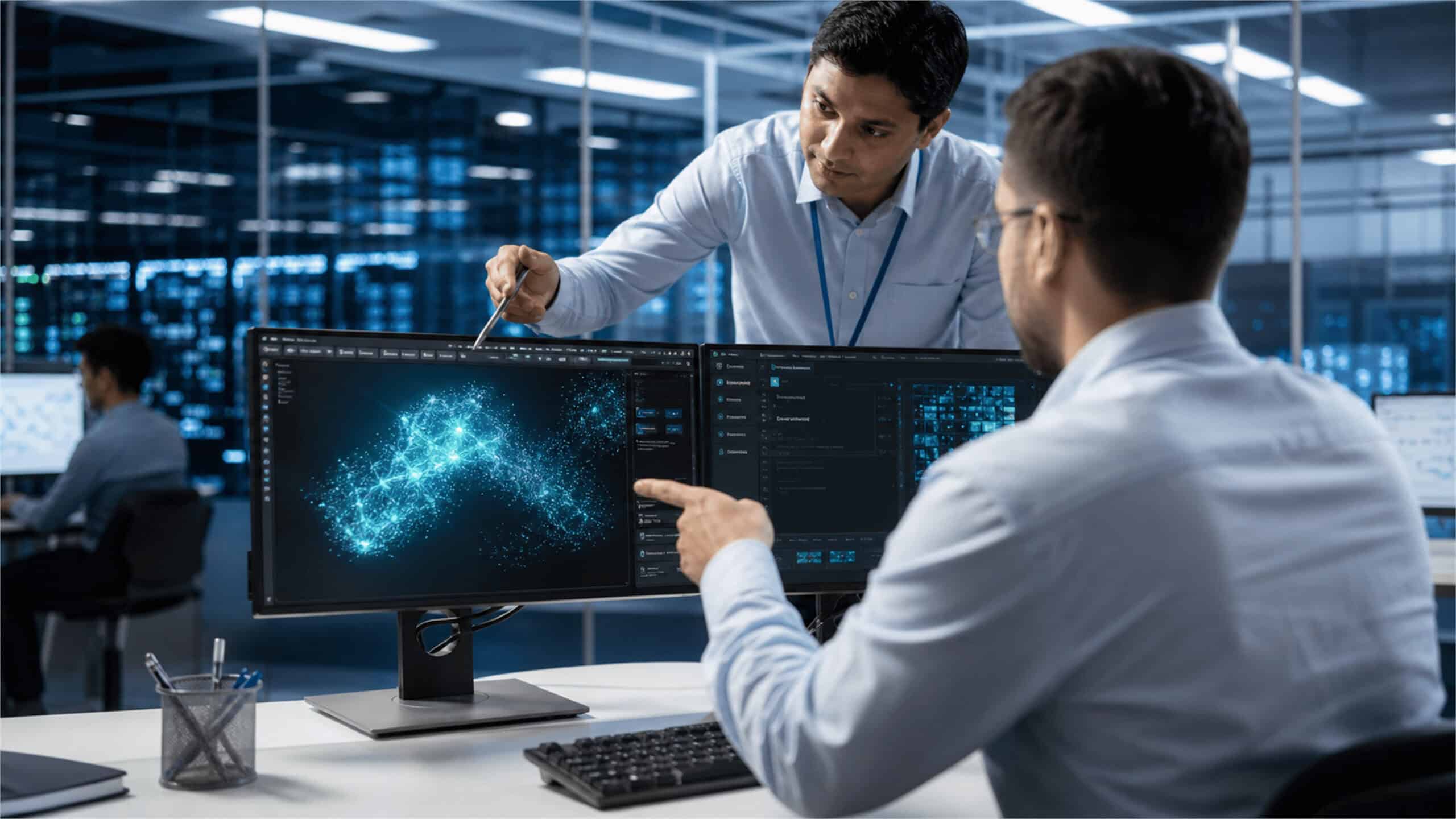
For predictive maintenance, a Robustel edge AI gateway is useful when vibration, energy, image, or other equipment data needs to be processed close to the machine before selected results are sent upstream. The right gateway is determined by the signal, model, inference frequency, software environment, and maintenance workflow—not simply by the NPU specification.
A motor producing continuous vibration data creates a very different edge workload from a pump reporting temperature every minute or a camera inspecting a conveyor. Before choosing hardware, the project should establish what data is available, what decision must be made locally, and whether AI inference provides a measurable advantage over simpler monitoring logic.
Start with the Maintenance Signal, Not the AI Hardware
Imagine a production line where a motor is critical to the process. Maintenance engineers want earlier warning of bearing degradation, but the existing PLC only exposes operating state, current, and several temperature values.
The first question should not be:
How many TOPS does the gateway provide?
It should be:
Does the available signal contain enough information to detect the condition we care about?
A Robustel EG5120 edge computing gateway can provide a local platform for collecting industrial data and running compatible inference workloads, but it cannot create useful predictive information from an unsuitable sensor or poorly defined data source.
Predictive-maintenance inputs may include:
- Vibration waveform or derived vibration features
- Motor current or power consumption
- Temperature
- Pressure or flow
- Acoustic signals
- Images
- Equipment state and operating hours
Each creates a different acquisition and compute requirement.
For example, a temperature measurement collected once per minute creates little data and may only require threshold or trend analysis. High-frequency vibration or continuous image input can create a much heavier processing workload where local preprocessing or inference becomes more valuable.
The gateway should therefore be selected after the signal path is understood, not before.
Why add edge processing when the cloud is already available? Watch “Why Do We Need Edge Computing If We Have the Cloud?” for a quick overview of where local processing complements cloud platforms before exploring the ten field constraints below.
Decide Whether the Problem Actually Needs AI
Not every maintenance problem requires machine learning.
Consider a pump where bearing temperature above an approved limit has a clear operational meaning. A fixed threshold combined with running state and duration may provide the required alert without an AI model.
Another machine may exhibit subtle combinations of vibration frequencies, current changes, and operating conditions before failure. In that case, anomaly detection or another validated model may provide information that fixed rules cannot capture as effectively.
A Robustel edge computing gateway can host either approach through suitable local applications. The important design decision is choosing the simplest method that reliably solves the maintenance problem.
A useful progression is:
| Maintenance requirement | Possible local method |
| Known limit exceeded | Threshold |
| Several known conditions must occur together | Rule-based logic |
| Trend changes over time | Statistical processing |
| Complex patterns are difficult to define manually | Compatible ML inference |
| Visual defect or equipment state must be identified | Compatible vision inference |
Moving directly to AI can add model development, validation, version control, runtime dependencies, and maintenance obligations without necessarily improving the result.
AI should therefore earn its place in the architecture.
Check the Complete Data Path Before Sizing the Gateway
Suppose a maintenance team wants to detect abnormal motor vibration.
The actual path may be:
Sensor → acquisition device or PLC → industrial protocol → edge gateway → preprocessing → inference → maintenance platform
A weakness at any earlier stage affects everything after it.
If the vibration signal is sampled too slowly, timestamps are inconsistent, the PLC exposes only a calculated summary, or communication drops measurements, additional AI processing at the gateway cannot reconstruct the missing information.
For this type of architecture, the Robustel EG5120 edge computing gateway can ingest industrial data through Ethernet or its software-configurable RS-232/RS-485 interfaces. Robustel also presents predictive maintenance as an example use case in which vibration or energy data is ingested via RS-485/Modbus, anomalies are scored locally using the project’s own models, and selected events are then published upstream.
The project still has to define:
- Sampling rate
- Data resolution
- Scaling and engineering units
- Timestamp accuracy
- Missing-data handling
- Operating-state context
- Preprocessing method
- Model input format
This is why predictive maintenance is not simply an “AI gateway” purchasing exercise. The data pipeline is part of the model.
Robustel Application example: machine visibility comes before predictive analytics
Robustel’s connected-CNC application example illustrates this prerequisite. A Robustel Edge Computing Gateway connects to the CNC controller through RS-232 or RS-485 and can collect operational information such as status, alarms, counters and temperatures without taking over the machine’s core control logic. RCMS then gives service teams remote visibility into the connected equipment and gateway. The example is not itself a predictive-maintenance deployment, but it shows the data-access layer that any later trend analysis or inference workflow depends on.
Match Compute Resources to the Actual Inference Workload
Once the data path is known, the gateway can be sized against the application.
The Robustel EG5120 edge computing gateway currently provides a quad-core Cortex-A53 CPU at 1.6 GHz, a 2.3 TOPS NPU, 2 GB or 4 GB LPDDR4 options, and 64 GB eMMC storage.
Those specifications are useful inputs, but none can independently answer whether a particular model will run satisfactorily.
The project should validate:
- Model architecture
- Model size
- Supported operators
- Runtime compatibility
- Input dimensions
- Preprocessing workload
- Inference frequency
- CPU and NPU utilisation
- Memory consumption
- Storage requirements
- Concurrent applications
- Required result latency
A 2.3 TOPS NPU is therefore not a universal predictive-maintenance capacity rating.
A small anomaly model processing derived vibration features every few seconds may create a very different resource profile from a vision model evaluating continuous image inputs. Even two models with similar file sizes may use different operators, memory, and accelerator resources.
Hardware sizing should come from a representative benchmark rather than the AI specification alone.
Robustel Application example: local inference is an application-specific workload
Robustel’s smart-parking application example provides a practical illustration outside predictive maintenance. The Robustel EG5120 edge computing gateway hosts compatible partner ANPR inference or preprocessing applications in containers, where selected results can be filtered and timestamped locally before compact data is forwarded upstream. This does not prove that a predictive-maintenance model will have the same resource requirements. It demonstrates the opposite: edge AI suitability depends on the specific input, preprocessing pipeline, runtime and inference workload being deployed.
Make Runtime Compatibility Part of the Buying Decision
A model that works on a development workstation is not automatically deployable on an industrial gateway.
The Robustel EG5120 runs RobustOS Pro, based on Debian 11, and supports Docker containers and Debian packages. This gives developers a familiar Linux environment for protocol bridges, data applications, and compatible ML workloads.
That flexibility is valuable when a machine builder already has a containerised preprocessing or inference application. However, the deployment still depends on the complete software stack.
Before standardising the gateway, verify:
- CPU architecture compatibility
- Required runtime version
- Libraries and dependencies
- Hardware-acceleration support
- Device drivers
- Container image size
- File-system requirements
- Application permissions
- Restart behaviour
- Update and rollback procedure
“Runs Linux” is not the same as “runs every Linux application”.
The same applies to Docker. Containerisation can simplify application packaging and deployment, but it does not remove hardware, driver, architecture, or runtime dependencies.
Define What Happens After the Model Detects an Anomaly
An anomaly score has little operational value unless someone or something knows what to do with it.
Consider a remote pumping asset. The gateway detects that a vibration pattern has moved outside the model’s expected range. Several actions may follow:
- Record the result locally with the original timestamp.
- Add machine state and relevant sensor context.
- Send an event to the maintenance platform.
- Increase data retention or sampling for investigation.
- Escalate the event according to an approved maintenance workflow.
A suitable application on a Robustel gateway can perform local processing and publish selected results upstream through supported network services. Robustel RCMS can separately help teams monitor and manage supported gateway fleets.
These responsibilities should remain distinct.
The AI model identifies a pattern according to its training and validation. It does not prove that a bearing, pump, or motor is about to fail. Maintenance teams still need thresholds, confidence criteria, contextual data, and a defined response process.
Predictive maintenance should therefore support engineering judgement rather than silently becoming control logic.
Know Where Edge AI Should Stop
Edge AI can be valuable when the raw input is large, local response is useful, WAN bandwidth is limited, or only selected results need to leave the site.
It should not be used to move every part of the AI lifecycle onto the gateway.
In most projects, model development and training remain on engineering workstations, servers, or cloud infrastructure. The edge gateway receives an approved model and performs inference against new local data.
The Robustel EG5120 edge computing gateway is positioned for this inference role; its product documentation specifically identifies anomaly detection and vision as example NPU workloads.
Other boundaries also matter:
- AI inference should not replace certified safety functions.
- An anomaly result should not automatically become a machine shutdown command.
- Local inference does not remove the need for model monitoring and version control.
- A gateway cannot compensate for poor sensors or missing source data.
- Higher compute capacity does not automatically improve model accuracy.
These boundaries keep predictive maintenance separate from deterministic machine control and functional safety.
Pilot the Whole Maintenance Workflow Before Scaling
A useful pilot should reproduce more than a successful model inference.
Run the Robustel EG5120 edge computing gateway with representative sensors, production data, the intended model, preprocessing code, network services, and any other containers expected in production.
The test should include:
- Normal equipment operation
- Representative abnormal conditions or validated test data
- Maximum expected sampling or image rate
- Concurrent applications
- Gateway restart
- Application restart
- WAN interruption
- Local result retention
- WAN recovery and event delivery
- Model or application update and rollback
Then evaluate the output from a maintenance perspective.
Does the alert arrive with enough context? Are false positives acceptable? Can an engineer identify which model version generated the result? Does the application recover correctly after power or network interruption?
A predictive-maintenance gateway is ready to scale only when the complete operational workflow has been validated—not when the NPU successfully executes one model.
FAQ
Q1. What is an edge AI gateway for predictive maintenance?
An edge AI gateway collects or receives equipment data and runs suitable processing or machine-learning inference close to the asset. It may analyse vibration, energy, temperature, images, or other signals before sending selected results upstream. Its role is usually inference and data integration rather than model training. The gateway should complement existing PLC, maintenance, and cloud systems rather than replace their control or engineering responsibilities.
Q2. Does predictive maintenance always require AI?
No. Fixed thresholds, operating rules, and statistical methods may be sufficient when failure indicators are already understood. AI becomes more relevant when useful patterns are difficult to define manually or when several signals must be evaluated together. Choosing AI unnecessarily adds model training, runtime compatibility, validation, monitoring, and lifecycle requirements. The maintenance problem should determine the method rather than the availability of AI hardware.
Q3. How much AI computing power does an edge gateway need?
There is no single TOPS value that defines a suitable predictive-maintenance gateway. Requirements depend on the model architecture, input size, inference frequency, runtime, preprocessing, memory use, and other applications running simultaneously. A vibration anomaly model and a vision model can create very different workloads. Representative benchmarking with the actual model is more reliable than selecting hardware from NPU performance alone.
Q4. Can an edge AI gateway train predictive-maintenance models locally?
Model training normally remains outside the industrial gateway because training and inference have different compute and data requirements. A Robustel EG5120 edge computing gateway is intended to run compatible inference workloads at the edge. Teams should train and validate their models in an appropriate development environment, then verify runtime compatibility, resource use, accuracy, failure behaviour, and version management before deploying them to the gateway.
Q5. When is the Robustel EG5120 a good fit for predictive maintenance?
The Robustel EG5120 edge computing gateway is relevant when a project needs industrial interfaces, local Linux applications, cellular connectivity, and compatible AI inference in one platform. Its 2.3 TOPS NPU can accelerate suitable workloads, while RobustOS Pro supports Docker and Debian packages. Final suitability still depends on the sensor data, model, runtime, memory, inference frequency, application dependencies, and validated maintenance workflow.
Conclusion
For predictive-maintenance projects that need local data integration and compatible inference, the Robustel EG5120 edge computing gateway can provide the execution platform between industrial equipment and the upstream maintenance system. Its value depends on matching the gateway to a validated signal, model, runtime, and operating workflow rather than selecting it from the NPU specification alone.
The strongest selection process therefore starts at the machine. Confirm what condition needs to be detected, whether the available data can reveal it, and whether AI provides an advantage over simpler logic. Only then should the project size compute, memory, storage, interfaces, and connectivity.
Edge AI can shorten the path from equipment data to useful maintenance information, but it does not turn an anomaly score into certainty. A well-designed Robustel edge AI gateway deployment keeps model inference, maintenance judgement, machine control, and safety responsibilities clearly separated.
Related Reading on Edge Computing in Industrial IoT:
À propos de l'auteur
Robert Liao | Technical Support Engineer
Robert is an IoT Technical Support Engineer at Robustel, specializing in industrial networking and edge connectivity. A certified Networking Engineer, Robert focuses on the deployment and troubleshooting of large-scale IIoT infrastructures. His work centers on architecting reliable, scalable system performance for complex industrial applications, bridging the gap between field hardware and cloud-side data management.