
Edge Computing in Manufacturing: Gateway Architecture, Applications and ROI

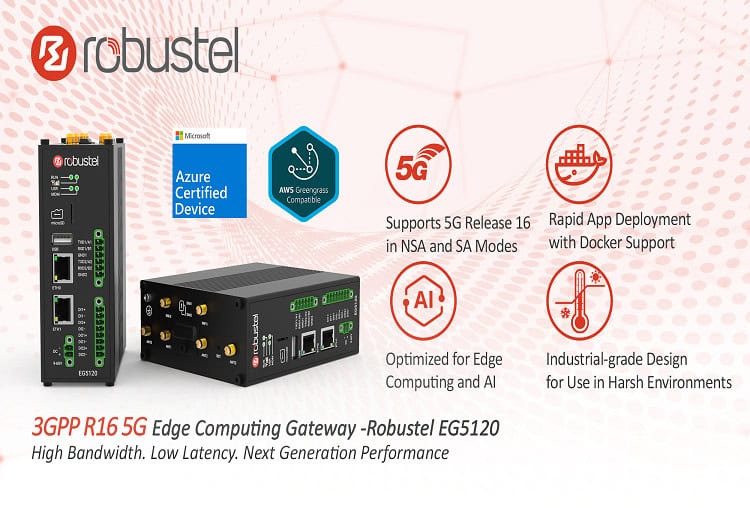
The Robustel EG5120 edge computing gateway fits manufacturing projects where local data integration, containerized applications or compatible inference need to operate close to production equipment, but edge computing creates value only when it removes a real factory constraint. Adding compute to a machine cabinet without defining the operational problem simply moves software closer to the line without proving that it improves production.
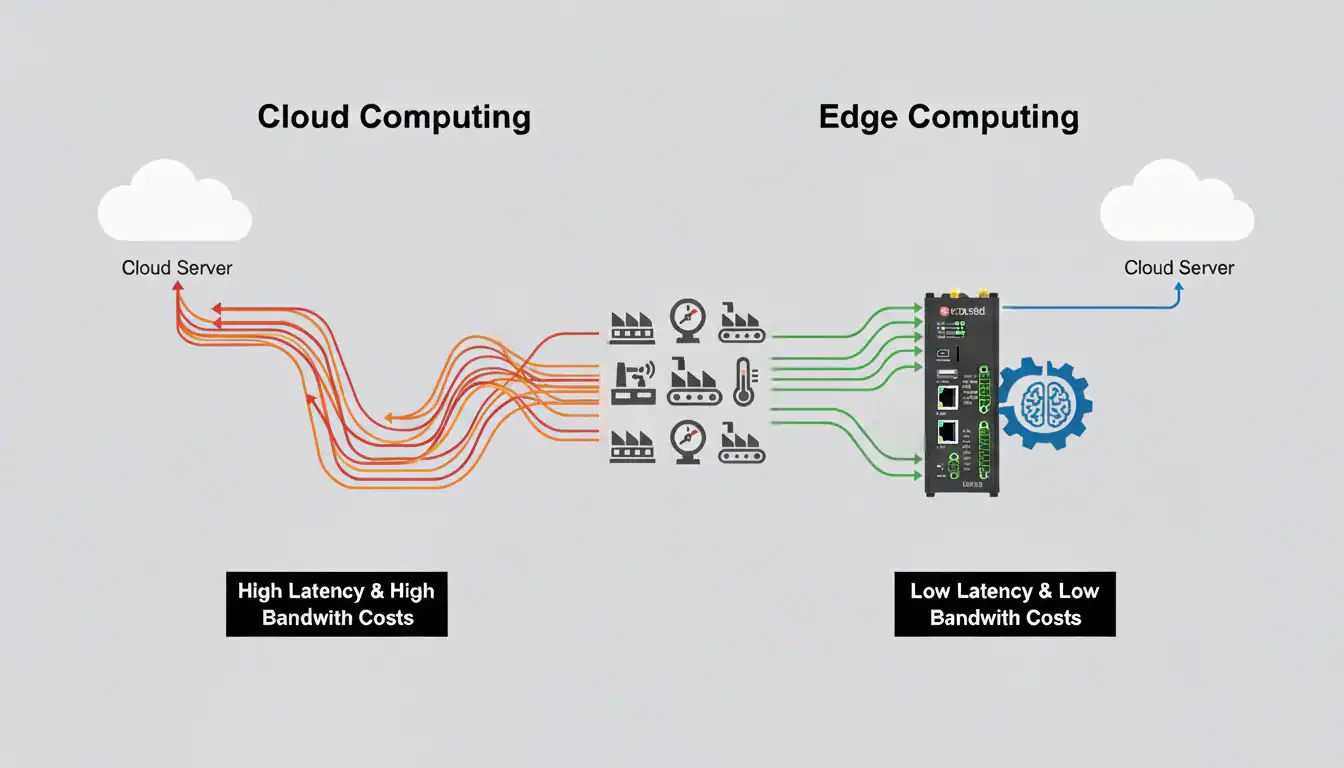
In manufacturing, the strongest edge cases usually appear where existing equipment cannot easily expose useful information upstream, where cloud dependency delays an application, or where raw machine data is too large or fragmented to send centrally without local processing.
Manufacturing Creates Local Constraints Before It Creates Edge Use Cases
Factories contain equipment built across different technology generations. One machine may expose Ethernet, another may rely on RS-485, and a third may have an existing PLC or controller that should remain completely responsible for production logic.
The edge architecture must work around those realities rather than expecting every asset to become cloud-native.
This becomes difficult in brownfield plants because connectivity is only the first problem. A gateway may successfully read a supported data point while the upstream application still does not know whether the value represents a temperature, counter, alarm state or machine mode. Data collection, interpretation and application context are separate tasks.
A useful edge deployment therefore starts by identifying one operational result—for example remote condition visibility, reduced upstream data volume or local event detection—and then works backward into the data path required to deliver it.
Manufacturing Constraint to Edge Responsibility
| Factory constraint | Possible edge responsibility | What should remain elsewhere | Robustel relevance |
|---|---|---|---|
| Legacy machine interfaces | Collect through supported exposed interfaces/protocols | Machine/controller retains core operation | Robustel EG gateways provide industrial Ethernet/serial options |
| WAN interruptions | Buffer selected records and continue approved local processing | Central reporting resumes after connectivity returns | RobustOS Pro applications can support local workflows |
| High raw-data volume | Filter or summarize locally | Long-term analysis remains central | EG5120/EG5200 fit heavier local workloads |
| Fast event detection | Identify local condition without cloud round trip | Operator or control system retains approved action responsibility | Compatible local application/inference |
| Remote support | Create controlled remote data/support path | Plant access policy remains authoritative | EG gateway + appropriate remote-management architecture |
| Machine safety | Not transferred merely because edge compute exists | PLC, safety PLC and certified control architecture | Maintain explicit control boundary |
The final row prevents one of the most serious architecture mistakes: treating general-purpose Linux compute as a substitute for certified machine control.
Keep the Existing Controller in Its Established Role
An edge retrofit should add capability around the existing control system rather than silently changing its responsibility. Where a PLC, machine controller or other production system already owns sequence control, interlocks and safety-related behaviour, the edge gateway should normally remain outside that control boundary.
The gateway can collect data through interfaces and protocols that are explicitly exposed by the existing equipment and supported by the Robustel platform, then provide local processing, buffering or an upstream data path where required. Ethernet or serial connectivity alone does not establish compatibility with every machine or controller protocol.
This distinction is important during brownfield integration. The project should first identify the actual interface and protocol available from the PLC or control layer, then verify that path against the gateway’s documented software and protocol support before treating the equipment as a usable data source.
Local Processing Should Solve a Specific Factory Problem
One factory may only need to normalize meter readings before they reach an energy platform. Another may need to buffer production data during a WAN outage. A machine-vision project may need to reduce high-volume input into compact event metadata before anything crosses the plant network.
These workloads have very different resource requirements.
The error usually appears during proof of concept. A small application works with one device and one data source, so the hardware is approved. Production then adds more equipment, logging, VPN services, a database and additional containers. CPU and memory that looked comfortable in the lab become shared by several persistent services.
Sizing should therefore include the complete production application stack rather than the demonstration workload alone.
How the Robustel EG5120 Edge Computing Gateway Supports Manufacturing Edge Applications
The Robustel EG5120 edge computing gateway provides a quad-core Cortex-A53 processor at 1.6 GHz, 2 GB or 4 GB LPDDR4, 64 GB eMMC and a 2.3 TOPS NPU, together with two Gigabit Ethernet ports, configurable RS-232/RS-485 interfaces and DI/DO.
This makes it a practical fit when a manufacturing cell needs more than simple routing or forwarding but does not require the wider five-Ethernet-port and peripheral architecture of EG5200.
The 64 GB eMMC can be useful where applications, logs or selected local data need more built-in storage. The NPU can support compatible inference workloads, but its published TOPS figure should never be used as proof that an arbitrary vision or predictive-maintenance model will meet production latency. The model runtime, input format, preprocessing, memory use and concurrent gateway services all need representative benchmarking.
The EG5000 Series Quick Pitch places this compute capability alongside the family’s industrial interfaces. That combination—not CPU performance in isolation—is what makes an edge gateway useful in manufacturing.
Verified EG5120 Resources and Their Manufacturing Role
| Robustel EG5120 resource | Potential manufacturing role | Boundary to verify |
|---|---|---|
| Quad-core Cortex-A53, 1.6 GHz | Local application processing | Measure actual concurrent workload |
| 2/4 GB LPDDR4 | Multiple lightweight services/containers | Memory peak matters more than nominal average |
| 64 Go eMMC | Applications, logs and defined local retention | Storage is shared with OS and applications |
| 2.3 TOPS NPU | Compatible local inference | Model/runtime compatibility must be validated |
| 2 × Gigabit Ethernet | IP equipment and network paths | Port count does not prove application throughput |
| 2 configurable RS-232/RS-485 | Compatible legacy field equipment | Interface does not imply every device protocol |
| DI/DO | Simple monitored/control points where appropriate | Do not infer machine safety functionality |
Remote Support Needs a Controlled Boundary
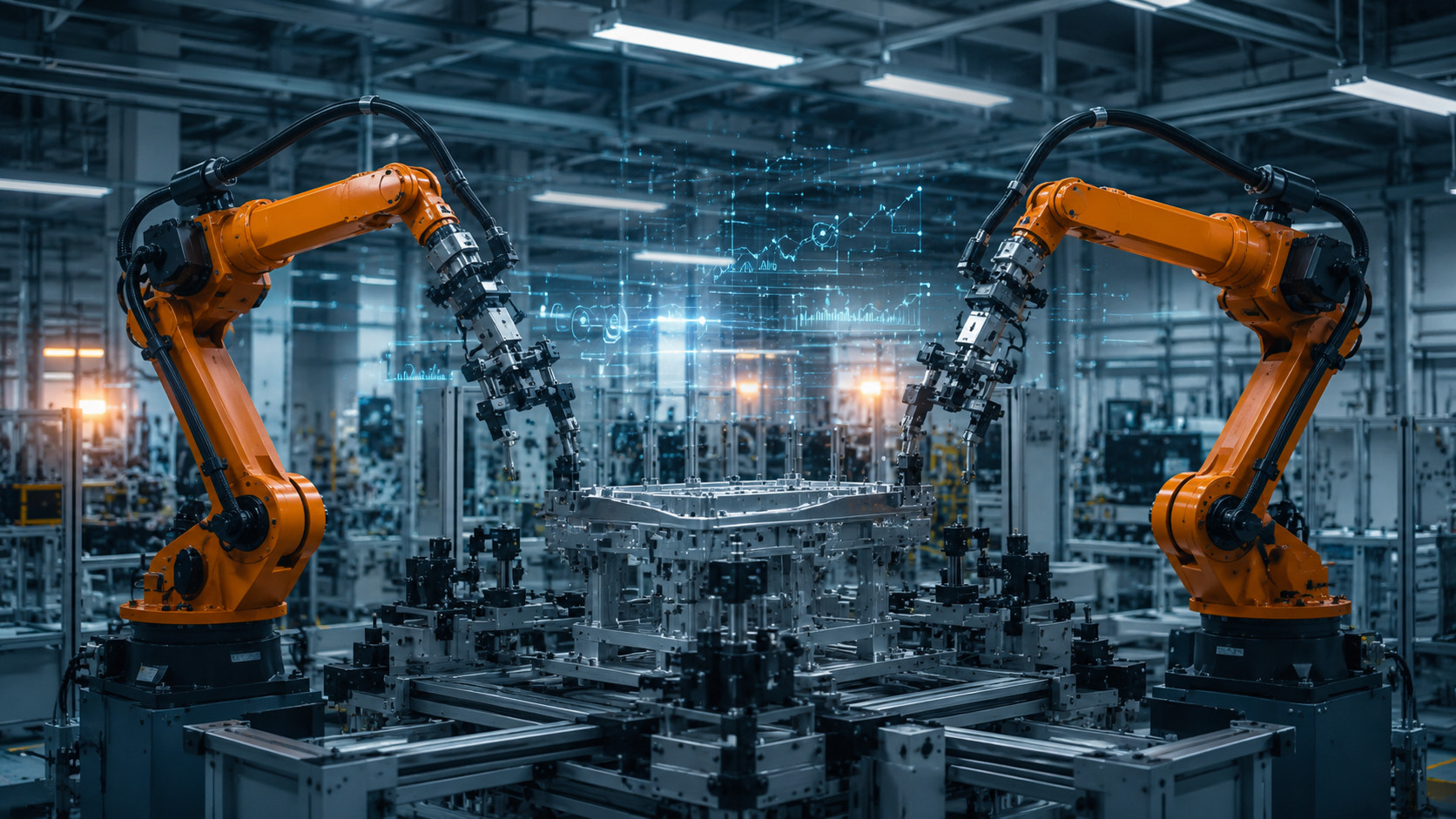
The Secure Remote Access to Industrial Robots Application Example illustrates another manufacturing pressure: equipment integrators may need diagnostic access after a robotic cell has been delivered to a customer.
The useful architectural lesson is the separation between local production control and a managed remote support path. An EG5120 can sit beside the existing controller environment and provide controlled connectivity without requiring the production controller itself to own internet access.
Again, the Application Example should not be read as evidence of native support for proprietary robot-controller protocols. The actual data and access path depend on the interfaces exposed by the robot, PLC, vision system or other approved control-layer equipment and on software supported by the gateway.
That boundary is especially important in a robotic cell because remote visibility and remote authority are not the same thing. Being able to inspect diagnostic information does not mean an external support session should bypass local safety procedures or production ownership.
Manufacturing ROI Comes from Avoided Operational Friction
Edge computing ROI is often described too loosely as “lower latency and lower cloud cost.”
Those may be benefits, but a factory should connect them to actual operating work.
If local filtering reduces 100 GB of raw data to a small daily event stream, the network and storage effect can be measured. If remote diagnostics avoid selected site visits, support cost can be compared before and after deployment. If local buffering prevents reporting gaps during a two-hour WAN interruption, the value lies in preserving the information required by the business application.
Edge Computing ROI Evidence
| Proposed benefit | Weak statement | Better evidence to collect | Robustel deployment role |
|---|---|---|---|
| Lower cloud traffic | “Edge reduces bandwidth” | Raw vs forwarded data volume | EG application filtering |
| Faster response | “Edge is low latency” | Event-to-application time | Local EG processing |
| Fewer site visits | “Remote access saves money” | Callouts avoided for diagnosable faults | EG + managed remote access |
| Better outage tolerance | “Edge works offline” | What continues, for how long and with what retained data | Local application/buffering |
| Lower retrofit cost | “Gateway replaces hardware” | Switch/converter/IPC components actually removed | Validate interfaces first |
| Better maintenance | “AI predicts failures” | Model accuracy and usable maintenance lead time | Compatible EG5120 inference only after validation |
A benefit becomes credible when a pilot can produce evidence against a known baseline.
RobustOS Pro Turns the Gateway into an Application Platform
The RobustOS Pro edge computing operating system provides the Debian-based environment used by supported EG gateways for containers and native Linux applications.
This is useful in manufacturing because developers can bring familiar software tools closer to the production data source rather than building every application around a proprietary embedded runtime.
It also changes ownership. A plant that deploys its own container now owns application dependencies, logs, configuration, update testing and rollback. RobustOS Pro provides the application environment; it does not remove software-engineering responsibility from the project.
Test the Production Path, Not Only the Demo
Manufacturing acceptance should use real equipment, expected polling rates or data volume, the intended container stack, actual network security rules and representative periods of WAN loss.
A model that runs on one sample image is not a production inference benchmark. A Modbus read from one register does not prove that several devices can be polled at the required cycle. A successful MQTT publication does not prove that delayed records will be interpreted correctly after an outage.
The pilot should deliberately create the faults that matter and confirm what the operator actually sees.
Foire aux questions
Q1. How is edge computing used in manufacturing?
Common uses include protocol integration, local data filtering, buffering, event detection, remote diagnostics and compatible AI inference. Edge computing is most useful when one of these functions provides measurable value by operating close to the production equipment.
Q2. Does edge computing replace PLCs in a factory?
Normally no. PLCs and approved control systems should retain the deterministic machine-control and safety responsibilities assigned to them. An edge gateway usually adds information processing, connectivity and higher-level application functions around that control architecture.
Q3. Can an edge gateway connect to CNC machines?
It can connect through industrial interfaces and protocols that are both exposed by the machine, PLC or control layer and supported by the gateway/application. This should not be interpreted as automatic native support for proprietary CNC-controller protocols.
Q4. When is the Robustel EG5120 a good manufacturing fit?
The Robustel EG5120 edge computing gateway is relevant when a cell needs Gigabit networking, industrial serial interfaces, substantial local application resources or compatible inference in a relatively compact gateway. Simpler collection workloads may not need this resource level.
Q5. How should manufacturers calculate edge-computing ROI?
Compare measurable before-and-after operating conditions: upstream data volume, site visits, recovery time, downtime caused by lost visibility, hardware consolidated and engineering effort required to maintain the edge application. Avoid assigning financial value to generic claims such as “lower latency” without a production baseline.
Conclusion
The Robustel EG5120 edge computing gateway fits manufacturing projects where local data processing, containerized software or compatible inference adds a defined layer around the existing production-control architecture. Its value is strongest when that additional layer solves a measurable factory constraint rather than simply adding more compute to the cabinet.
Manufacturing edge projects should therefore begin with the production problem, preserve clear control and protocol boundaries, benchmark the complete application stack and calculate ROI from operational evidence. That produces a more sustainable architecture than treating edge computing as an Industry 4.0 feature to be added everywhere.
Explore more articles about Robustel’s edge computing gateways in industrial IoT:
À propos de l'auteur
Robert Liao | Technical Support Engineer
Robert is an IoT Technical Support Engineer at Robustel, specializing in industrial networking and edge connectivity. A certified Networking Engineer, Robert focuses on the deployment and troubleshooting of large-scale IIoT infrastructures. His work centers on architecting reliable, scalable system performance for complex industrial applications, bridging the gap between field hardware and cloud-side data management.