
Beyond Connectivity: RobustelEG5120 vs. EG5100 for Edge AI and IoT Orchestration
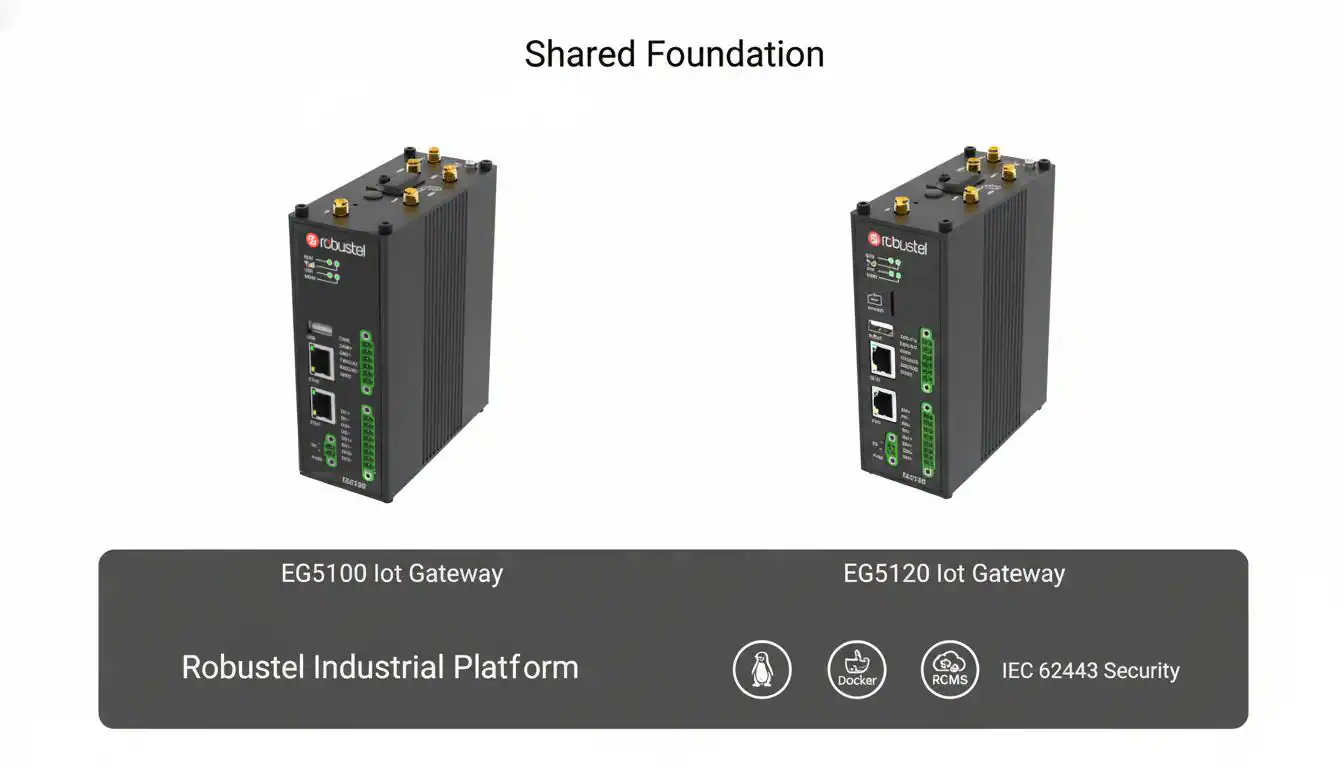
Choosing between the Robustel EG5100 and EG5120 isn’t just about cost—it’s about matching your silicon to your software stack. Both share the same industrial-grade Debian 11 DNA and Docker support, but their computational ceilings are worlds apart. This guide provides the definitive technical breakdown to ensure you don’t under-spec your site or over-inflate your CAPEX.
Key Decision Factors:
- Architecture Shift: Moving from the EG5100’s Single-Core A7 (efficient data bridging) to the EG5120’s Quad-Core A53 (multi-service edge orchestration).
- The AI Threshold: Why the 2.3 TOPS NPU in the EG5120 is the non-negotiable “future-proof” factor for machine vision and predictive maintenance.
- Memory & Throughput: Comparing 512MB DDR3 vs. 2GB DDR4 and the impact of Gigabit Ethernet on high-bandwidth data aggregation.
- TCO Logic: How to balance upfront hardware savings against the long-term risk of technical debt and expensive field “truck-rolls.”
Introduction: The Final Pivot in Your IoT Hardware Journey
You’ve already done the heavy lifting. You’ve navigated the flooded market of “prosumer” boards, successfully dodged the “Raspberry Pi trap” for mission-critical sites, and committed to a professional-grade Industrial IoT Gateway. You’ve landed on the Robustel ecosystem. Smart move.
Now, you face the final technical pivot: The EG5100 or the EG5120?
At first glance, they are siblings. They share the same ruggedized DNA, they are both orchestrated via RCMS (Robustel Cloud Manager Service), and both run on our Debian-based RobustOS Pro. But underneath the hood, they are two distinct beasts engineered for two very different operational profiles.
In the field, I’ve seen engineers over-spec and inflate their project CAPEX, and I’ve seen them under-spec and hit a performance wall during the first firmware update. This guide is the official EG5120 vs. EG5100 head-to-head breakdown to ensure your hardware choice matches your application’s compute demands.
The Shared DNA—Why Both are Enterprise-Ready
Before we dive into the divergence, let’s establish the baseline. Regardless of which model you deploy, you are investing in a standardized Industrial IoT Gateway platform. Both the EG5100 and EG5120 share a core “DNA” designed for 24/7 mission-critical uptime:
- RobustOS Pro (Debian 11): This is not a restrictive “black box.” Both devices run a native, open Debian IoT Gateway environment. You get full root access, apt-get capabilities, and a familiar Linux ecosystem for rapid development.
- Edge Containerization: Docker comes pre-installed on both. Whether you are running a lightweight Python script or a complex microservice, you can package your app on a laptop and deploy it seamlessly as a container.
- RCMS Fleet Management: Both are fully integrated with our RCMS (Robustel Cloud Manager Service). This allows for centralized remote monitoring, zero-touch batch configuration, and secure OTA updates for both firmware and your Docker containers.
- Industrial-Grade Hardware: We don’t use consumer-grade SD cards that fail under vibration. Both units feature high-endure eMMC flash storage, wide-temperature operation (-40 to +70°C), and rugged DIN-rail mounting.
- Security by Design: Both gateways are developed under our IEC 62443-4-1 certified secure development lifecycle, ensuring your edge-to-cloud path is hardened against modern threats.
You can’t make a “bad” choice here—but you can make an inefficient one if your compute requirements don’t match the silicon. Let’s look at the “Compute Gap”.
The Compute Gap—Performance Tier Breakdown
When you look at the spec sheet, the design philosophies of these two gateways diverge sharply. This isn’t just a minor iteration; it is the difference between a reliable Field Bridge and a high-performance Edge Server.
1. Processing Power: Single-Core vs. Quad-Core Architecture
This is the most significant performance threshold.
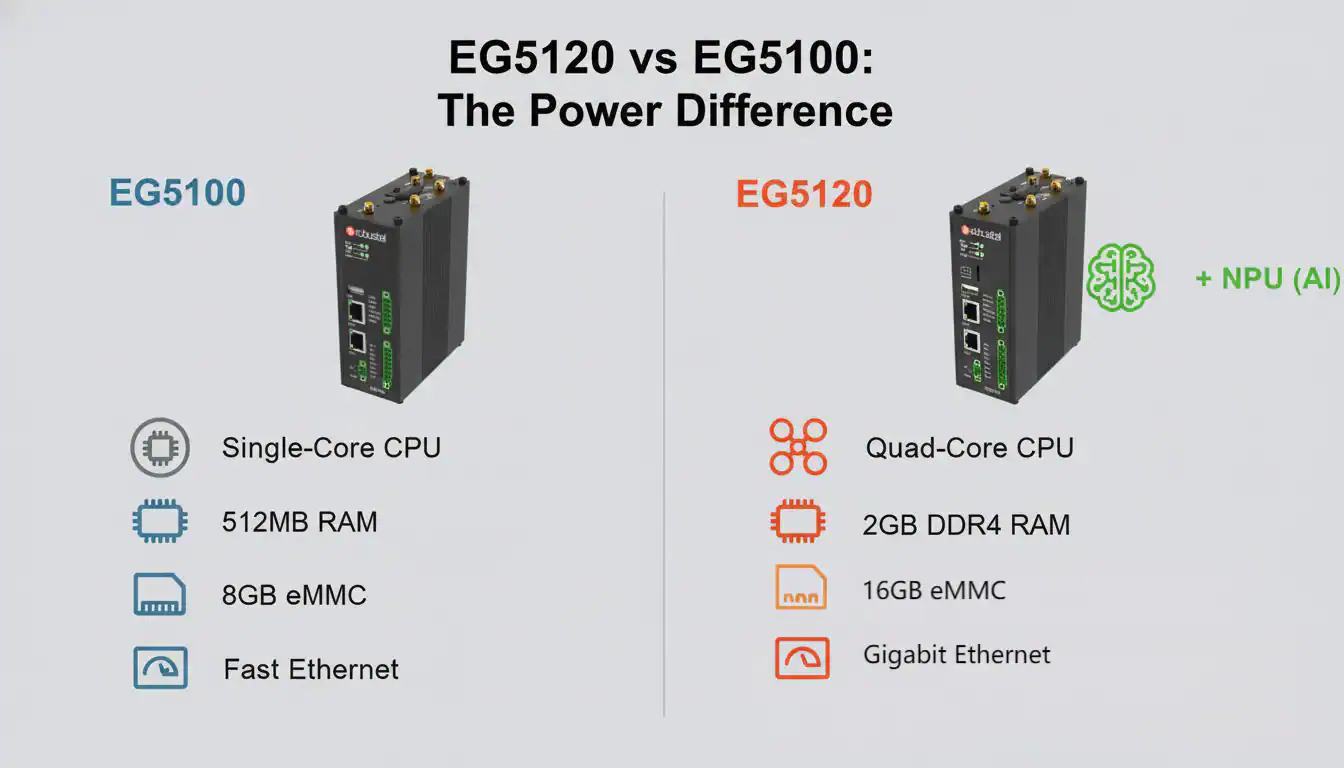
- EG5100: Powered by a Single-Core ARM Cortex-A7 (800MHz) with 512MB DDR3 RAM.
- EG5120: Powered by a Quad-Core ARM Cortex-A53 (1.6GHz) with 2GB DDR4 RAM.
The Engineering Reality: The EG5100 is an exceptional IoT Gateway for dedicated PLC data collection. It comfortably handles a single Docker container (like Node-RED) for Modbus-to-MQTT translation. However, the EG5120 is a true Multi-Service Edge Gateway. It can orchestrate multiple heavy containers simultaneously—running a local InfluxDB database, a Grafana dashboard, and custom Python analytics without hitting a CPU bottleneck. If your gateway needs to act as a localized server, the EG5120 is the baseline.
2. The AI Factor: Dedicated NPU Acceleration
This is the “Future-Proof” differentiator for 2026 and beyond.
- EG5100: No NPU.
- EG5120: Features an integrated 2.3 TOPS Neural Processing Unit (NPU).
The Engineering Reality: An NPU is a specialized silicon co-processor built for Linear Algebra and AI Inference. If your roadmap includes Predictive Maintenance (vibration analysis) or Machine Vision (defect detection), the EG5120 is the only viable choice. It executes complex ML models in milliseconds, whereas a single-core CPU would suffer from extreme Inference Latency or total system hang.
3. Data Throughput: Gigabit vs. Fast Ethernet
- EG5100: 10/100 Mbps (Fast Ethernet).
- EG5120: 10/100/1000 Mbps (Gigabit Ethernet) + USB 3.0.
The Engineering Reality: For standard telemetry (small MQTT packets), 100 Mbps is plenty. But if your Industrial Gateway is aggregating high-bandwidth data from multiple IP cameras or acting as a node on a high-speed corporate backbone, the Gigabit ports on the EG5120 ensure your network interface never becomes a bottleneck.
The Strategic Selection—Matching Hardware to Task
Let’s simplify the procurement logic. Your choice between the EG5120 vs. EG5100 should be dictated by your Edge Compute Profile, not just your immediate connectivity needs.
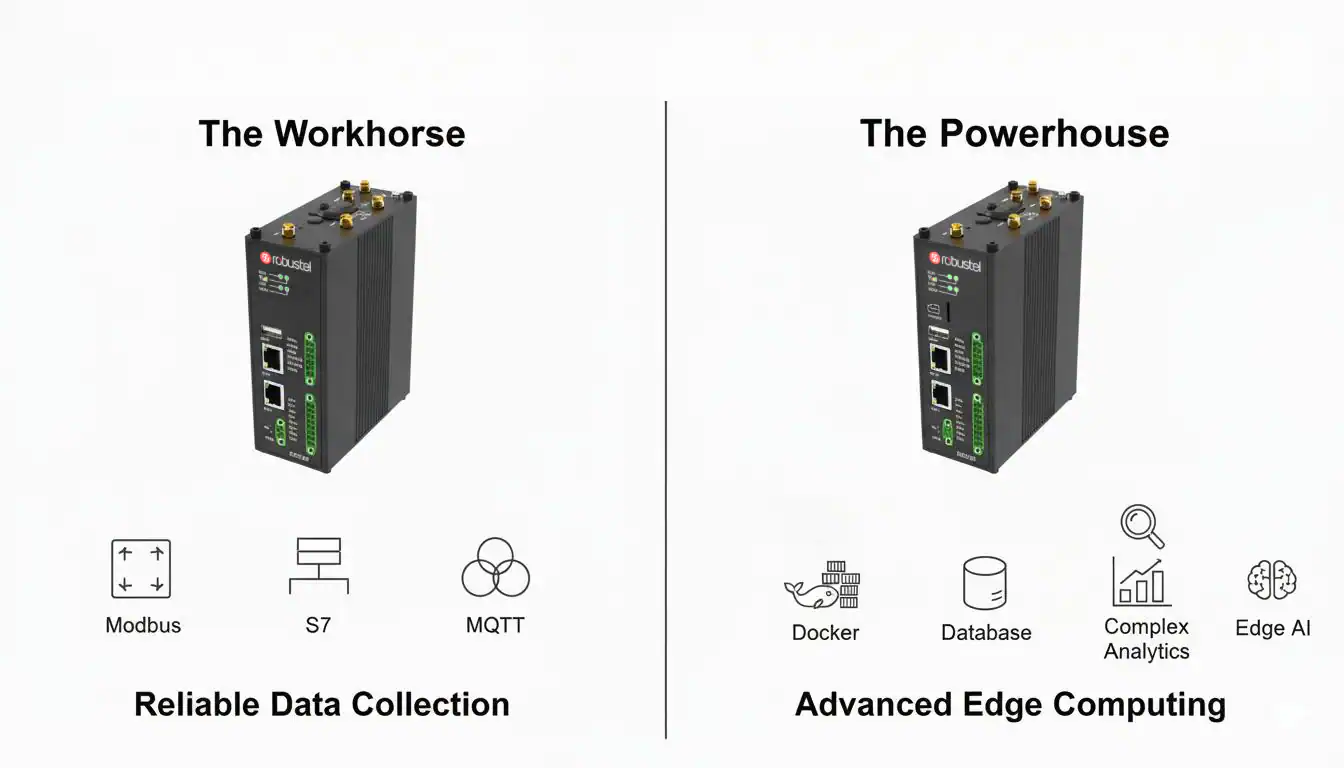
Select the EG5100 (The Field Workhorse) if:
- Primary Task: You need reliable Protocol Translation (e.g., Modbus/S7 to MQTT) or simple data logging.
- Software Load: You plan to run one or two lightweight Docker containers, such as a basic Python script or a standard Node-RED flow.
- Compute Demand: Your application is not latency-critical and doesn’t require heavy data pre-processing at the source.
- Roadmap: Edge AI and Machine Learning are not requirements for this specific deployment site.
- Economic Factor: Upfront CAPEX and TCO (Total Cost of Ownership) are your primary drivers for a high-volume, simple connectivity rollout.
Deploy the EG5120 (The Edge Powerhouse) if:
- Intelligence Requirement: You have any roadmap for Edge AI, Computer Vision, or Acoustic Analysis. The 2.3 TOPS NPU is a non-negotiable requirement here.
- Service Orchestration: You need to run multiple, high-resource Docker containers (e.g., a local InfluxDB instance, a heavy web server, or multi-threaded analytics).
- System Throughput: Your application requires significant CPU Headroom for real-time data aggregation and complex filtering before cloud transmission.
- Network Backbone: You require Gigabit Ethernet or USB 3.0 for high-speed local data ingestion (e.g., from high-resolution sensors or cameras).
- Future-Proofing: You want to avoid “truck-rolls” for hardware swaps. This Industrial Gateway provides the computational ceiling to handle future software stack evolutions without a hardware refresh.
The TCO “Gut Check”—Future-Proofing vs. Technical Debt
When advising our customers on the EG5120 vs. EG5100 decision, I always return to one metric: The cost of a “truck-roll” versus the cost of silicon.
The EG5100 is a fantastic, high-reliability Industrial Gateway for dedicated tasks. However, the price delta between these two models is negligible compared to the massive operational expense of swapping out 500 gateways in three years because your software stack outgrew the hardware.
- The EG5100 is the smart, economical choice if—and only if—you are 100% certain your deployment will remain a pure data-collection play for its entire lifecycle.
- For everything else, the EG5120 is the definitive answer. It is the Industrial Raspberry Pi alternative that actually belongs on a DIN rail. It provides the computational “headroom” to experiment with Edge AI, orchestrate complex microservices, and scale your intelligence as your project matures.
Don’t let a minor CAPEX saving today build a massive performance bottleneck for your IoT fleet tomorrow. Invest in the headroom; your future self will thank you.
Foire aux questions
Q1: Can the EG5100 still run Docker containers?
A1: Yes, absolutely. Both gateways run RobustOS Pro, which includes native Docker support. The key difference is performance. The EG5100 is great for a single, lightweight container. The EG5120 is designed to run multiple, complex containers thanks to its Quad-Core CPU and 2GB of RAM.
Q2: Is the EG5120 overkill if I just want to read Modbus from my PLC?
A2: Yes, probably. If your only task is simple Modbus to MQTT translation, the EG5100 is the more cost-effective Passerelle IoT for that job. But I always ask, “Are you sure that’s all you’ll ever want to do with that data?”
Q3: Is the management experience (RCMS) different between the EG5120 and EG5100?
A3: No, the RCMS experience is identical. Both gateways are managed from the same platform, with the same powerful features for remote access (RobustVPN), Docker management, and OTA updates. The platform treats them as a unified fleet; the only difference is the hardware capability on the device itself.
À propos de l'auteur
Robert Liao | Ingénieur support technique
Robert Liao is an IoT Technical Support Engineer at Robustel, specializing in industrial networking and edge connectivity. A certified Networking Engineer, Robert focuses on the deployment and troubleshooting of large-scale IIoT infrastructures. His work centers on architecting reliable, scalable system performance for complex industrial applications, bridging the gap between field hardware and cloud-side data management.