
0–24 V Analog Signal Gateway: Wiring, Scaling and Edge Acquisition Guide
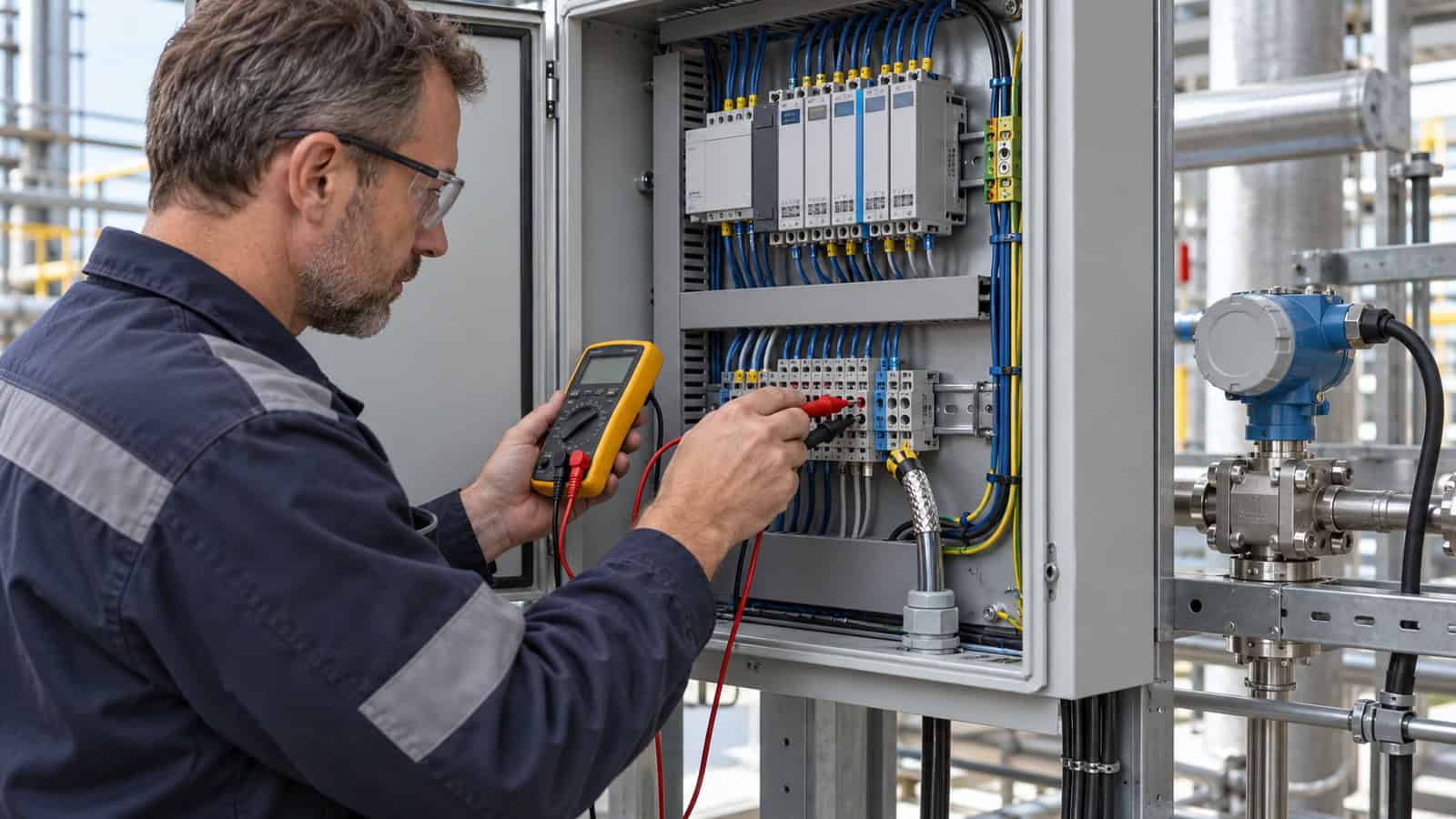
The Robustel EG3120e Edge Computing Gateway provides two documented voltage-type analogue inputs with a 0–24 V range, making it suitable for selected industrial sensors and transducers. It is not a native 4–20 mA input, so current-loop sources need appropriate external conversion or conditioning before connection.
Confirm the Signal Before Wiring
Read the source manual and record output type, minimum/maximum voltage, reference, source impedance, isolation and fault behaviour. A terminal labelled “analogue” may produce voltage, current, resistance or a powered transducer signal; these are not interchangeable.
| Source question | Record | Reason |
|---|---|---|
| what is the electrical output? | exact voltage/current range | prevents incompatible connection |
| what shares the reference? | common/ground and isolation | avoids offset and ground-loop problems |
| what does zero mean? | process zero, open circuit or fault | prevents false normal values |
| how is it scaled? | engineering range and equation | creates usable data |
Wire for a Stable Reference
Follow the exact Robustel EG3120e and sensor terminal documentation. Keep analogue wiring away from noisy power conductors, use the required shielding practice and confirm the common reference before energising. Add external protection or isolation when the site risk assessment requires it.
Measure the signal at the gateway terminals with an appropriate instrument while the process or signal source is at a known condition. Comparing only the sensor display and software value can hide a wiring drop, shared-reference error or scaling mistake because two wrong assumptions may still produce a plausible number.
Record the terminal reading, raw gateway value and published engineering value together. If the error appears at the terminal, investigate the field circuit; if the terminal is correct and the raw value differs, investigate the input boundary; if both agree but the engineering value is wrong, the mapping or scale owner has the next action.
Convert Voltage into an Engineering Value
Define the linear or device-specific scale, unit, valid range and fault states. Store both raw and scaled values during commissioning. Check at least low, mid and high points using a known source or process reference.
Keep the scaling expression with the point definition rather than burying it in a dashboard. When a sensor is replaced or its range changes, a technician can compare the source specification, raw input and published engineering value before editing production logic.
The Robustel’s video “How to Collect PLC Data for SCADA, MES & Cloud with an Edge Gateway” helps explain the later data path. The analogue conversion remains a separate measurement task that should be proven before publishing to SCADA, MES or cloud systems.
How the Robustel EG3120e Edge Computing Gateway Supports 0–24 V Acquisition
Robustel EG3120e Edge Computing Gateway combines two 0–24 V voltage-type analogue inputs with serial, CAN, DI/DO, Ethernet, Wi-Fi 6, LTE/eSIM and local RobustOS Pro compute. This supports projects that mix a modest number of analogue values with existing digital and protocol data at a distributed site.
| Acceptance point | EG3120e-related check |
|---|---|
| electrical fit | source remains within the documented 0–24 V range |
| data conversion | raw value maps correctly to unit and scale |
| fault handling | open, short or out-of-range state is distinguishable where the design allows |
| local workload | acquisition, storage and publishing remain stable under sustained load |
For the compatible EG3120e, Robustel’s E2C Factory can place the verified signal inside a documented collection, processing, visualisation and northbound workflow. That can make the operating data more transparent, provided the original electrical conversion and point semantics have already been validated.
Size the local workload with the real sample interval, point count, history and northbound retry behaviour. Analogue acquisition is usually modest in volume, but unbounded logs or repeated failed publishes can consume storage long before the process values do.
Treat Current Loops as a Separate Design
A 4–20 mA transmitter cannot be assumed to connect directly to a voltage input. A correctly selected resistor or signal conditioner may convert current to voltage, but range, tolerance, power, isolation and fault indication must be engineered. For precision, safety or regulatory measurements, use appropriate instrumentation and traceable design evidence.
Robustel’s solar and battery-site application example shows why remote measurements sit inside a wider power, communications and application architecture. For EG3120e analogue acquisition, preserve that separation: the conditioner and sensor establish the electrical measurement; the gateway handles the accepted value and data path.
Validate Faults and Recovery
Robustel’s secure remote access to industrial robots application example reinforces the boundary between machine functions and remote data access. Test the analogue path without altering the equipment’s control responsibility.
Disconnect the source, force an out-of-range condition where safe, restart the gateway and remove the WAN. Confirm how stale values, local storage and restored publishing appear. Assign the wiring fault to the electrical owner and the mapping fault to the application owner.
Close the test by comparing the recovered value with the physical reference and the upstream history. If the data returns without a clear gap or quality transition, the receiving application may conceal the very fault that maintenance needs to see.
Foire aux questions
Q1. What is an analogue input signal?
It is a continuously varying electrical signal representing a measured condition. The input range, reference and scaling must match the source.
Q2. What is the difference between voltage and current signals?
Voltage signals are measured across a potential difference; current loops encode the value as current, commonly 4–20 mA. They require different input or conditioning arrangements.
Q3. How do you scale an analogue input?
Map the measured electrical range to the engineering range using the sensor’s documented relationship, then verify several known points and fault states.
Q4. Why does an analogue signal fluctuate?
Possible causes include process variation, electrical noise, poor reference, grounding, wiring or the sensor itself. Compare the terminal measurement with the raw gateway value before filtering.
Q5. What analogue signals can the Robustel EG3120e Edge Computing Gateway acquire?
It provides two documented voltage-type 0–24 V analogue inputs. Other signal types, including 4–20 mA, need a correctly engineered external interface.
Conclusion
The Robustel EG3120e Edge Computing Gateway is a practical 0–24 V acquisition node when the source, reference, scaling and fault behaviour are known. Its wider interfaces and compute can bring that verified value into an edge workflow without changing the underlying measurement responsibility.
Commission the signal at the terminals, raw input, scaled record and receiving application. Retaining those four observations gives future engineers a reliable way to distinguish sensor, wiring, conversion and software faults.
Explore More Articles About Robustel Edge Computing Gateways




À propos de l'auteur
Robustel Editorial Team
The Robustel Editorial Team publishes practical articles on industrial connectivity, edge computing, LoRaWAN and device management, focusing on deployment considerations, technical limitations and long-term operation.